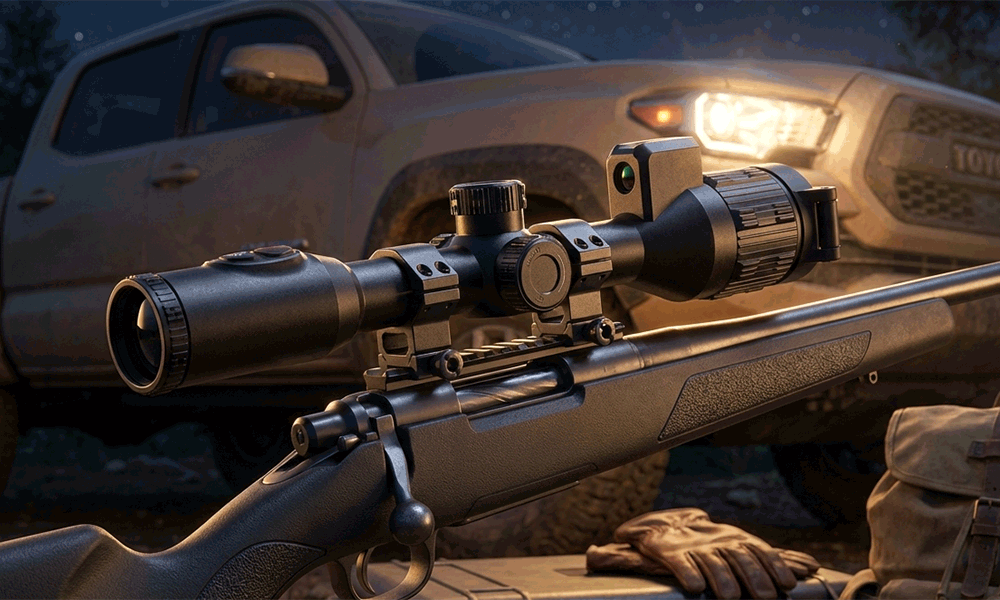
In today’s premium hunting market, integrated Laser Rangefinders (LRF) and ballistic calculators are no longer “nice-to-have” features. They are becoming the clearest signal that a thermal scope belongs in the professional tier. The reason is simple: night hunting compresses time. Targets appear briefly, move unpredictably, and often sit near cluttered vegetation. When the user can measure distance instantly and apply an aiming solution without switching devices or doing mental math, the product feels decisively more capable.
Table of Contents
ToggleBut OEM buyers quickly discover a reality that spec sheets gloss over: integrating an LRF is not mainly a hardware-add-on exercise. It’s a trust engineering exercise. If the ranging occasionally jumps to the wrong object, if readings drift after recoil, or if ballistic outputs are confusing in the field, the feature becomes a liability. In the premium segment, reliability problems are punished harder because expectations are higher and dealers won’t risk their reputation.
This article explains what actually determines success: the physical alignment of the LRF path relative to the reticle and thermal axis, the calibration workflow that keeps that alignment stable across production, and the ballistic computation pipeline that turns range into a usable hold under stress. If you’re planning a Thermal Rifle Scopes — OEM/ODM program, these are the principles that prevent returns and protect premium positioning.
Why LRF + Ballistics Became the “Premium Baseline”
Integrated ranging removes the slowest part of night hunting workflow: estimating distance. Ballistics removes the most error-prone part: translating that distance into a correct hold. Together they turn a thermal scope from a viewing tool into a decision tool.
This matters commercially because it creates a clear product ladder. The same core platform can support a non-LRF mid-tier SKU and an LRF flagship SKU with a defendable price gap. It also aligns across categories. A brand that sells scopes often sells handheld scouting devices and clip-ons too, and the same “range + confidence” story can connect the lineup, from Thermal Monoculars to Thermal Clip-On Sight.
What “Alignment” Really Means in an LRF Thermal Scope
Most people interpret alignment as “the laser points where the crosshair points.” That’s only the surface. In a thermal scope, alignment is a relationship between multiple references that must remain stable under recoil, temperature changes, and assembly tolerance stack-up.
At minimum, you must maintain a predictable relationship between:
- the LRF emitter/receiver axis,
- the thermal optical axis (image center),
- the reticle reference,
- and the mechanical structure that holds all of the above in place.
Even if a unit is aligned perfectly on a bench, real field use stresses it in ways that cause drift: recoil shock, thermal expansion of housing parts, vibration, impact during transport, and internal heat load during 50/60Hz operation, recording, or streaming. When drift appears, the user doesn’t say “alignment tolerance shifted.” They say, “the rangefinder is unreliable,” and then they stop trusting the entire scope.
Integration Architecture: Side-Mounted vs Near-Coaxial
Most integrated LRF thermal scopes follow one of two packaging strategies. The first is a side-mounted LRF module placed near the objective lens area. This is common because it’s scalable, easier to package, and doesn’t force a redesign of the main thermal optical path. The trade-off is that the laser path is offset from the thermal axis, so parallax and “wrong target ranging” become the primary engineering risks in real hunting scenes.
The second strategy is a near-coaxial or closely coupled integration approach, where the LRF optical elements sit closer to the main optical axis. This reduces parallax sensitivity and improves “range where you aim” behavior, but generally increases mechanical complexity and cost. In practice, many OEM programs use side-mounted LRF for premium-value tiers and reserve near-coaxial approaches for flagship models where the brand story and margin justify the added effort.
| Architecture | Why brands choose it | Primary risk | Best-fit tier |
|---|---|---|---|
| Side-mounted module | scalable packaging, easier integration | parallax + drift sensitivity | premium-value, high volume |
| Near-coaxial / closely coupled | improved aim consistency, stronger premium narrative | cost + tighter tolerance demands | flagship high-end |
No matter which architecture you choose, performance depends on two things: whether the mechanical structure holds alignment under shock, and whether the firmware/UI helps the user range the intended target in clutter.
Parallax and Wrong-Target Ranging in Brush: The Real-World Failure Mode
In hunting environments, you rarely range a perfectly isolated target. You range animals near brush, across uneven terrain, and under humidity where returns are noisier. With an offset LRF axis, the laser can return from a nearer branch rather than the animal’s body. The user believes they ranged the animal, but the device ranged the foreground. That mismatch is what kills trust.
The best OEM implementations don’t pretend parallax doesn’t exist. They reduce its impact through disciplined packaging, careful beam divergence selection, calibration anchored to practical hunting distances, and UI behaviors that encourage intentional ranging. A stable ranging indicator, a brief range lock state, and anti-flicker logic (so readings don’t jump between multiple returns) are often more valuable than pushing a bigger “max range” number.
In other words, “1000m LRF” is not the most important hunting spec. Target-correct ranging in clutter is.
Recoil and Shock: Why Bench Accuracy Doesn’t Matter if It Drifts
Thermal scopes live on rifles. That means repeated shock cycles. Under recoil, microscopic shifts can occur in lens holders, LRF brackets, fasteners, connectors, and housing joints. LRF alignment is unforgiving: a tiny angular change in the laser axis can translate into meaningful targeting mismatch at distance.
For OEM programs, recoil survivability and LRF alignment must be treated as the same project. It’s not enough that the LRF ranges accurately on day one. It must continue to range and correlate with the reticle reference after the product has been used as a real hunting tool.
Design choices that protect alignment are rarely glamorous, but they are decisive: retention geometry, controlled torque strategy, appropriate thread-locking, strain relief for connectors, and bracket support designed to resist micro-creep under impulse loads. If you already have a platform-level integration capability, it helps to formalize this as part of your Rangefinder Module Integration process rather than treating it as a one-off accessory.
Temperature Drift: The Second Enemy After Recoil
Even when mechanical fixation is solid, temperature changes can shift geometry and calibration baselines. Outdoor use includes cold nights, warm storage, rapid transitions (vehicle to field), and internal heat rise during heavy processing. These effects can change the system’s behavior even if no part “fails.”
Premium LRF scopes must remain trustworthy after warm-up and under high-load use (50/60Hz, recording, wireless). If users notice the ranging behavior is different after the scope has been running for 20–30 minutes, they interpret it as unreliability even if the system remains technically “within tolerance.”
That’s why serious OEM programs treat LRF integration as a system that includes mechanical stability, temperature sensing, and internal thermal behavior control. This becomes even more important when your roadmap includes platform features that combine ranging and computation in a unified experience, such as Thermal + LRF Fusion & Ballistics.
Ballistic Calculators: The Math Is Easy. The Context Is Hard.
Ballistics is not difficult because the physics is complicated. Ballistics is difficult because the user context is hostile: night, gloves, stress, and minimal patience for deep menus. If the ballistic workflow feels like a spreadsheet stuffed into a scope, adoption will be low and support tickets will be high.
A field-ready ballistic design works when configuration happens before the hunt and execution happens during the hunt. Before the hunt, the user sets up a profile: ammo, muzzle velocity (or a known preset), zero distance, sight height, and optional environmental defaults. During the hunt, they press range and receive a correction they can apply immediately.
Most successful OEM implementations follow a tiered complexity model. The in-scope experience should remain simple (range + hold output), while advanced profile management can live in a deeper setup mode or a companion app. This prevents the classic failure mode where the scope becomes “feature-rich but annoying,” which is not what premium buyers want.
| Ballistic workflow level | What it does | Why it works commercially |
|---|---|---|
| Field-basic | range + selected profile + hold (MOA/MIL) | fast, low error rate, easy dealer training |
| Field-advanced | adds angle compensation + optional environment defaults | better real-world accuracy without UI overload |
| Pro setup | deeper profile management via app or deep menu | serves power users without punishing mainstream users |
The “Trust Stack”: Making Range Data Reliable Enough for Ballistics
A ballistic calculator is only as good as the range data feeding it. In clutter, ranging returns can bounce between objects. A robust system needs stability logic so the user isn’t shown misleading numbers that change every fraction of a second.
This usually means combining several behaviors: repeatable sampling, filtering of obviously unstable returns, optional range lock, and UI clarity about whether the reading is actively updating or locked. The key is to make the system feel deliberate. When the device behaves predictably, users trust it even in difficult scenes.
Calibration: Factory Alignment and Optional User Tuning
Premium OEM programs typically separate calibration into two layers. The first layer is factory calibration, where baseline alignment and ranging behavior are established and verified across production. This is where multi-distance verification and acceptance criteria protect unit-to-unit consistency. Without a disciplined factory process, you end up with “one great demo sample” and a production batch that disappoints dealers.
The second layer is optional user tuning, used carefully. Some brands provide controlled adjustment to align the ranging reference to user preference or mounting behavior. This should never replace factory discipline, but it can reduce support friction and increase satisfaction if implemented with guardrails and clear guidance.
If a supplier cannot explain calibration as a repeatable process, that’s a risk signal. Premium features demand premium process.
Validation: Proving the Feature Under Recoil, Temperature, and Clutter
If you want dealers to trust LRF + ballistics, validation must look like real use. That means validating target-correct ranging in clutter, repeatability at multiple distances, behavior after recoil cycles, and stability across temperature variation and high-load operating profiles.
A practical validation plan should answer three questions:
- Does the LRF consistently range the intended target in realistic hunting scenes?
- Does ranging behavior remain stable after recoil and transport shock?
- Does the ballistic output remain usable, clear, and consistent under stress?
If you can answer those convincingly, you can price the feature confidently.
OEM Decision Checklist: Questions That Prevent Expensive Mistakes
Before signing a program, your supplier should be able to answer these questions clearly. This isn’t about revealing proprietary secrets. It’s about proving the feature is engineered, validated, and service-ready.
- How is LRF-to-reticle alignment performed and verified, and how is drift controlled after recoil and temperature cycling?
- How does the system reduce wrong-target ranging in brush and cluttered scenes?
- What is the factory QC plan for LRF verification across production batches?
- How is ballistic output presented (MOA/MIL/reticle shift), and how many steps does it take for a hunter to use it at night?
- What is the service plan for premium LRF models (spares, repair, RMA turnaround)?
When answers are vague, the feature becomes a warranty and reputation risk. When answers are structured, you’re looking at a program that can scale.
Conclusion: LRF + Ballistics Is Premium Only When It’s Trusted
Integrated LRF and ballistic calculators can be one of the strongest differentiators in modern thermal riflescopes. They improve speed and confidence in night hunting and create a clean premium story for dealers. But the feature only earns its premium status when it is trustworthy. Trust comes from alignment stability, drift control under recoil and temperature change, consistent factory calibration, and a ballistic UI that works under real field stress.
Treat it as a system, not a checkbox, and it becomes a true brand moat.
CTA: Build a Reliable LRF + Ballistic Thermal Scope Platform
If you’re planning a premium thermal scope line with integrated LRF and ballistic assistance, we can support OEM/ODM development with a platform approach that prioritizes alignment stability, field usability, and production consistency.
Share the following via our Contact form:
- Target market (US / EU / AU / Other)
- Platform type (riflescope / clip-on + scope combo / custom platform)
- LRF requirement (range target, size constraints, preferred integration architecture)
- Ballistic workflow preference (basic holdover / reticle shift / app-managed profiles)
- Reliability target (caliber class and shock requirements)
For buyers who need a supplier that can support premium positioning long-term, you can also review our Manufacturing & Quality process, available Certificates, and Warranty policy for channel confidence.
Recommended Reading for OEM Buyers