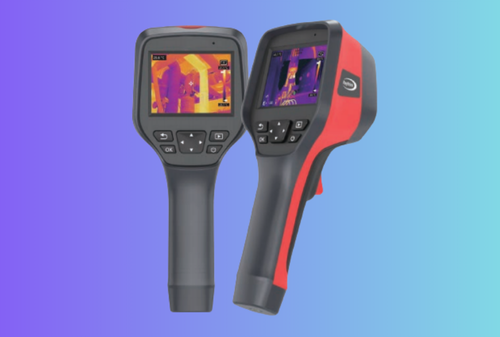
Predictive maintenance has moved from “advanced program” to “operational requirement.” As factories, utilities, and facility teams push toward higher uptime and safer operations, maintenance is increasingly judged by outcomes: fewer unplanned shutdowns, clearer root-cause evidence, and faster decision-making across large asset fleets. In that reality, handheld industrial thermal cameras are no longer niche inspection tools. They are becoming one of the most scalable ways to detect early-stage anomalies before they turn into downtime.
Table of Contents
ToggleFor industrial instrument brands and large distributors, the market shift is equally clear. Buyers are not only comparing image resolution or temperature range. They are comparing whether a device behaves like a professional measurement tool: consistent temperature readings, trustworthy documentation, smooth workflows, and rugged reliability in real field conditions. That “professional tool” identity is what drives repeat purchase, fleet standardization, and channel confidence.
This OEM guide explains how to build a handheld industrial thermal camera program that fits modern predictive maintenance use cases. We’ll cover where thermal fits into Industry 4.0 workflows, how measurement engineering translates into credible specifications, why calibration and compensation strategies protect your brand, what a software ecosystem must deliver for B2B customers, and how to differentiate in a crowded market through practical product decisions like display quality, grip ergonomics, and battery endurance. Where relevant, we’ll also connect the handheld device to broader thermal platform capabilities such as modules and integration services, because many industrial brands eventually expand from handhelds to embedded or fixed monitoring products.
If you’re evaluating an OEM partner for a thermal inspection product line, it helps to treat this category as “measurement + workflow,” not “camera + marketing.” The rest of this guide is built around that mindset.
1) Industry 4.0 and the Predictive Maintenance Reality
Industry 4.0 is often described in big words: digital twins, smart factories, AI-driven insights. On the ground, predictive maintenance is far less glamorous and far more practical. Technicians need to walk assets, capture evidence, compare against baselines, and produce repeatable reports that supervisors can trust. The value of handheld thermography is that it compresses this loop. A skilled operator can detect abnormal heating patterns quickly, capture both thermal and visual evidence, and turn findings into actionable tickets.
Thermal imaging becomes the “front-line sensor” in predictive maintenance because heat is a common symptom of failure across systems. Electrical faults, mechanical friction, insulation breakdown, and fluid ingress often appear as temperature anomalies before catastrophic failure occurs. In many facilities, thermal inspection sits at the intersection of safety and cost: it reduces the risk of arc faults and fires, and it reduces the cost of emergency repairs and secondary damage.
In practice, modern B2B buyers want three outcomes from handheld thermal cameras. They want earlier detection of issues that are easy to miss with spot thermometers. They want credible temperature measurements that withstand internal review, audit requirements, and contractor handoffs. They want workflow speed, because an inspection tool that slows reporting and follow-up is rarely adopted at scale.
Those three outcomes map directly to the OEM design priorities you must get right: sensitivity and measurement behavior, calibration credibility, and software/reporting workflow.
2) Where Handheld Industrial Thermal Cameras Deliver the Most Value
Handheld thermography is not a single “application.” It is a family of workflows across electrical, mechanical, building, and process environments. The best OEM programs position use cases with enough specificity that buyers can immediately see ROI and justify procurement.
Electrical inspection is the most common and often the most urgent use case. Thermal cameras reveal hotspots caused by loose connections, phase imbalance, overloaded circuits, deteriorating contacts, and abnormal resistance. A typical inspection includes scanning panels, breakers, busbars, cable terminations, and transformers. What matters is not only identifying the hotspot, but capturing repeatable evidence that can be compared across time and referenced in a work order.
Mechanical maintenance is the second major pillar. Bearings, motors, pumps, gearboxes, and belt drives often present as localized heating when friction increases, lubrication fails, or alignment is off. Thermal allows technicians to identify abnormal patterns without disassembling equipment. The value here is speed and triage: thermal does not replace vibration analysis or ultrasound, but it tells you where to look first and where the risk is rising.
Building diagnostics is a fast-growing segment that overlaps with facilities management and energy efficiency. Thermal reveals insulation gaps, air leakage, moisture intrusion, HVAC faults, and thermal bridging. This market cares about usability, visual/thermal overlay, and reporting for owners, contractors, and insurers. Measurement accuracy matters, but so does the ability to produce clear, client-facing documentation.
Across these markets, handheld thermal cameras also support specialized workflows: refractory inspection, process monitoring, solar panel diagnostics, and safety checks in high-risk environments. The common thread is that thermal provides a fast, non-contact way to locate anomalies, then documentation makes those anomalies actionable.
3) Measurement Engineering: Turning Specs Into Trust
Industrial buyers are far less forgiving than consumer buyers. They expect a handheld thermal camera to behave like a measurement instrument, not a “viewer.” That means your specifications and your real-world behavior must align. The most important measurement topics are temperature range, accuracy, spot size/IFOV, emissivity behavior, and environmental effects.
Temperature range matters because predictive maintenance spans multiple temperature regimes. A device that measures from around -20°C up to 550°C and beyond covers most building diagnostics and electrical inspection scenarios, while higher ranges support refractory and process applications. The OEM decision is not just “how high can we go,” but how you segment SKUs. Many successful product lines offer one “maintenance range” version optimized for accuracy and sensitivity in typical industrial temperatures, and a higher-range version optimized for specialized high-temperature applications.
Accuracy specifications are often written as “±2°C” or “±2%,” but buyers increasingly ask what that means in practice. Accuracy depends on calibration method, target emissivity, reflected background temperature, distance, ambient conditions, and measurement setup. A professional OEM strategy treats accuracy as a system capability that must be supported by calibration and workflow guidance, not as a single line on a brochure.
Spot size and IFOV (instantaneous field of view) determine whether the camera is actually measuring the target or a mixture of target and background. In predictive maintenance, “small hotspots” are common: a single lug, a connector, a bearing surface. If the camera’s effective spot size is too large at the working distance, the temperature reading will be averaged and the anomaly can appear less severe than it is. That can create false reassurance, which is the worst outcome in maintenance.
Emissivity is where many real-world measurement problems originate. Industrial surfaces vary dramatically: painted metal, oxidized copper, shiny aluminum, rubber insulation, coated pipes, and reflective enclosures. Emissivity settings and reflected temperature handling are not optional “advanced features.” They are the difference between credible and misleading results. An OEM handheld camera should make emissivity input practical, fast, and hard to ignore, because operators in the field will not spend time navigating deep menus while standing in front of a panel.
A practical way to present measurement engineering to B2B buyers is to connect each spec to the field consequence. The table below can also guide your SKU planning and your marketing documentation.
| Spec / Capability | What It Controls in Real Inspections | OEM Design Implication |
|---|---|---|
| Temperature range | Whether the device fits common PdM + special high-temp tasks | Consider tiered SKUs: maintenance range vs high-temp range |
| Accuracy spec | Whether readings are trusted in reports and decisions | Must be backed by calibration method + compensation workflow |
| IFOV / spot size | Whether hotspots are measured or averaged away | Ensure lens + resolution choices match typical working distances |
| Emissivity support | Whether readings reflect real surface temperature | UI must make emissivity easy and fast; include presets |
| Reflected temperature | Error on shiny/reflective surfaces | Provide workflow guidance and UI fields for professionals |
| Environmental compensation | Robustness in different ambient conditions | Requires thoughtful firmware + user inputs, not just lab specs |
When brands get these fundamentals right, distributors can sell the device as a “measurement tool” rather than a “thermal camera,” which changes pricing power and trust dynamics.
4) Calibration and Traceability: Protecting Your Brand’s Credibility
In industrial markets, calibration is not a technical detail. It is a credibility system. Buyers want to know whether your handheld thermal camera can be calibrated, how stable it remains across time and temperature, and what evidence they can include in reports and audits.
Blackbody calibration is the foundation of thermographic measurement. In OEM terms, calibration decisions affect not only the accuracy statement you can publish, but also the operational burden you place on customers. A professional program defines how calibration is performed at the factory, how often field calibration is recommended, and what traceability documentation is available.
Environmental compensation becomes important because real inspections are rarely performed in perfect lab conditions. Ambient temperature, humidity, distance, and reflective surroundings can shift readings. The best industrial cameras do not pretend these factors don’t exist. They incorporate user inputs and firmware compensation strategies that make real-world measurement more trustworthy, while also educating users through workflows and reporting guidance.
A key OEM insight is that calibration and compensation must be aligned with software and reporting. A customer may accept a certain uncertainty band if the report clearly documents setup conditions and if measurements are consistent across time for trending. But if readings are unstable and documentation is weak, customers will blame the product, not the workflow.
This is also why it’s valuable to publish a transparent calibration story, supported by documentation and certificates. For brands building a strong industrial channel, being able to point to a dedicated certificates page is not just compliance theater. It is a buyer assurance signal that reduces procurement friction.
If your product line is built on thermal imaging modules (either for handheld devices or future fixed systems), it can help to frame calibration as a platform capability rather than a one-off. In many OEM programs, handheld devices are the first step, and embedded monitoring follows. Linking the platform concept to modules and integration makes that roadmap believable. If relevant to your offering, you can reference your module platform pages such as Thermal Camera Module and Thermal Camera Module Integration.
5) Image Quality for Industrial Work: What Actually Matters Beyond Resolution
Industrial buyers do care about resolution, but in predictive maintenance the more important question is whether the camera reveals actionable anomalies early and reliably. That performance is shaped by sensitivity (NETD), optics, focus behavior, display quality, and processing stability.
Sensitivity matters because early-stage faults often produce faint thermal anomalies. A hotspot may start as a small temperature rise above baseline. If the device’s noise floor is high, the anomaly blends into background noise and becomes hard to interpret. In electrical inspections, this is especially important when scanning large panels and trying to distinguish meaningful temperature differences among many components.
Optics and focus behavior matter because hotspots are often small and distance varies. A camera that focuses quickly and holds clarity across typical working distances reduces operator fatigue and improves confidence in both detection and measurement. A device that “looks sharp” only in ideal focus conditions creates inconsistent field outcomes.
Display quality influences perceived contrast and usability. Industrial inspections are often performed in bright environments, tight spaces, or awkward angles. A high-quality display with good brightness and contrast helps technicians interpret thermal patterns without constantly adjusting settings. This is one of the simplest differentiators that brands underestimate: the same sensor can feel more professional when the display is readable, color mapping is consistent, and UI feedback is clear.
Processing stability is a hidden requirement. Predictive maintenance programs depend on repeatability. If the device’s image processing behavior changes aggressively across scenes, or if automatic modes create inconsistent results, technicians lose trust. A professional tool gives operators predictable control while still offering helpful automation.
If you want to position a handheld industrial camera as premium, you should explain image quality in outcome terms: clearer hotspot separation, less noise fatigue during long scans, more consistent measurement behavior, and better documentation outputs. For deeper sensitivity education specific to inspection environments, a related guide can focus on NETD and faint anomaly detection, which we will cover in a cluster article later in this series.
6) The Software Ecosystem: Where B2B Buyers Actually Feel the Difference
In predictive maintenance, a thermal camera is not only a device. It is a workflow node. The moment the inspection ends, the real work begins: analysis, annotation, reporting, archiving, and follow-up.
This is why software is one of the strongest OEM differentiation levers in industrial thermography. A serious B2B buyer wants a workflow that is fast, repeatable, and scalable across technicians and sites. They want to produce reports that match internal standards, include correct branding, and integrate with existing maintenance systems.
PC analysis software remains critical because many industrial customers perform deeper review on desktops. They want temperature points/lines/areas, isotherms, alarm thresholds, and batch processing. They want to compare images over time and track trends. They want exports that are stable and readable, not screenshots that look like a consumer app.
Mobile apps matter because inspections happen in the field. Apps can streamline uploading, tagging, voice notes, photo pairing, QR/asset code scanning, and immediate sharing with supervisors. For large enterprises, cloud sync and access control become important.
Automated reporting is the single most requested workflow improvement in industrial thermography. Buyers want templates that generate consistent reports with the right images, annotations, asset identifiers, operator signatures, and recommended actions. In many markets, the ability to produce standardized reports quickly is more valuable than a small increase in sensor resolution. This is why OEM programs that support custom reporting, white-label software, and integration with enterprise systems often win large distributor programs.
A practical OEM positioning statement is that the device does not merely capture thermal images. It accelerates inspection-to-action. When you sell that workflow outcome, you attract higher-quality B2B buyers.
7) Differentiation Strategy in a Crowded Market: Practical Levers That Sell
Industrial handheld thermal cameras compete in a market where many products appear similar. Meaningful differentiation comes from the features that technicians feel every day: screen quality, grip comfort, battery endurance, rugged reliability, and the friction level of the UI.
Display quality is an immediate trust cue. A bright, sharp screen with stable color mapping looks professional. Poor display readability looks cheap, regardless of the sensor. Ergonomics is equally visible. Industrial inspection is often one-handed, with gloves, while holding a flashlight or managing safety gear. A comfortable grip, balanced weight distribution, and reliable button layout reduce fatigue and mistakes.
Battery endurance is not just runtime. It’s operational stability. If a camera runs out mid-inspection, the workflow breaks. If charging is slow or unreliable, technicians stop trusting the tool. Premium programs treat battery design and charging behavior as core differentiation, not accessory decisions.
Ruggedization and field durability matter because industrial devices face drops, dust, moisture, and repeated connector use. IP rating and drop performance must be engineered into the structure, not claimed lightly. The best OEM strategy aligns ruggedization with serviceability, ensuring that the device can survive real use while keeping warranty costs controlled.
The most important strategic insight is that differentiation should match the buyer type. Large distributors often want reliability, consistent documentation, and low return rates. Industrial brands want a product that can be positioned as professional, with strong software and calibration credibility. End users want comfort and confidence.
The table below summarizes how different buyers tend to evaluate differentiation levers, which can help you decide where to invest first.
| Differentiation Lever | End Users (Technicians) | Brands | Distributors |
|---|---|---|---|
| Display quality | Comfort and clarity in the field | Premium perception | Lower support burden |
| Ergonomics and grip | Less fatigue and fewer mistakes | Product identity | Fewer returns |
| Battery endurance | Long inspections, fewer interruptions | Specification strength | Fleet reliability |
| Ruggedization | Survives real work | Brand trust | Reduced warranty cost |
| Software/reporting | Faster workflow, better evidence | Value story | Higher sell-through |
| Calibration credibility | Trust in readings | Procurement acceptance | Enterprise readiness |
This is why industrial handheld thermal cameras should be designed and marketed as tools that improve workflow, not just devices with better specs.
8) OEM/ODM Execution: From Platform Choice to Brand-Ready Product
A strong OEM program is not only about building a device. It’s about building a repeatable product line that can scale through channels, remain consistent across batches, and evolve through software updates.
The first OEM decision is platform selection: sensor class, optics strategy, display strategy, and compute headroom for software features. The second decision is customization depth. Some brands want quick private label entry. Others want deeper differentiation through industrial design, UI behavior, reporting software, and accessories.
A professional OEM roadmap includes not only EVT/DVT/PVT style steps, but also the operational pieces that industrial buyers care about: documentation, traceability, calibration support, and after-sales response. A high-quality manufacturing and QC process becomes a selling point in industrial channels, because distributors are sensitive to return rates and brand risk. Linking to quality standards and certifications can reduce friction for procurement conversations, especially with enterprise customers. If you maintain public documentation for this, it helps to reference pages such as Manufacturing & Quality, Certificates, and Downloads.
The final OEM insight is that industrial tools require lifecycle thinking. Firmware and software are not “ship once.” Customers expect updates, bug fixes, feature improvements, and long-term support. When your OEM program treats software as part of the product lifecycle, not a one-time deliverable, your brand positioning becomes more durable.
9) A Practical Buyer Mindset: How to Choose the Right OEM Partner
Industrial buyers and distributors are not only buying performance. They are buying risk reduction. That means your OEM approach should help them answer three questions quickly: will this tool detect issues early, will the measurements be credible, and will the workflow be efficient enough to scale?
A credible OEM partner can show a coherent story across hardware, calibration, software, ruggedization, and quality control. They can explain what accuracy means in real conditions, how calibration evidence is produced, how reports are generated, and how the device survives field abuse. They can also commit to a process: a clear development timeline, validation checkpoints, and consistent pilot-to-production outcomes.
If your goal is to attract industrial instrument brands and large distributors, your content should reflect that maturity. The point of this pillar page is not to impress casual readers. It is to help procurement-oriented buyers evaluate whether your OEM program understands industrial reality.
Ready to Build a Handheld Industrial Thermal Camera OEM Program?
If you’re planning a handheld industrial thermal camera line for predictive maintenance, electrical inspection, or building diagnostics, we can help you define the right product tier, measurement strategy, and software workflow so the final product behaves like a professional tool and scales through industrial channels.
Start with a quick project brief through Contact. If you already have a module-based roadmap or want to expand from handheld devices to embedded systems, you can also reference Thermal Camera Module and Thermal Camera Module Integration as part of your OEM architecture discussion. For procurement documentation and compliance readiness, Certificates and Downloads can be useful supporting materials.
Tell us your target industries, temperature range requirements, accuracy expectations, reporting workflow needs, ruggedization targets, and forecast volume. We will respond with a recommended platform direction, customization roadmap, and validation plan aligned to real predictive maintenance use cases.
Related Articles in This Series
- The Science of Accuracy: Blackbody Calibration and Environmental Compensation in Industrial Thermal Sensors
- Streamlining Workflows: Developing Custom Analysis Software for Industrial Reporting
- Ruggedization Standards: IP Ratings and Drop Testing for Industrial Handheld Devices
- Why NETD Matters in Electrical Inspection: Detecting Faint Thermal Anomalies