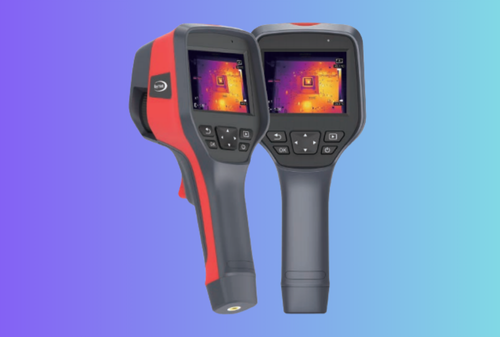
In predictive maintenance, “accuracy” is not a marketing line. It is the difference between a credible inspection program and a tool that creates arguments. Industrial buyers do not only want to see hotspots. They want temperature data they can trust, compare over time, and defend in a report when decisions are reviewed by supervisors, auditors, insurers, or customers.
Table of Contents
ToggleThat is why accuracy in industrial thermography must be treated as a complete measurement system. A handheld thermal camera does not measure “true temperature” automatically. It estimates surface temperature based on infrared radiation, then converts that estimate through calibration, assumptions, and compensation. When those assumptions match reality, the measurement is meaningful. When they don’t, the number can be precise-looking but wrong.
This article explains how industrial thermal accuracy is built in practice. We’ll cover what blackbody calibration actually does, why “±2°C” is more conditional than most datasheets admit, how emissivity and reflections distort measurements, and how environmental compensation and workflow discipline protect your brand from “accuracy disputes.” If you haven’t read the OEM overview, start with the pillar guide: Predictive Maintenance OEM Guide: Handheld Thermal Cameras.
Accuracy Starts With a Simple Truth: Thermal Cameras Measure Radiation, Not Temperature
An infrared camera detects radiation in a band (typically long-wave infrared for common industrial handheld devices) and converts that signal into a temperature estimate. That conversion requires assumptions about how the target emits radiation, how much of what the camera sees is actually emitted by the target, and how much is reflected background radiation or transmitted through the air.
This is why a thermal camera can show a stable, repeatable number on a shiny metal surface and still be wrong. The camera is not “lying.” It is doing exactly what it was designed to do, using the inputs and assumptions it has. The job of an industrial-grade thermal solution is to reduce uncertainty by combining calibration, compensation, and operator-friendly workflows that make the assumptions more correct.
For OEM brands, this is also a messaging opportunity. The strongest industrial positioning is not “our camera is accurate.” The strongest positioning is “our camera is accurate when used correctly, and our system makes correct use easier, faster, and more repeatable.”
What Blackbody Calibration Actually Means (and What It Doesn’t)
Blackbody calibration is the foundation of measurement credibility in thermography. A blackbody is a reference source designed to emit radiation in a predictable way at a known temperature. When a thermal camera is calibrated against a blackbody, the camera’s internal conversion model is adjusted so that its readings match the known reference under defined conditions.
That sounds straightforward, but it is important to understand what blackbody calibration is really doing. It is aligning the camera’s radiometric response to a reference source in controlled conditions. It does not magically remove all real-world errors, because real-world targets are not perfect blackbodies. Industrial surfaces vary in emissivity, reflectivity, texture, oxidation, paint, and geometry. Ambient conditions also vary. Blackbody calibration gives you a stable baseline. Environmental compensation and correct usage workflows determine whether that baseline translates into field-credible temperature estimates.
In OEM programs, calibration is also about consistency across production. A brand cannot build trust if one unit reads slightly differently than the next for the same target and setup. A professional blackbody calibration process reduces unit-to-unit variation and makes your accuracy spec defensible.
The “±2°C” Problem: Accuracy Is Conditional, Not Universal
Many handheld industrial thermal cameras advertise accuracy such as ±2°C or ±2%. This is not inherently misleading, but it is often misunderstood. Accuracy depends on conditions such as target temperature range, ambient temperature, emissivity assumptions, distance, atmospheric effects, and whether the target is reflective.
For industrial buyers, the practical question is not “is it ±2°C always?” The practical question is “is it accurate enough to make decisions in my workflow, and is it consistent enough for trending?” In predictive maintenance, trending consistency is often more valuable than absolute accuracy, because many decisions are based on changes over time rather than a single reading. A 10°C increase on a connector compared to baseline is meaningful even if the absolute reading has some uncertainty, provided the measurement setup is consistent and documented.
That is why the best OEM programs connect accuracy to workflow. They make it easy to record emissivity, reflected temperature assumptions, distance, and environmental context in the report. They also provide a calibration and validation plan that supports stable trending.
The Real Error Sources That Trigger “Accuracy Disputes” in Industrial Use
Accuracy disputes in industrial thermography almost always come from the same handful of causes. The camera is blamed, but the root cause is usually a mismatch between the physical scene and the camera’s assumptions.
The most frequent issue is emissivity. Painted surfaces, oxidized metals, rubber insulation, and matte coatings can behave predictably, while shiny metals and polished surfaces can reflect background radiation strongly. That reflection can dominate what the camera sees, producing a reading that looks plausible but is largely a reflection of the environment.
The second frequent issue is reflected background temperature. In an electrical cabinet, a shiny busbar might reflect a warm breaker, a technician’s body, or even the sun-warmed cabinet door. If the reflected component is not accounted for, the reading can be wrong even if the camera is well calibrated.
Distance and spot size also matter. If the hotspot is small and the camera’s effective spot includes cooler surrounding material, the measurement becomes averaged and the anomaly appears less severe. In predictive maintenance, that can delay intervention.
Atmospheric effects and environmental conditions matter most at longer distances and in harsh environments. Humidity, dust, and temperature gradients can change transmission. In many handheld inspections this effect is modest, but in certain sites and distances it becomes non-trivial.
To keep these concepts practical for OEM planning, the table below summarizes the most common drivers of measurement error and what an industrial product line should do about them.
| Accuracy Risk Driver | What Goes Wrong in the Field | What a Professional OEM System Should Provide |
|---|---|---|
| Emissivity mismatch | Wrong absolute readings, inconsistent comparisons | Fast emissivity input, presets, training workflow, report fields |
| Reflected background radiation | Shiny surfaces read “environment,” not target | Reflected temp input, guidance, report transparency |
| Spot size / IFOV mismatch | Hotspots averaged away, early faults missed | Correct optics/resolution pairing, clear distance guidance |
| Focus errors | Smearing and incorrect ROI measurement | Easy focus control, stable sharpness behavior |
| Environmental transmission | Distance-based attenuation, inconsistent readings | Practical compensation options for long-distance scenarios |
| Unit-to-unit variation | Fleet inconsistency, distrust in comparisons | Robust blackbody calibration + QC consistency checks |
When you design around these risks, accuracy stops being a fragile claim and becomes a capability buyers can rely on.
Environmental Compensation: What It Is and Why It Matters
Environmental compensation is the set of methods used to account for conditions that alter the radiation the sensor receives. In industrial handheld devices, this often means supporting inputs or modes that help users correct for emissivity, reflected temperature, distance, and sometimes atmospheric parameters.
The key is not to overwhelm the user with physics. The key is to give operators a workflow that is fast enough to use, while still reducing the most damaging errors. A common failure pattern in the market is offering advanced compensation settings that are buried in deep menus and rarely used. In practice, a professional industrial camera benefits more from a well-designed “measurement workflow” UI than from an intimidating list of parameters.
For OEM brands, environmental compensation should be framed as a trust feature. You are not adding complexity for its own sake. You are making the measurement more defensible and the report more credible.
Blackbody Calibration in Practice: Factory, Fleet, and Field
A professional calibration story has three layers: factory calibration, fleet consistency, and field recertification.
Factory calibration establishes the baseline accuracy and unit consistency. For OEM programs, this is where blackbody reference and calibration procedures matter most. Brands that want to serve large distributors should be ready to explain calibration coverage across temperature ranges and how calibration stability is verified.
Fleet consistency matters because industrial customers often deploy multiple units across a team. If two devices measure noticeably differently, trust erodes immediately. Good OEM QC processes include cross-unit checks and acceptance criteria designed to reduce drift across production lots.
Field recertification matters because calibration is not a “one-and-done” event. Industrial customers may require periodic recalibration, especially for regulated environments or critical inspections. A mature OEM program supports a clear recalibration path and documentation. This is also where having a public documentation and certificate workflow can reduce procurement friction. If your site provides supporting documentation, linking users to Certificates and Downloads reinforces trust without making the article feel like a brochure.
Accuracy vs Sensitivity: Why NETD Still Matters in Measurement Workflows
A common confusion in industrial thermal imaging is mixing accuracy and sensitivity. Accuracy is about how close the temperature estimate is to a reference. Sensitivity (often discussed as NETD) is about how well the camera can distinguish small differences in temperature. They are related in the user experience, but they are not the same.
In predictive maintenance, sensitivity matters because early-stage faults often manifest as faint thermal anomalies. A camera with better sensitivity can reveal subtle gradients that help technicians identify where a problem is starting, even if absolute measurement uncertainty exists. This is especially important in electrical inspections where a developing connection issue may appear as a small rise relative to baseline.
That’s why many OEM product lines separate “high sensitivity inspection models” from “general measurement models,” even if both have similar stated accuracy. Sensitivity helps you see the anomaly earlier. Calibration and compensation help you describe it credibly. For a dedicated deep-dive on this topic, the series includes a cluster article focused on NETD in electrical inspection, and it should be tightly cross-linked once published.
How to Make Accuracy “Usable” Through UI and Reporting
Industrial buyers don’t want to fight the tool. If emissivity and reflected temperature inputs are painful, operators skip them, and accuracy disputes increase. A professional OEM camera makes measurement inputs easy and makes the resulting assumptions visible in the report.
This is where software and reporting become part of accuracy. A modern predictive maintenance workflow often expects that each thermal capture can be traced with context: asset ID, operator, time, settings, measurement points, and notes. If your software automatically logs emissivity, distance assumptions, and measurement mode into the report template, you reduce misunderstandings and make trending more reliable.
For OEM brands, this is also a differentiation lever. Two cameras can share similar sensor specs. The one that produces clearer, more traceable reports will win in enterprise procurement. Once you publish your software workflow article, this accuracy article should link to it as the natural “what happens after measurement” continuation.
A Practical Measurement Workflow That Reduces Accuracy Problems
Industrial thermography works best when the workflow is designed to be repeatable, not heroic. A good workflow does not demand that every technician be a physicist. It demands that the product makes the right steps easy.
In practice, many industrial teams standardize how emissivity is handled for common surfaces, how measurements are captured (distance and angle habits), and how reports are structured. When brands support this standardization through UI presets and reporting templates, the customer’s whole program becomes more scalable.
This is also why training content and documentation are part of OEM value. Industrial brands and distributors want fewer support calls and fewer arguments on readings. A camera that is “accurate” but confusing creates support cost. A camera that is “accurate enough” and predictable with good reporting creates confidence and repeat orders.
OEM Guidance: How to Specify Accuracy Requirements Without Trapping Yourself
If you are building a private-label or OEM industrial thermal camera line, the biggest mistake is writing accuracy claims without defining operating conditions and validation methods. The safest approach is to align your public claims with what you can consistently deliver and support, then ensure your software and documentation reinforce those claims.
A strong OEM requirement set includes the measurement range, the intended core use cases (electrical panels, building diagnostics, mechanical maintenance), and the reporting workflow expectations. It also includes a calibration plan, unit-to-unit consistency expectations, and a recertification story. This protects you commercially because accuracy disputes tend to become warranty disputes, and warranty disputes tend to become channel distrust.
If your program includes modular expansion or you plan to build multiple device families on the same core, it’s also worth aligning calibration and measurement behavior across product categories. Many industrial brands start with handhelds, then expand into modules and integrated solutions later. If relevant, supporting pages like Thermal Camera Module and Thermal Camera Module Integration can help you present that roadmap as a coherent system strategy.
Conclusion: Accuracy Is an Ecosystem, Not a Number
Industrial thermal accuracy is built by combining blackbody calibration, smart compensation, and field-usable workflows. Blackbody calibration provides the baseline and production consistency that makes your spec credible. Environmental compensation addresses real-world conditions that distort readings. UI and reporting convert these capabilities into repeatable, defensible workflows that B2B customers can scale.
If your brand wants to win in predictive maintenance markets, the best strategy is not to chase the most aggressive accuracy claim. The best strategy is to build a measurement system that stays consistent across time, is transparent in reporting, and reduces human error through thoughtful design. That is what industrial buyers recognize as professional.
CTA: Planning an Industrial Thermal Camera OEM Program With Measurement Credibility?
If you’re building a handheld industrial thermal camera line for predictive maintenance, we can help you define an accuracy and calibration strategy that matches your target applications, reporting requirements, and channel expectations.
Start a project brief through Contact and share your intended use cases (electrical / mechanical / building diagnostics), temperature range needs, accuracy expectations, calibration documentation requirements, and whether you need PC software, mobile app workflows, or automated reporting. We can recommend a platform direction, calibration and validation plan, and documentation package aligned to enterprise-ready deployment.
Related Articles in This Predictive Maintenance Series (Internal Links)
- Predictive Maintenance OEM Guide: Handheld Thermal Cameras
- Streamlining Workflows: Developing Custom Analysis Software for Industrial Reporting
- Ruggedization Standards: IP Ratings and Drop Testing for Industrial Handheld Devices
- Why NETD Matters in Electrical Inspection: Detecting Faint Thermal Anomalies