Reliability-First OEM/ODM for Thermal Optics
In thermal optics, reliability isn’t a label you print at the end; it is an engineering system that starts before the first CAD sketch. This playbook shows OEM/ODM buyers how to specify, integrate, and scale private-label thermal devices with fewer field failures and clearer ROI, using methods that connect design choices to downstream service cost.
Table of Contents
ToggleExecutive Summary
Many programs fail not because the sensor was wrong, but because quality was treated as a phase instead of a requirement. A reliability-first approach threads DFM/DFA, environmental margins, and test coverage through the RFQ, the EVT/DVT builds, and the first mass production lot. If you select a core only on resolution, NETD, and price, you will miss the metrics that drive total cost—shock resistance, seal integrity, firmware update safety, MTBF, and traceability. Bake these into the contract, validate them using bench, environmental, and pilot trials, and align the paperwork for CE/FCC/RoHS, IEC 60825-1 (where lasers are used), and dual-use export rules. Do this well and reliability becomes a margin lever, not an expense line (MarketsandMarkets, 2024; IEC, 2021; JEDEC, 2017).
Use Cases & Buyer Scenarios
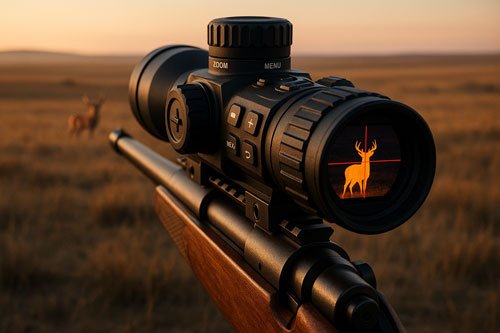
Hunting brands moving into weapon-mounted products need platforms that keep zero after recoil, boot quickly in the cold, and survive rain and dirt. A sensible family pairs a durable scope with a compact handheld to widen the price ladder and reduce returns. For the former, see our Thermal Rifle Scopes; for the latter, explore Thermal Monoculars to create good/better/best bundles.
Security and industrial integrators face different stressors: duty cycles run for months, software must be stable, and the network stack cannot crash. Choose cores that ship with documented streaming APIs and watchdogs; where distance annotation matters, fuse the core with a Laser Rangefinder Module and set an error budget—for example, ±1 m at 1 km with a latency ceiling that preserves the operator’s tempo.
Channel distributors stepping into private label should prefer platforms that are serviceable and traceable. Modular eyepieces, standard fasteners, and serial-lot tracking sound mundane, yet they cut RMA handling times dramatically. As sales grow, the same platform can evolve into binocular or clip-on variants, giving room for differentiation through optics, UI, and firmware; consider Thermal Binoculars or a Thermal Clip-On Sight path when your roadmap calls for that.
Spec & Selection Guide
Performance still matters, but a reliability-first RFQ evaluates it alongside durability and service economics. The table below compresses the core parameters buyers actually trade off during sourcing. For adaptable options and drawings, review our Thermal camera module family.
| Parameter | What it means | Typical range | Why it matters |
|---|---|---|---|
| Sensor Resolution | Pixel matrix of the core | 256×192 → 640×512 | Higher pixel count extends recognition distance and digital zoom latitude |
| NETD (mK) | Thermal sensitivity | ≤40 mK preferred | Lower values produce cleaner imagery in fog/low-contrast scenes |
| Optics (Focal/F#) | Lens geometry & speed | 19–75 mm / F1.0–1.2 | Defines field of view vs. range and signal throughput |
| Refresh Rate | Frame rate | 25–50 Hz | Smoother motion and less blur (note export implications) |
| Power Draw | Typical electrical load | 1.5–3.5 W | Drives battery life and UAV payload limits |
| SDK & I/O | Interfaces and dev tools | UART/USB/Ethernet/CAN/MAVLink | Determines integration effort and update safety |
| Shock & Seal | Recoil/IP rating | ≥1000 g; IP66–IP67 | Reticle stability and water/dust resistance shape service rate |
| MTBF & Traceability | Reliability & tracking | ≥10,000 h; full lot codes | Enables warranty economics and root-cause analysis |
Decision guidance:
If the device must survive recoil, prioritize shock qualification and reticle shift limits before debating lens length. If it will run continuously on infrastructure, treat MTBF, remote update safety, and watchdog resets as first-order requirements. If it must fly or fit in a pocket, the winners are low power, light weight, and clean MAVLink or USB-C integration. When ranging overlay is needed, select a core and Laser Rangefinder Module pair with IEC 60825-1 labeling and overlay accuracy defined at three FOVs.
Integration & Engineering Notes
Electrical design should respect isolation and sequencing. External ports deserve TVS protection because many “mysterious” failures are hot-plug ESD events. Some shutters and detectors are sensitive to ramp rates; follow the vendor’s timing diagram and provide brownout handling. For UAV payloads, MAVLink brings discipline—assign message IDs for range and temperature overlays, time-synchronize with the IMU, and keep a heartbeat to gate recording and power states. Remote updates should be dual-bank with rollback; the cheapest way to lose a customer is to brick units in the field.
Mechanically, maintain axial alignment within ±0.05 mm and choose thread-lockers rated for your temperature envelope. Weapon-mounted systems—or clip-ons in front of day optics—deserve test coverage across calibers (for example, .308 and 12-gauge) because recoil signatures differ. Sealing is chemistry as much as geometry; pick O-rings that resist your chosen lubricants and check compression set after thermal cycling. A serviceable design—field-swappable eyecups, lens caps, and batteries—cuts downtime and keeps total landed cost in check. If the roadmap includes pistol platforms, weight, recoil survivability, and compact UI treatment will dominate; that is where Thermal Pistol Sights enter.
Firmware and ISP tuning should be restrained, deliberate, and documented. AGC and NUC presets for forest, open field, and urban scenes prevent pumping and provide a consistent brand look. Keep palette choices purposeful rather than exhaustive. When fusing range data, publish overlay accuracy in pixels and keep end-to-end latency below 100 ms so the UI feels anchored to reality. Telemetry—sensor temperature, frame drops, and error codes—belongs in the log from day one because it shortens warranty triage.
Validation benefits from a tiered approach. Begin at the bench with image quality across temperature and with ripple on the power rail. Move to environmental work—thermal shocks between −20 °C and +60 °C, humidity, and salt fog if your customers sail. Use HALT/HASS to overstress the design and expose weak links such as connectors, solder joints, and seals; the method is common in reliability engineering and pays for itself by reducing early-life failures (JEDEC, 2017). Finish with a structured pilot of a few dozen units in real use, and set acceptance criteria that are explicit: bad-pixel rate below 0.3 %, focus deviation after a drop test below ±0.05 mrad, and ranging error within ±1 m at 1 km.
Compliance, Export & Certifications
Paperwork moves markets. CE, FCC, and RoHS are the baseline for EU and US entry; ask for test reports, not just declarations. If your SKU includes a laser rangefinder, build to IEC 60825-1 and treat labels, accessible emission limits, and user warnings as non-negotiable, because retailers and insurers will (IEC, 2021). Export status must be clarified early as higher frame rates or resolutions can fall under 6A003/6A993 dual-use classifications; the right answer is often “NLR,” but only after someone checks properly. Keep a compact technical file—drawings, BoM, risk analysis, and test reports—so adding markets later is a sprint, not a rewrite.
Business Model, MOQ & Lead Time
Programs that survive first contact with the market usually follow a predictable cadence. Engineering samples (one to five units) ship in one to two weeks with evaluation boards and SDKs. The first ODM build of 50–100 units needs four to six weeks for housing, UI, palettes, and branding. Mass production of 300–500 units runs eight to ten weeks once tooling is settled, with QC lot reports included. Private-label options range from logo engraving and localized firmware to packaging kits and channel-ready photos. A realistic distributor model might see an ODM unit cost around $620 and an average resale near $965, producing a gross margin of ~35.7 %. If reliability work holds the twelve-month service rate close to two percent and RMA handling is about $45 per unit, the effective margin still sits near the mid-thirties and annual ROI approaches the 90 % mark on 600 units. In other words, reliability is marketing you don’t have to pay for.
Pitfalls, Benchmarks & QA
The most expensive mistakes are subtle. NETD is often quoted at 25 °C, but the useful number is its drift across temperature; insist on the curve. Focus that survives a vibration table can still creep after a drop if fasteners and thread-lockers were chosen casually. Single-bank firmware updates look tidy until an interrupted flash bricks a batch. Seemingly trivial accessories—eyecups, lens caps, and cables—create downtime when they are not stocked. Compliance gaps discovered after you have printed packaging are awkward and costly. Lack of lot codes ruins root-cause analysis. And marketing claims that stretch beyond Johnson-criteria estimates will boomerang into returns. For planning purposes, the Johnson model suggests that a human target (1.8 × 0.5 m) is typically detected at roughly 650 m/1200 m/1800 m for 19/35/50 mm lenses, with recognition and identification at lower fractions; local weather will push these numbers around (FLIR/US Army notes, 2022).
FAQs
How is a reliability-first RFQ different from a typical RFQ?
It treats reliability as a contracted deliverable by specifying shock and IP targets, environmental margins, traceability, and acceptance tests, alongside the usual resolution/NETD/price line items.
Do weapon-mounted devices need special specs?
Yes. Recoil survival at or above 1000 g and reticle shift limits (for example, ≤0.1 mrad after test) matter more than an extra handful of pixels. Clip-on concepts benefit from separate alignment and seal checks; see our Thermal Clip-On Sight path for reference.
Can I add ranging later?
Often. Choose a core with spare I/O and fuse in a Laser Rangefinder Module, then publish overlay accuracy and latency limits so expectations are set.
How should I publish range claims responsibly?
Use Johnson criteria and report detection, recognition, and identification separately with the test conditions listed. Conservative numbers protect your brand.
What documentation should I request at MP?
Final drawings, firmware version matrix, QC lot reports, calibration files, and a short service manual. These documents shorten every future RMA.
Call-to-Action (CTA)
If your next thermal product needs to last—in the field and in your P&L—begin with reliability. Gemin Optics supports OEM/ODM partners with module-level documentation, reliability testing, and private-label options across devices from Thermal Rifle Scopes to handhelds and fused systems. Let’s co-engineer a platform that passes the lab and the market.