Thermal Binoculars OEM/ODM: A Complete Builder’s Guide
Lead: Dual-eye thermal binoculars are moving from niche to must-have across hunting, SAR, law-enforcement and perimeter security. This guide gives OEM/ODM product managers and integrators a practical, engineering-driven path from concept to a field-proven binocular—covering specs, interfaces, compliance, QA, and a simple ROI model.
Table of Contents
ToggleExecutive Summary
- Pick optics first, not firmware. Lens focal length and aperture drive field-of-view (FOV), detection range, size/weight and bill-of-materials more than any other decision.
- Resolution & NETD determine clarity under stress. 640×480/12 µm with ≤35 mK NETD is today’s sweet spot for premium handhelds; 384×288/12 µm with ≤40 mK wins value builds.
- Design for fusion early. If you plan to overlay ranging, e-compass, or GPS, lock the boresight and timing budget between the thermal core and the Laser Rangefinder Module during EVT—not after ID is frozen.
- Compliance isn’t an afterthought. CE/FCC/RoHS plus IEC 60825-1 laser safety (LRF) and export controls (EAR/EU Dual-Use) affect frame-rate, sales regions, and even your labeling.
- Speed to revenue = kits + docs. Offer configurable SKUs (lens/LRF/battery/UI), provide integration docs, and link accessories from day one to shorten distributor onboarding.
Use Cases & Buyer Scenarios
Wildlife & Hunting Brands: Long-Range Observation
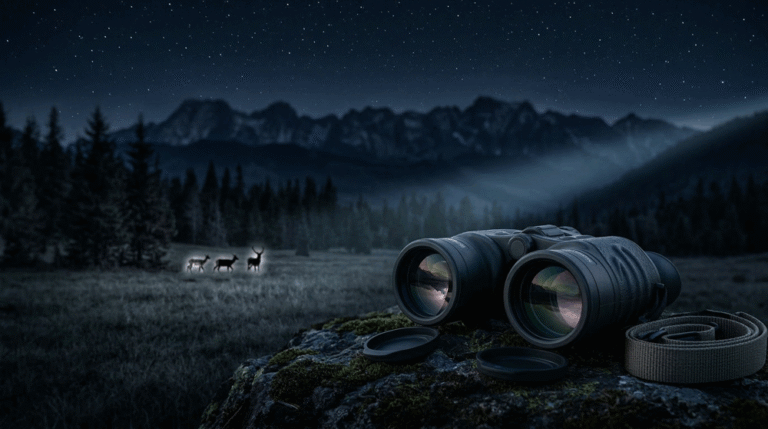
Premium brands want long-range spotting to complement Thermal Rifle Scopes in low-light or foliage-heavy terrain. Key asks: light weight for dawn-to-dusk carry, 1.5–2.5× base magnification with clean digital zoom, Class 1 eye-safe LRF readout to 1,500–2,000 m, and battery life ≥6 hours at 25 °C.
Search & Rescue / Law Enforcement: Fast Target Discrimination
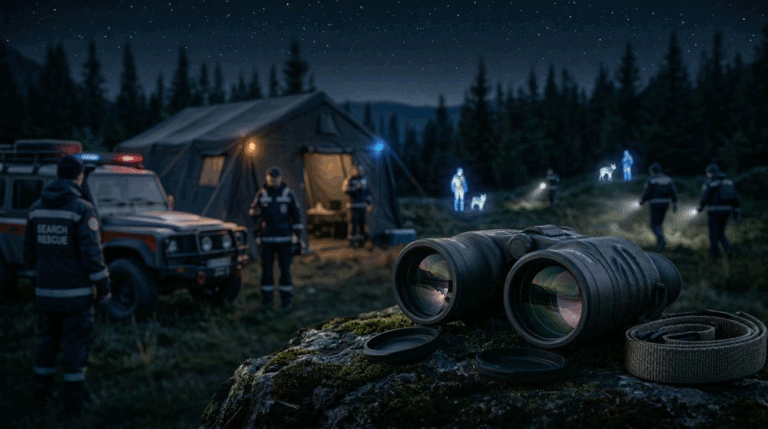
SAR teams prioritize wide FOV + high sensitivity to see low-contrast subjects in rain/fog. Requirements: 640×480/12 µm, ≤35 mK NETD, fast startup (<3 s from sleep), hot-swap batteries, tripod socket, and IP67 sealing. Optional GNSS + compass aids after-action reports.
Industrial & Security Integrations: 24/7 Perimeter & Utilities
Security integrators deploy binoculars for mobile patrols and substation checks. Needs: stable radiometric modes, reliable Wi-Fi/HDMI out for command vans, and SDK hooks to log LRF/compass to incident systems. Consider offering a “pro kit”: hard case, charger, spare batteries, Picatinny rail, and USB-C tether.
Related pages: If your project eventually down-sizes into a mono device, see Thermal Monoculars; for clip-on architectures, see Thermal Clip-On Sight.
Spec & Selection Guide (the heart)
Core parameters that matter
-
Resolution & Pixel Pitch: 384×288 or 640×480 at 12 µm is mainstream; 1280×1024 (12 µm) is emerging for ultra-long-range. More pixels = longer recognition distance but higher compute/power.
-
NETD (Thermal Sensitivity): Lower is better. ≤35 mK produces cleaner imagery in fog, drizzle, or when subjects are near ambient.
-
Optics (Focal Length & f/-number): Long lenses extend range but narrow FOV and add mass. Faster f/-numbers gather more signal (better SNR) but cost/weight rise.
-
Refresh Rate: 25–50 Hz feels natural for panning; note export limits (some regions restrict >9 Hz commercial units).
-
LRF Integration: 905 nm (cost-effective, compact) vs 1550 nm (better eye safety margin and atmospheric transmission, typically larger). Sync and boresight with the thermal channel.
-
Power System: 18650/21700 cells or proprietary packs; budget 3.5–6.5 W with LRF on.
-
I/O & SDK: USB-C UVC, UART/CAN for internal modules, HDMI/Wi-Fi for viewing, and an SDK for overlays and logging.
Example comparison (typical OEM options)
| Parameter | Value Option A | Value Option B | Value Option C |
|---|---|---|---|
| Core Resolution / Pitch | 384×288 / 12 µm | 640×480 / 12 µm | 1280×1024 / 12 µm |
| Lens (focal length / f-#) | 35 mm / f/1.0 | 50 mm / f/1.0 | 75 mm / f/1.0 |
| HFOV (approx.) | ~10.7° | ~8.8° | ~6.0° |
| NETD (typical) | ≤40 mK | ≤35 mK | ≤35 mK |
| Refresh Rate | 25 Hz | 50 Hz* | 50 Hz* |
| LRF Range (Class 1) | 1200 m | 1800 m | 2000 m |
| Power Draw (avg) | ~3.8 W | ~4.5 W | ~5.8 W |
*Regional restrictions may apply for >9 Hz exports.
Simple decision rules
-
If handheld comfort and all-day carry are critical then keep total mass ≤1.1 kg and prefer 35–50 mm lenses.
-
If identification beyond 1 km is mandatory then choose 640×480/50 mm or 1280×1024/75 mm with ≤35 mK NETD.
-
If frequent fog/drizzle then prioritize low NETD and faster optics (f/1.0–f/1.1).
-
If you need reliable ranging tags in the video then lock LRF-to-thermal boresight at ≤0.5 mrad and timestamp both data streams.
Mini flow (conceptual):
Start
├─ Need ID >1 km? ── Yes → 640/50 mm or 1280/75 mm, ≤35 mK
│ No → 384/35 mm, ≤40 mK
├─ Fog/Rain common? ── Yes → f/1.0 lens + advanced AGC
├─ Must log ranges? ── Yes → UART/SDK + boresight ≤0.5 mrad
└─ Weight target <1.1 kg? → Use Mg chassis + 35–50 mm lens
Planning a bespoke core? Explore our Thermal camera module options to standardize ISP and SDK across product lines.
Integration & Engineering Notes
Electrical & Interfaces (UART/USB/CAN/SDK)
-
Internal buses: UART or SPI for LRF module telemetry; I²C for sensors (gyro/compass); optional CAN for robust inter-board messaging.
-
External I/O: USB-C for UVC video and config; HDMI for live monitors; Wi-Fi (802.11n) for app preview and OTA; BLE for remote control.
-
Sync & timestamping: Use a common monotonic clock for the thermal core and LRF to align range overlays; expose in the SDK for partners.
-
Power architecture: Separate switching rails for core, display, and LRF; isolate LRF pulse driver; add supercap for brown-out resilience during pulses.
Optics & Mechanics (mounting, alignment, sealing)
-
Boresight: Co-align LRF emitter/receiver and thermal optical axis at 100 m nominal; validate parallax error up to 2 km. Provide a 3-point mechanical shim or software offset.
-
Chassis: Magnesium or glass-filled nylon over internal aluminum spine balances stiffness and weight.
-
Sealing: IP67 targets—double O-rings at eyecups, Gore vent for pressure equalization, and nitrogen purge to prevent internal fogging.
-
Ergonomics: Inter-pupillary adjustment 56–74 mm; 18–20 mm eye relief; textured focus ring usable with gloves; tripod socket and hand strap.
-
Windows: Hard-coated germanium front element; consider sacrificial window for patrol units.
Firmware/ISP/Tuning (AGC, palettes, fusion)
-
AGC & detail: Use scene-based NUC, DDE/ACE sharpening carefully (avoid haloing), and palette presets (White-Hot, Black-Hot, Ironbow) with a “Pro” dynamic range mode for fog.
-
LRF fusion: Overlay stabilized range box; configurable ballistic/holdover is optional for hunting SKUs; for pro SKUs, log range+azimuth+GPS.
-
Shutterless operation: If you go FFC-less, plan for temperature drift calibration at EVT and service menu for manual FFC.
-
Media: 1080p recording @30 fps from upscaled thermal; geo-tag sidecar (JSON) for evidence handling.
Testing & Validation (bench → field)
-
Bench: NETD verification with calibrated blackbody; boresight at 100 m collimator; EMC pre-scan with LRF pulsing; ingress tests with 1 m water immersion.
-
Environmental: −30 °C to +55 °C operation; thermal shock −20 ↔ +40 °C; 1.5 m drop on all faces; salt fog for coastal customers.
-
Field acceptance: DRI range test on ISO targets, fog/haze trials, ranging accuracy ±1 m at ≤500 m and ±0.5% beyond; battery runtime test at −10 °C and +40 °C.
Compliance, Export & Certifications
-
Laser Safety: Integrated LRFs must be classified and labeled per IEC 60825-1:2014 (EN 60825-1:2014/A11:2021 in the EU). The A11:2021 amendment is the current harmonized basis for EU conformity under LVD (UL/BSI explainers available).
-
CE/FCC/RoHS: Typical stack: EMC (EN 55032/55035), safety (EN 62368-1 if applicable electronics), radio (if Wi-Fi/BLE), and RoHS/REACH declarations.
-
Export Controls (examples, not legal advice):
-
United States: Many thermal cameras fall under ECCN 6A003 with reporting/licensing rules and country-specific restrictions. Frame rate, pitch, and resolution can be relevant.
-
European Union: The EU Dual-Use list (Annex I of Regulation 2021/821) is periodically updated; check latest delegated acts when planning shipments.
-
-
Labeling & docs: Include laser class label near the aperture, user warnings, and a compliance section in your IFU. Maintain a technical file and test reports for market surveillance.
Business Model, MOQ & Lead Time (OEM/ODM)
-
Typical MOQs: 50–100 units per finalized SKU; pilot runs as low as 10–20 for validation.
-
Sampling: EVT/PVT samples in 2–4 weeks depending on lens/LRF availability; custom ID may add 3–6 weeks.
-
Mass production: 6–10 weeks ARO for standard configs; plan earlier for special lenses or 1550 nm LRFs.
-
Private label & kitting: Colorways, overlays, splash screen, packaging, multilingual IFU, and pro kit (tripod, spare batteries, charger, harness).
-
Documentation: API/SDK, optical boresight guide, EMC/LVD test report excerpts, repair manual, parts catalog.
Simple distributor ROI model (illustrative)
| Item | Value |
|---|---|
| Ex-Works Unit Cost | $1,350 |
| Wholesale (to dealer) | $1,850 |
| MSRP | $2,499 |
| Distributor Gross Margin | ~$500 (27% on cost) |
| Dealer Margin (MSRP vs wholesale) | ~$649 |
| Annual Volume (target) | 300 units |
| Distributor Gross Profit | ~$150,000 |
Assumptions: Standard 640/50 mm SKU with LRF 1.8 km, accessories kit included. Adjust for region, warranty term, and marketing co-op.
Pitfalls, Benchmarks & QA
Common mistakes (and fixes)
-
Choosing lens before use-case. Start from required recognition distance and working FOV; back-solve focal length.
-
Ignoring boresight drift. Temperature and shock can shift alignment—use mechanical pins + software trim and a quick field-zero menu.
-
Under-budgeting power. LRF pulses and Wi-Fi spikes cause brown-outs; isolate rails and add hold-up capacitance.
-
Over-sharpened ISP. Aggressive DDE looks great indoors and awful in fog; tune on difficult scenes.
-
No EMC margin. LRF drivers can fail radiated emissions—pre-scan early with worst-case pulse repetition.
-
Frame-rate/export surprise. Confirm EAR/EU rules before marketing materials are printed.
-
Weak sealing around eyecups. Sweat + rain ingress kills units—double seals and breathers are cheap insurance.
Field benchmarks—DRI explained
-
Detection: “Something is there.”
-
Recognition: “It’s a person vs animal/vehicle.”
-
Identification: “It’s a person carrying a pack.”
Using Johnson’s criteria, pixel counts across the target drive D/R/I distances; higher resolution and longer lenses extend I-range disproportionately. Always publish method (target size, ambient, humidity, wind) with your spec sheet.
FAQs
1) What’s a realistic NETD target for thermal binoculars?
Aim for ≤35 mK on premium SKUs and ≤40 mK on value models to preserve contrast in fog/rain.
2) 905 nm vs 1550 nm LRF—how should we choose?
905 nm is compact and cost-efficient for 1–1.5 km ranges. 1550 nm offers better eye-safety margins and atmospheric behavior for 2 km+, but modules are larger and pricier. Both must comply with IEC/EN 60825-1 labeling and testing.
3) Can binoculars record video with range overlays?
Yes. Use UVC/MP4 recording and log a JSON sidecar (timestamp, range, azimuth, GPS). Many integrators ingest this into evidence systems.
4) How do we prevent LRF/thermal misalignment after shipping?
Use dowel-pin references, low-creep spacers, and a software trim routine. Validate drift across −30 → +55 °C and after 1.5 m drops.
5) What frame-rates can we export globally?
Rules vary by destination and spec (pitch, resolution). Some countries restrict >9 Hz commercial exports. Check EAR/EU Dual-Use lists and obtain licenses as needed.
6) What battery system is best?
Dual 18650/21700 with hot-swap sleds are serviceable worldwide. Publish runtime at −10 °C and +40 °C with LRF and Wi-Fi enabled.
7) How big is the thermal market—is binocular demand growing?
Analysts estimate the global thermal/infrared imaging market at ~$7–8 B in 2024, with continued growth across defense, security, and automotive—tailwinds that benefit premium handhelds like binoculars.
Call-to-Action (CTA)
Ready to prototype a dual-eye platform your dealers will love? Explore our Thermal Binoculars line, pair it with a compact Laser Rangefinder Module, and standardize firmware across families via our Thermal camera module SDK. Tell us your target ranges, FOV, and battery goals—we’ll return a build plan and EVT samples.