Picking the right lens is where many thermal projects are won or lost. A lens defines field of view (FOV), instantaneous field of view (IFOV), and—ultimately—what your operators can reliably detect from the ground or in the air. For fixed security cameras, a sensible FOV reduces camera count and false alarms; for UAV gimbals, it governs swath, operator workload, and how much stabilization you really need. This guide gives B2B teams a practical framework to choose focal length and FOV for a thermal imager module, thermal camera core, or complete thermal imaging camera module, with math you can sanity-check and integration advice that avoids costly rework. We cite open formulas and industry references so your choices are defensible to engineering and procurement alike.
Understanding the Core Concept
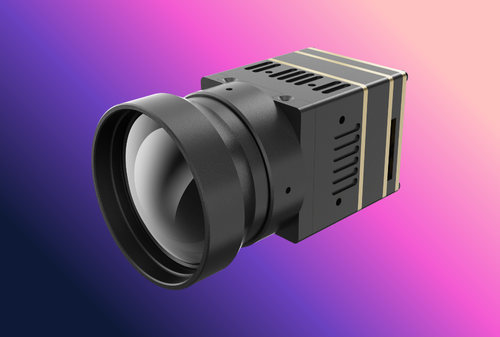
A thermal system starts with an uncooled microbolometer and a lens. The sensor’s pixel pitch and format (for example, 640×512 at 12 µm) set the canvas; the lens turns that canvas into a usable scene. FOV determines how wide your scene is; IFOV converts focal length and pixel size into “detail per pixel”; the f-number (e.g., f/1.0 vs. f/1.2) affects signal-to-noise and lens size. Think of the lens as a trade-off dial: wider FOVs favor coverage and situational awareness, while narrower FOVs put more pixels on distant targets but demand better stabilization and focus. Typical 12 µm-pitch cores—such as 640×512 LWIR modules—are a common baseline in modern projects and are available with multiple lens options for different standoff distances.
For security deployments, the camera often lives on a mast or rooftop and watches fixed approach lanes, fence lines, and gates. The design goal is stable, repeatable detection with low nuisance alarms. For UAVs, altitude, airspeed, and gimbal tuning change the equation: a lens that looks superb on a fixed mount can be unforgiving in the air if your HFOV is too narrow and the gimbal or pilot cannot hold hover. In both worlds, the “right” choice is the focal length that meets your detection/recognition/identification goal without over-specifying mass, cost, or operator effort.
Market Relevance and Applications
Security (ground). Perimeter and critical-infrastructure jobs typically combine one wider-FOV node for situational awareness with one telephoto node for long corridors and distant approaches. The wide node helps VMS analytics keep false alarms in check by maintaining context, while the tele node ensures people and vehicles at range cross the pixel thresholds you’ve planned for. This approach often reduces total camera count compared with running all-wide or all-tele, and it produces cleaner alarm clips for rapid review.
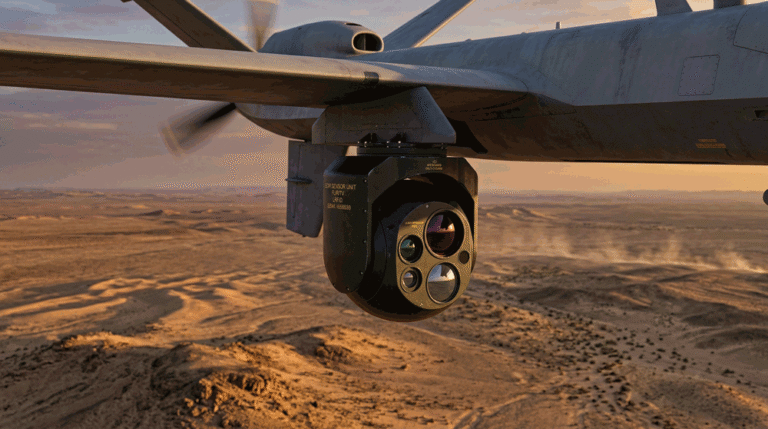
UAV (air). Public safety, inspection, and mapping flights live and die by swath and stability. At 100–120 m AGL, a moderate HFOV keeps ground coverage efficient while preserving enough pixel density to separate humans from clutter. Over-narrow lenses increase operator workload and jitter blur; over-wide lenses reduce re-flight risk but may miss small, hot targets unless altitude is lowered. A practical pattern for 640×512/12 µm cores is to fly a 19–25 mm lens for search and add a 35 mm “clarification” lens only when the gimbal and pilot workflow are dialed in.
From an ROI standpoint, the lens decision influences both CAPEX and OPEX. Longer, faster lenses are heavier and pricier; on drones, that weight can cut flight time and raise battery spend, while on fixed sites it increases load on pan-tilt units and wind-shake sensitivity. On the upside, good IFOV at the correct distance can defer expensive lighting upgrades and reduce truck rolls by improving alarm accuracy.
Technical Insights and Key Specifications
FOV and IFOV, in one page
Two simple relationships drive most choices:
-
Rectilinear FOV (horizontal):

where ff is focal length. This is the workhorse formula for mapping sensor size to angle of view. -
IFOV (radians/pixel): approximately pixel size ÷ focal length. Converting to mrad gives an intuitive “milliradians per pixel” figure; smaller is better for detail. Alternative definitions express IFOV as FOV divided by pixel count across the axis of interest; both are used in thermal literature.
With a 640×512/12 µm sensor (sensor width ≈ 7.68 mm), typical horizontal FOVs are:
| Focal length (mm) | 9 | 13 | 19 | 25 | 35 | 50 |
|---|---|---|---|---|---|---|
| HFOV (deg) | ~46.4° | ~32.9° | ~22.9° | ~17.5° | ~12.5° | ~8.8° |
These values match published ranges for 12 µm VOx cores and align with vendor lens charts you’ll see during procurement.
What distance can I expect? (Johnson-style planning)
For planning, many teams still use Johnson’s criteria: the pixel count across a target’s critical dimension associated with detection, recognition, and identification. Modern guidance varies slightly by task and post-processing, but the essence holds: more pixels on target increases the probability of correct classification. As a rule-of-thumb, using ~2 px for detection, ~6–8 px for recognition, and ~12–14 px for identification gives defensible ranges for proposals and early design reviews (final performance depends on NETD, contrast, and atmosphere).
If you plug IFOV (in mrad) and target width into Range≈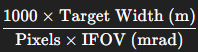
you can sanity-check whether a 25 mm or a 35 mm lens is the real break-even for your corridor or UAV altitude. Because atmospheric transmission, platform motion, and AGC behavior vary, treat computed ranges as “planning numbers,” then verify with field tests.
Ground swath from the air
For UAV operations at altitude hh, horizontal ground swath is approximately 2h⋅tan(HFOV/2)2h \cdot \tan(\text{HFOV}/2). This is why a 20–35° HFOV is a sweet spot for search at 100–120 m AGL: the swath stays wide enough to minimize re-flights without starving the scene of pixels on human-sized targets. Once you narrow below ~12°, tiny gimbal errors smear more than a pixel, and pilots tend to fight framing during turns and transitions. Industry payload vendors underscore the connection between tight FOV and stabilization demands; plan gimbal specs with optics in mind rather than as an afterthought.
Weight, aperture, and the real cost of “long”
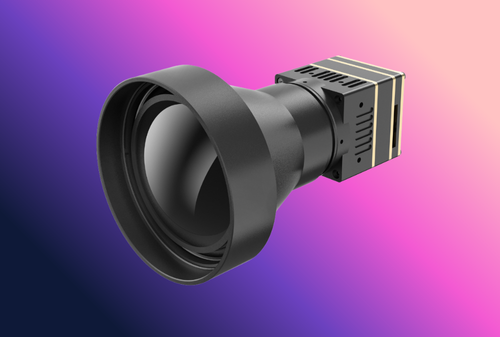
Germanium scales fast: a 50 mm f/1.0 lens is materially heavier than a 25 mm f/1.2. On a mast, mass shows up as wind sensitivity and load on PTZ gears; in the air, mass shows up as shorter flights, more battery cycles, and higher gimbal torque requirements. While f/1.0 often improves SNR/NETD, the system-level ROI may still favor a lighter 25 mm f/1.2 for UAV search with a second, rarely-used 35 mm lens for clarification. Keep optics, gimbal, and airframe in one budget conversation so you don’t “win the lens spec” and lose the mission.
Integration and OEM/ODM Considerations
Lens choice becomes much easier when the rest of the stack is clear. Start with the core—sensor resolution, frame rate, and supported video buses—and then decide how you’ll deliver video to the rest of the system. Many teams take a digital output from the thermal camera core and add a compact encoder to stream RTSP/ONVIF into a VMS or over a radio link. Synchronization matters when you pair thermal with visible or ranging sensors; a clean UART/CAN control path and timestamping will keep gimbal pointing, metadata, and footage aligned in post.
Focus is often under-planned. For fixed security nodes, a calculated hyperfocal setting can cover typical approach distances without sacrificing near-field clarity. On UAVs, a lightweight motorized focus (or a carefully chosen fixed-focus distance) saves pilots from hunting during altitude changes. Finally, define NUC/FFC cadence, AGC profiles, and the limited set of palettes operators will actually use; over-choice raises training time without improving outcomes.
If you’re building around a thermal imaging camera module for the first time, standardize deliverables up front—SDK, drivers, CAD, compliance packs (CE/FCC/RoHS), and a test plan—so each focal length feels like a “variant,” not a new product. Your PMs and QA teams will thank you at EVT, DVT, and MP.
Cost, Compliance, and Lifecycle ROI
Budgeting the lens in isolation is a trap. The “price delta” between 25 mm and 35 mm is small next to what those choices imply for gimbal class, airframe endurance, or pan-tilt longevity. Map both CAPEX (lens, gimbal, core, encoder) and OPEX (window cleaning, replacement, flight batteries, nuisance alarms). In high-dust areas, a sacrificial window can more than pay for itself. If you pair thermal with a laser for aiming or ranging, lock IEC 60825-1 Class 1 into the spec and handle diffuser and firmware budgets early to avoid compliance churn later.
Buyer takeaways. Do the math first, then verify in the field; balance HFOV with stabilization reality; don’t optimize for a corner case; standardize on two workhorse focal lengths if you can; and plan lens, gimbal, and power as a single system.
Security vs. UAV: Putting it together
For a refinery perimeter, we often see 19 mm on yard-awareness nodes and 35–50 mm watching long approach corridors, with hyperfocal focus and restrained AGC to keep analytics stable. For public-safety UAV search at 100–120 m AGL, a 19–25 mm lens on a 640×512/12 µm core is a robust first pick; only introduce 35 mm for hover-based overwatch once the gimbal is demonstrably rock-steady. In both cases, a small set of palettes (white-hot/black-hot plus one color) and a locked NUC routine reduce operator friction. The result isn’t just better imagery; it’s a system that scales across teams, sites, and aircraft without constant retraining.
Internal Resources
-
Build around a configurable thermal camera module for Security and UAV.
-
See practical checklists in our Thermal camera module integration notes.
-
Pairing thermal with ranging? Start here: Laser Rangefinder Module.
-
For spec trade-offs and procurement reviews, read the OEM buyer’s guide for thermal camera modules.
FAQs
Do I really need two lenses for a site?
Not always. Many security sites work with one well-placed telephoto node and one moderate-FOV node. The key is to validate the pixel-on-target math against your lanes and fence lines, then confirm with clips from a trial unit.
Can digital zoom replace a longer lens?
Digital zoom crops; it doesn’t change IFOV. Use it for framing, not for long-range gains. Optical focal length is what truly increases pixels on target.
Is f/1.0 always better than f/1.2?
f/1.0 helps SNR but raises diameter, mass, and cost. On drones, a lighter 25 mm f/1.2 that keeps swath and hover time can beat a heavier 35–50 mm f/1.0 once you count batteries and pilot workload.
What’s a safe starting point for UAV search?
A 640×512/12 µm core with a 19–25 mm lens balances swath and detail at 100–120 m AGL. Add a 35 mm only after you validate gimbal stability and SOPs in real wind.
Call to Action
If you’d like us to run your numbers (HFOV, IFOV, Johnson-style ranges) against your distances, altitudes, and enclosure limits—and suggest lens/gimbal pairings you can actually procure this quarter—contact our engineering team for a 30-minute optics consult. If you’re still selecting a platform, we can also configure a thermal camera module with the right lens set and provide SDK, drivers, CAD, and a commissioning checklist you can hand to manufacturing.