When you spec a thermal camera module, a thermal imaging module, or a complete thermal imager module for a real mission, the 12 µm vs. 17 µm decision is not a fashion choice—it’s a system choice. Pixel pitch changes how much lens you need to achieve a given field of view (and therefore range), what that lens will weigh and cost, how the detector will perform on NETD, and how close you’ll run to the diffraction limit at long-wave infrared. The right answer depends on your optics budget, platform constraints, and target geometry—not on a single marketing bullet.
What “pixel pitch” really changes in system terms
Pixel pitch is the center-to-center spacing of pixels on the microbolometer. Over the last two decades, uncooled LWIR sensors have shrunk from ~45 µm to today’s common 17 µm and 12 µm families, while array sizes increased (e.g., 640×480/512 and beyond). Smaller pitch lets you pack more sampling points into the same focal plane and, for a given lens, yields a smaller instantaneous field of view (IFOV) per pixel—more pixels across the same target, all else equal.
Two first-principles relationships govern what you get on target:
-
- Rectilinear FOV:
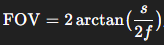 , where sss is sensor dimension (width/height/diagonal) and fff is focal length.
- Rectilinear FOV:
-
- IFOV (per pixel, radians): approximately
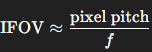 . Smaller pitch or longer fff reduces IFOV, increasing angular detail per pixel. (Engineers also estimate range using Johnson-style perceptual thresholds in pixels across the target.)
- IFOV (per pixel, radians): approximately
From these, a few truths follow:
-
Same lens, different pitch. If you keep the same focal length, 12 µm collects ~17/12 ≈ 1.42× more pixels per angle than 17 µm. That directly pushes detection/recognition/identification distances upward in planning models that scale with pixels on target.
-
Same FOV, different lens. If you demand the same FOV, a 12 µm sensor reaches it with a shorter focal length (roughly 0.71×), which usually means a smaller-diameter, lighter, cheaper LWIR lens for the same f-number. That’s a real BOM and payload win.
On the noise side, NETD (noise-equivalent temperature) is your practical yardstick for sensitivity. Typical uncooled imagers sit in the tens to hundreds of millikelvin range, and system NETD reflects detector physics, optics f/#, and processing. Smaller pixels can challenge SNR if all else is equal, but modern processes and optics often claw that back. Treat NETD as a measured system property, not a guess from pitch alone.
Finally, at LWIR wavelengths (~8–14 µm), diffraction matters. The diameter of the diffraction blur (Airy disk) in the image plane scales with 2.44 λN2.44\,\lambda N (where NN is f/#). At λ≈10 μm\lambda \approx 10\,\mu\text{m} and f/1.0, that central lobe is on the order of ~24 µm across—meaning a 12 µm pixel slightly oversamples a good f/1 lens, while 17 µm is closer to the diffraction footprint. This is one reason 12 µm can yield finer detail if the lens and mechanics support it.
Market reality: security vs. UAV
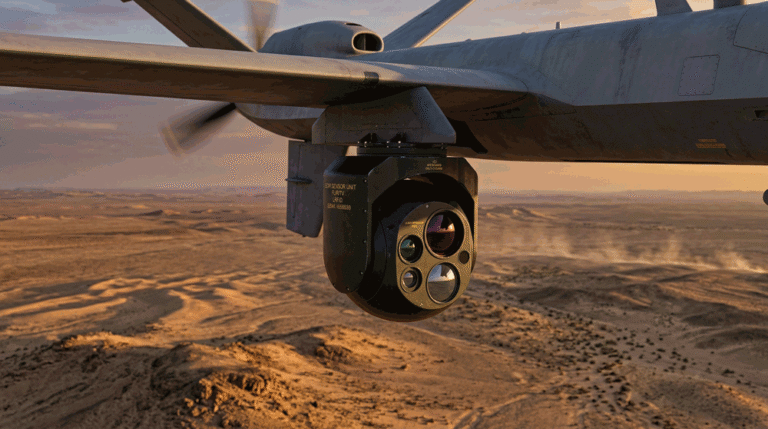
For ground security, camera placement is fixed and wind-shake is your enemy. The 12 µm route often lets you step down a focal length for the same FOV, cutting lens cost and mast load while keeping enough pixels on human-sized targets to meet your response thresholds. For UAV gimbals, weight and stability dominate. A 12 µm core can hold the same swath with a shorter, lighter lens, directly helping endurance and PID tuning. If you try to chase range with a heavy, long 17 µm lens on a small gimbal, you may give back the “spec win” as blur in real wind.
A practical comparison (same array size, 640-wide)
Below we compare what happens when you pick 12 µm vs. 17 µm for a 640-wide sensor, first holding focal length fixed (more pixels on target), then holding FOV fixed (smaller lens).
Case A — Hold focal length constant (e.g., 35 mm)
-
IFOV scales with pitch: IFOV12/IFOV17≈12/17\mathrm{IFOV}_{12} / \mathrm{IFOV}_{17} \approx 12/17.
-
Johnson planning (pixels across target) improves by ~1.42× for 12 µm, implying a similar gain in detection distance for a given target width when contrast and atmosphere cooperate.
Case B — Hold FOV constant (same horizontal FOV goal)
-
To match the 17 µm sensor’s FOV, the 12 µm option uses roughly 0.71× focal length; for f/1 optics, lens diameter scales with ff. Net: lighter/cheaper lens for the same view, with the same pixels across the scene (still 640).
Either way, smaller pitch gives you room to optimize: you can take the range boost (Case A) or the lens/BOM savings (Case B)—or split the difference for a balanced spec.
What about NETD and MRTD?
NETD captures how much temperature change equals the sensor’s noise floor; MRTD (minimum resolvable temperature difference) ties that sensitivity to spatial detail using a bar-target test and the system’s MTF. NETD numbers in the tens of millikelvin are typical for modern uncooled systems; MRTD curves show how that sensitivity translates across spatial frequencies. Put simply: lower NETD and stronger MTF make small, low-contrast targets easier to see at distance. Pixel pitch alone does not guarantee lower NETD, but 12 µm can still win on effective range when paired with good f/1 optics and clean processing.
Diffraction and “useful sampling” at LWIR
LWIR’s long wavelength makes diffraction a first-order constraint. Using the Airy expression, f/1.0 at 10 µm yields a ~24 µm central spot; at f/1.2 it’s ~29 µm. That means a 12 µm pixel oversamples the spot (≈2 pixels across the lobe), which helps interpolation, deconvolution, and EIS; 17 µm is closer to critical sampling. If your lens is not close to diffraction-limited, or mechanics blur detail, the extra sampling from 12 µm won’t fully convert to range—but when the optics are good, it does.
Cost and weight implications (the often-ignored win)
Germanium and coatings dominate lens cost. Because focal length and entrance pupil diameter scale together for the same f/#, a 12 µm system meeting the same FOV can step down focal length and front element size. That reduces lens cost, weight, and moment of inertia, easing PTZ stress on masts and extending flight time on drones. For integrators chasing ROI, this is typically the decisive advantage of 12 µm over 17 µm—even before you count the range boost of Case A.
A math-grounded mini-example
Say your mission demands ~18° HFOV on a 640-wide array and you care about human detection at 400–500 m.
-
With 17 µm, the sensor width is 640×17 μm=10.88 mm. The 18° HFOV needs f≈
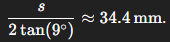 .
. -
With 12 µm, the width is 7.68 mm. For the same 18° HFOV, f≈24.3 mmf.
Both deliver the same angular sampling (because both are 640 px across 18°), but the 12 µm lens is ~10 mm shorter focal length—meaning a materially smaller, lighter, cheaper lens at f/1.0–f/1.2. If instead you keep 35 mm in both cases, the 12 µm build shrinks IFOV by ~29%, giving you ~1.4× more pixels on target for planning distances via Johnson criteria.
Engineering trade-offs you must acknowledge
-
Sensitivity (NETD) is a system metric. Don’t assume 12 µm is noisier; demand measured NETD at your frame rate and FPN correction scheme, then validate MRTD across spatial frequency to see what the operator will actually perceive.
-
Atmosphere eats contrast on long paths; humidity and aerosols can erase theoretical wins. Always sanity-check long-range claims against LWIR atmospheric windows and expected weather.
-
Stability protects “one-pixel truth.” Narrow-angle benefits at 12 µm evaporate if mounts resonate or gimbals are under-tuned.
-
Diffraction caps what optics can deliver at f/1. Faster glass won’t beat physics; ensure lens MTF is credible near your intended spatial frequencies.
Decision guide: when 12 µm wins, when 17 µm still makes sense
Choose 12 µm when your platform values either smaller lenses at the same FOV (weight/BOM savings) or more pixels on target with the same lens (range uplift). This is common in UAV gimbals, compact PTZ heads, and multi-payload builds where grams and torque matter.
Choose 17 µm when you are standardizing on legacy optics, prioritizing cost minimization across a fleet of fixed sites, or when your procurement channel already stocks robust 17 µm lens sets and the platform can absorb their size/weight. In noisy, low-contrast scenes with modest optical quality, the real-world gap can shrink; in those cases, logistics may trump small differences in theoretical range.
Integration notes (OEM/ODM)
Lock your choice into a BOM family so variants differ only in optics and focus mechanics. Expose the same SDK surfaces (AGC/NUC, palette set, encoder settings), and publish CAD/HW keep-outs that support both a shorter 12 µm lens and a longer 17 µm lens. For customers combining thermal with ranging, add time-sync and safety labeling early so FOV and pixel-on-target math stays aligned with the ranging reticle. For module-level builds, start from a configurable Thermal camera module, implement presets from our Thermal camera module integration, and align commercial terms via the OEM/ODM Partner Program. When you’re ready to compare lens trees and availability by quarter, contact us and we’ll simulate IFOV/DRI against your distances and platforms—before you cut POs.
FAQs
Does 12 µm always have better range?
With the same lens, yes in planning terms (smaller IFOV ≈ more pixels on target). With the same FOV, 12 µm primarily saves lens size/weight/cost rather than raw range. Real-world outcomes still depend on NETD, optics, and stability.
Is 17 µm less “noisy” by default?
Not necessarily. NETD depends on detector design, optics f/#, frame rate, and processing. Compare measured NETD and MRTD on the actual camera, not just the pitch.
Will I be diffraction-limited with 12 µm?
At LWIR and f/1.0–f/1.2, diffraction spots are ~24–29 µm across; 12 µm samples the spot well, 17 µm is nearer to critical sampling. If your lens and mechanics are solid, 12 µm can exploit that extra sampling.
Which pitch is better for UAVs?
Most small-UAS payloads benefit from 12 µm because it delivers the same FOV with a shorter, lighter lens. If you already own a stable, higher-torque gimbal and compatible 17 µm optics, 17 µm can still be perfectly viable.
Call to Action
Need a defensible, procurement-ready recommendation—not just brochure math? We’ll run FOV/IFOV/DRI simulations for your targets and ranges, price the lens trees that meet them, and return a short list you can actually source this quarter. Start with our configurable Thermal camera module, review implementation steps in Thermal camera module integration, align teams through the OEM/ODM Partner Program, and contact us to see 12 µm vs. 17 µm modeled on your platform.