A thermal imaging camera core ultimately lives within physics: range and certainty are bounded by optics, sampling, signal-to-noise, the atmosphere, and the human observer. “Detection, recognition, and identification” (D/R/I) are not marketing words but technical thresholds; plan with them and a thermal imager module or thermal camera module will meet mission goals with fewer surprises. Ignore them and you end up with long focal lengths that underperform in wind, humidity, or compression artifacts. This article explains what truly caps D/R/I—and how to write specs that survive the field.
Table of Contents
ToggleUnderstanding D/R/I on a thermal imaging camera core
Engineers use Johnson criteria to convert pixels into probabilities: how many line pairs across a target (or equivalently, pixels across its critical dimension) yield a 50% chance of a correct task outcome. Canonical thresholds are widely cited:
| Task | Johnson threshold (line pairs across target) |
|---|---|
| Detection (object present) | ~1.0 ± 0.25 |
| Orientation (pose) | ~1.4 ± 0.35 |
| Recognition (class) | ~4.0 ± 0.8 |
| Identification (specific) | ~6.4 ± 1.5 |
These were derived from observer studies and remain the common planning baseline for thermal systems.
Two geometry terms map camera choices to those thresholds:
-
- Field of view (FOV): the angular extent imaged by the lens and sensor.
-
- Instantaneous field of view (IFOV): angular size per pixel (≈ pixel pitch / focal length). IFOV ties a pixel to an angle in the scene and, with range, to a size on target.
With FOV/IFOV and a target width, you can predict how many pixels land on the target at a given range, then check which Johnson task is realistic—before you buy lenses or publish datasheets.
What really caps range: five hard limits
1) MTF (modulation transfer function) across the chain.
MTF describes how contrast at different spatial frequencies passes from scene → lens → sensor → display. Focus error, aberrations, aperture diffraction, windows, and mounts all reduce MTF, which lowers the effective pixels-on-target your observer can use. Even perfect sampling cannot recover contrast that optics fail to deliver.
2) Sampling (IFOV) and FOV.
For a fixed target width, smaller IFOV (more angular detail per pixel) increases pixels on target and pushes you toward recognition/ID at longer distances—until other limits intervene. Conversely, a wider FOV reduces pixels on target but improves coverage and search efficiency. The “right” spec is therefore a mission-dependent balance, not “as telephoto as possible.”
3) SNR/NETD and MRTD (what the operator actually sees).
Low NETD boosts faint contrast; MRTD folds contrast and spatial frequency into a single, perception-oriented curve using bar targets. At long range, you live on the left side of the MRTD curve; if NETD rises (sensor warms, lens slows, window soils), faint details vanish and your recognition/ID probabilities drop even when pixels-on-target math looked fine.
4) Atmosphere and path length.
IR contrast decays with humidity, aerosols, and hot backgrounds. The infrared atmospheric window (8–14 µm) is helpful but not magical; attenuation still follows Beer–Lambert behavior over long slant paths. Model the window, but sanity-check with field clips in your real weather.
5) Display and compression.
Even a great core can lose recognizability if the display/encoder crushes mid-tones or quantizes fine contrast. NIST’s studies on thermal imager display quality show task performance moves with image quality—an often underestimated factor in D/R/I.
Security vs UAV: same physics, different constraints
Fixed security. Masts and rooftops favor stability and repeatability. You can safely run moderate FOV on the “awareness” node and a longer lens on a “corridor” node to hit recognition at the site’s maximum approach distance. The wind, window cleanliness, and pan-tilt backlash are your practical enemies because they shave MTF just when you need it most.
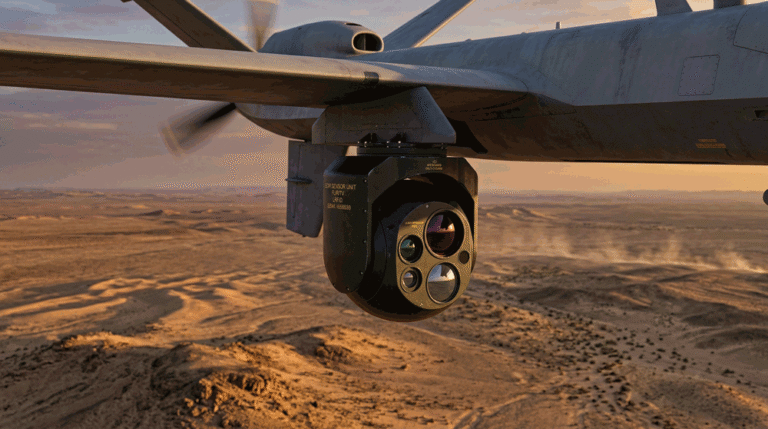
UAV gimbals. Altitude, motion, and operator workload favor FOVs that keep ground swath reasonable. Narrow HFOV magnifies every micro-tremor; if the gimbal isn’t rock-steady, you trade away the recognition/ID you hoped to gain. Many teams standardize a “search FOV” and use momentary hover-plus-zoom for clarification rather than flying narrow all the time.
How to spec D/R/I for a thermal imaging camera core
Start with geometry, add physics, then de-risk with human factors:
-
- Geometry: choose FOV and IFOV that put the Johnson threshold you care about at the distances that matter. Use target widths representative of your mission (human torso ~0.5 m; sedan width ~1.8–2.0 m).
-
- Optics & MTF: specify a lens and window stack that holds contrast near your key spatial frequencies; lock focus strategy (fixed hyperfocal vs motorized).
-
- SNR: require measured NETD at your operating frame rate and f/#; validate MRTD on the actual camera, not just the sensor.
-
- Atmosphere: treat Beer–Lambert attenuation as a planning tax; confirm with test flights or mast trials during worst-case humidity.
-
- Display/Codec: set minimum bitrates and tone-mapping rules so small contrasts survive to the operator. NIST shows that image quality shifts task performance; build that into acceptance.
Why “more pixels” is not always “more ID”
Johnson thresholds assume usable contrast. If MTF is poor (de-focus, vibrations, cheap window) or if SNR collapses (high NETD, slow optics), the system cannot present the needed line pairs with sufficient modulation; the observer will “see” mush. Think of sampling as the opportunity to achieve D/R/I—MTF and SNR are what cash the check.
Worked micro-example (recognition of a person at 300 m)
Suppose you run a 640-wide core and choose an HFOV that yields ~0.9 mrad/pixel IFOV. A 0.5 m torso then subtends ~0.5 m / 300 m ≈ 1.67 mrad, or ~1.86 pixels across the torso—good for detection only. If you want recognition (~4 lp ≈ ~8 px across), you need ~4× more pixels on target: either reduce IFOV (longer focal length or smaller pitch), shorten range, or accept lower certainty. That’s the trade space—no post-processing can conjure missing modulation at the required spatial frequency.
Engineering levers that actually move D/R/I
-
- Lens f/# and coatings: faster glass raises SNR; good AR coatings and clean windows preserve contrast. Past a point, diffraction and mass trade against each other; pick realistically.
-
- Focus discipline: hyperfocal for fixed sites; controlled motorized focus for altitude changes. MTF falls off brutally with slight de-focus.
-
- AGC/NUC policy: stabilize mid-tones where targets live; run non-uniformity correction at times that won’t erase moments, but often enough to prevent fixed-pattern noise from raising the effective NETD.
-
- Display/encoder: avoid aggressive compression on long standoffs; keep frame pacing steady so motion doesn’t smear edges the operator needs for recognition.
-
- Atmospheric pragmatism: in humid heat, lower your expectations or shorten ranges; the infrared window helps, but attenuation remains.
Writing buyer-proof specifications
When you draft a PRD or datasheet:
-
- State the Johnson task and target width at your headline range (e.g., “person recognition, 0.5 m, 350 m, 50% probability”).
-
- Disclose FOV and IFOV and how they were derived.
-
- Provide NETD at frame rate and f/#, and an MRTD curve for the camera.
-
- Define acceptance tests: stability/MTF check, display/codec settings (with a NIST-style image-quality sanity test), and an atmosphere note (“validated at 24 °C, 70% RH, light haze”).
This keeps engineering, sales, and customers aligned on what “detect,” “recognize,” and “identify” truly mean in your context.
Integration & OEM/ODM considerations
D/R/I should not drift between SKUs or platforms. Ship a thermal imaging camera core with the same presets and control surfaces across payloads so operators learn once:
-
- Offer day/night tone-curves and a limited palette set by default.
-
- Expose focus, AGC, and encoder settings in a consistent SDK across air and ground enclosures.
-
- Publish CAD keep-outs for lens/window stacks that protect MTF in wind and under cleaning.
To accelerate productization, start here:
-
- Build on a configurable Thermal camera module to lock FOV/IFOV families early.
-
- See practical implementation notes in Thermal camera module integration.
-
- If pairing a finder with ranging reticles for ID-level evidence, review Laser Rangefinder Modules for sync and overlay alignment.
-
- Align commercial terms via the OEM/ODM Partner Program, then run a field validation before mass commit.
(Each internal link appears once for clean pasting into your editor.)
Cost, compliance, and lifecycle ROI
Every dB of SNR or bit of MTF you protect upstream saves downstream costs: fewer nuisance alarms, fewer re-flights, faster reviews. Budget for lenses, coatings, stable mounts, and adequate bitrates instead of overspending on focal length alone. If regulations or evidence chains apply, write your D/R/I acceptance to those standards and capture display/encoder settings in the commissioning report. NIST’s work makes a simple point: operator task success tracks image quality—so make image quality part of your budget, not an afterthought.
FAQs
Does digital zoom change D/R/I?
No. Digital zoom crops the image; it doesn’t improve IFOV or MTF. Use it to frame, not to extend Johnson-class ranges.
Is MRTD more useful than NETD?
They complement each other. NETD is a scalar sensitivity figure; MRTD shows the temperature difference required to resolve detail at different spatial frequencies—the way operators experience performance.
How much does weather really matter?
A lot. Over humid, hazy paths, contrast attenuates (Beer–Lambert) even inside the infrared window; plan for seasonal range swings and validate at the worst month, not the best day.
If I hit the Johnson number, do I guarantee recognition?
No—Johnson gives ~50% probability under its test conditions. Real systems are limited by MTF, SNR, display choices, and motion. Treat it as a planning threshold, then field-verify.
Call to Action
Want D/R/I numbers you can defend in a design review—and confirm on a mast or airframe? We’ll model FOV/IFOV against your target set, fold in MTF and MRTD, and return a short list of lenses, windows, and encoder settings you can actually source this quarter. Start with our configurable Thermal camera module, review build details in Thermal camera module integration, align via the OEM/ODM Partner Program, and contact us to schedule a D/R/I planning session.