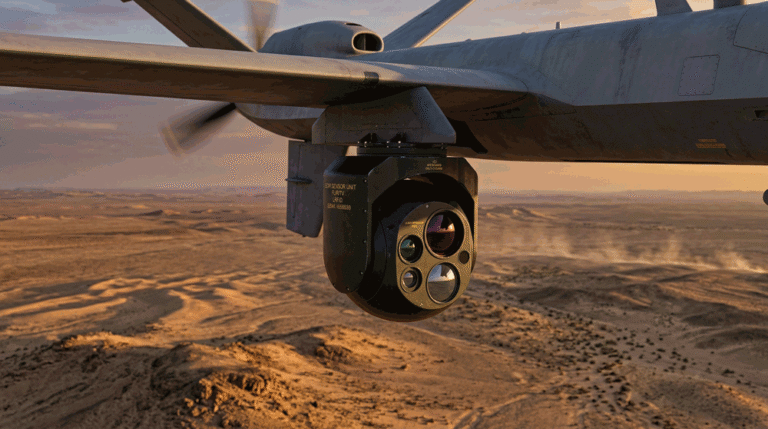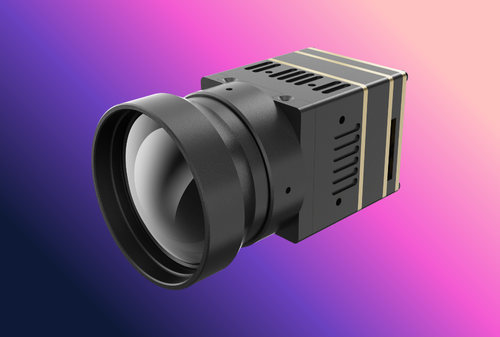
A thermal imaging camera core in a UAV payload succeeds or fails on its non-uniformity correction (NUC) strategy: shuttered (flat-field) vs shutterless (scene-based). The choice determines if you get uninterrupted video, stable NETD in changing air temperatures, minimal fixed-pattern noise (FPN), and a gimbal that doesn’t twitch every time the camera recalibrates. In this guide, we translate detector physics and algorithm literature into concrete integration steps for UAVs, show when each NUC approach wins, and propose acceptance criteria you can put in a PRD and defend in a design review.
Table of Contents
ToggleWhat NUC actually fixes—and why UAVs feel it more
Every uncooled microbolometer module ships with pixel-to-pixel variations in offset (DSNU) and gain (PRNU). Without correction, these appear as streaks or checkerboard textures that don’t move with the scene—fixed-pattern noise. NUC compensates those per-pixel differences so the live image looks uniform and small ΔT details are visible rather than buried in pattern noise. Uncooled arrays also drift with temperature; as the focal plane warms or cools during climb, hover, and descent, offsets and gains shift, so NUC must keep up to preserve NETD and image quality.
The UAV environment amplifies the problem. Unlike a mast camera with slowly varying temperatures, small airborne payloads see rapid FPA temperature swings, wind-driven convection, and abrupt view changes (sky/ground/sea). If your NUC approach can’t track those changes, faint target contrast collapses even if optics and resolution are adequate. A modern thermal imaging module or thermal imaging camera core therefore needs a NUC policy matched to aircraft dynamics, not just a lab metric.
Two families of NUC
Shuttered (flat-field) NUC briefly inserts an internal high-emissivity shutter in front of the detector. The core samples a “known uniform scene,” updates pixel offsets (and sometimes gains), then returns to live video. It is direct, robust, and conceptually simple; the tradeoff is a frozen/black frame and a tiny mechanical impulse as the shutter moves—both undesirable mid-flight.
Shutterless (scene-based) NUC estimates offsets/gains from the live video stream itself, using temporal statistics, motion registration, or single-image models. Done well, it maintains uniformity without a mechanical interruption; done poorly, it can produce “ghosting” or residual striping when the scene lacks diversity (e.g., blank sea/sky) or when motion compensation is imperfect.
Hybrid NUC uses shutterless most of the time and schedules conditional shutter events (e.g., after a temperature delta, at takeoff/landing, or on operator command) as a safety net. On UAVs, that’s often the practical sweet spot.
What the detector and noise literature says
NUC is correcting offset and gain non-uniformities that are stable in time but drift with temperature. In imaging terms: DSNU (dark-signal non-uniformity) and PRNU (photo-response non-uniformity). Flat-field/shutter events measure them directly; scene-based methods infer them by assuming the world moves while the pattern stays fixed. A wide literature explores these ideas—from two-point (lab) calibration and updates, to motion-registered temporal filters, to single-image estimators and newer learning-based approaches. The consensus: NUC is mandatory for staring FPAs; scene-based methods can markedly reduce shutter dependence but still benefit from occasional ground-truth resets.
UAV-specific pros and cons
Shuttered NUC — strengths for UAVs
- Predictable reset: quickly clamps DSNU drift after climbs or sun exposure.
- Radiometric trust: using an internal reference boosts confidence in temperature stability for analytics.
Shuttered NUC — UAV tradeoffs
- Freeze/black frame just when the pilot might need continuity; this is unacceptable in certain public-safety missions.
- Impulse/weight/power: the mechanism adds grams and a tiny torque step that control loops must absorb.
Shutterless NUC — strengths for UAVs
- Continuous video: no freezes; better operator situational awareness.
- No moving parts: lower mass, no wear-out mode, quieter signature.
Shutterless NUC — UAV cautions
- Scene dependence: uniform scenes (sky/sea/snowfields) can starve the algorithm of diversity, leading to residual striping or “ghosts.”
- Rapid thermal transients: FPA temperature jumps during ascent/descent can outpace lightweight estimators unless temperature is explicitly modeled.
How NUC interacts with NETD, MRTD, and “what the pilot actually sees”
NETD is your scalar sensitivity figure; MRTD curves show required ΔT vs spatial frequency—the lens and sampling’s “detail scale.” NUC errors raise the effective noise floor and depress mid-frequency contrast, which means low-contrast targets disappear earlier with range. Display quality and encoding then either preserve or crush what remains. In NIST’s user studies, task success moved with display image quality—your NUC gains can be squandered by poor tone mapping or compression. Treat NUC, NETD, optics MTF, and display/codec as a single system rather than isolated settings.
Engineering the three working modes
1) Shutter-dominant (with operator timing).
Use shuttered NUC at mission-defined times: just after take-off, post-climb when FPA temperature stabilizes, and during hover lulls. The UI announces a 0.3–1.0 s freeze window; the gimbal controller ignores the impulse (or the camera masks it). This suits evidence-grade missions where radiometric stability outweighs continuity—e.g., inspection or forensic capture.
2) Shutterless-dominant (with guardrails).
Run motion-registered scene-based NUC continually; gate it off if the field is too uniform or if tracking confidence drops, then prompt the operator (or auto-trigger) a quick shutter reset. Keep a thermal model of the FPA temperature and feed it into the estimator to chase drift. This is the common choice for search and overwatch.
3) Hybrid (recommended default).
Default to shutterless; allow event-based shutters when (a) ΔT of the FPA exceeds a threshold, (b) estimator confidence is low for N seconds, (c) operator taps “Calibrate now,” or (d) the aircraft is landed or stationary. This minimizes freezes while protecting against slow bias buildup. The literature supports these hybrids: shutterless algorithms (motion-registered, PCA, temperature-aware) perform well between flat-field references, but long drift periods still benefit from a periodic anchor.
Flight-phase playbook (so pilots aren’t surprised)
- Pre-flight / warm-up (on the ground): perform a shuttered NUC and log the FPA temperature as a baseline.
- Take-off to climb: suspend shutter events; run shutterless NUC with conservative gains because rapid ΔT and large sky fractions can mislead estimators.
- Cruise / search: enable shutterless fully; allow an operator “Manual Calibrate” if faint striping appears.
- Hover / confirm: optionally allow a brief shutter event before recording evidence clips; otherwise hold shutterless if continuity is paramount.
- Descent / landing: trigger a shutter event near ground when safe or schedule it automatically after touchdown.
This rhythm gives the operator continuity during dynamic phases and a reset option before critical evidence capture.
UI and SDK details that make (or break) adoption
- Confidence meter: expose an on-screen bar (or small icon) that turns amber when scene diversity is low for too long; offer a soft “Calibrate now.”
- Freeze-time budget: if shutters are allowed, display a countdown (e.g., “Calibrating 0.5 s”) and buffer video so the flight UI remains responsive.
- Logging: record each NUC event (type, ΔT since last, confidence state) with GPS time; this matters for reproducibility and service.
- Policies: ship two profiles—Search (shutterless-dominant, no auto shutters aloft) and Overwatch (hybrid with low-frequency shutters allowed in hover).
- APIs: in your thermal imaging camera core SDK, keep one stable surface for:
nuc_mode,nuc_trigger(),fpa_temp,scene_diversity, and a stream of per-pixel gain/offset versions so analytics can tag anomalies to NUC states.
Mechanics, optics, and stabilization—why gimbals matter
A shutter is a small moving mass. Even well-balanced mechanisms inject a transient torque the control loop must absorb. If your gimbal is lightly damped or near saturation (tiny drones, high wind), the step can ring and erode MTF during the second or two following the event. On the optics side, window contamination and small de-focus cut mid-frequency MTF—the very band that carries recognition and ID details. If you adopt shutterless, motion registration assumes the scene moves while FPN stays put; that assumption fails if the image is blurred or vibrating. In practice: stability ≈ NUC headroom.
Choosing the algorithms
The shutterless family includes:
- Temporal high-pass / constant-statistics estimators with image registration to separate motion from pattern (classic and fast).
- Kalman-style estimators that track pixel offsets as slowly varying states.
- Single-image models (e.g., temperature-aware or PCA-based) that infer offsets without long histories—useful for slow motion or uniform scenes.
- Learning-based single-image approaches that denoise and correct non-uniformity jointly (use with care for explainability and latency).
Peer-reviewed work shows that registration-aided temporal estimators reduce ghosting and drift; single-image and temperature-aware models help when motion is limited. A pragmatic stack is temporal+registration as the default, falling back to single-image or temperature-aware estimators when scene diversity is low, with the shutter as the ultimate reset.
Radiometry vs “pretty pictures”
UAV teams often conflate “uniform video” with “accurate temperature.” A shutterless stream can look clean but drift radiometrically during long hot flights if it never references a true flat field. If your mission needs radiometric accuracy (inspection, hotspot trending), you either (a) allow occasional shutters, (b) build an auxiliary reference (e.g., internal warm/cold plates or an external quick-flip reference tile), or (c) accept that the output is “qualitative thermal” with guardrails. This is why many radiometric payloads remain hybrid even when continuity is important.
Acceptance tests you can put in a PRD
For each NUC mode you plan to ship, define measurable limits:
- Freeze time (if shuttered): ≤ 1.0 s; no more than once per X minutes in Search profile.
- Residual FPN: quantify striping amplitude in a uniform-scene test; set a max RMS in counts or mK.
- Drift after ΔT: warm/cool the camera by Y °C; verify that radiometric error stays within ±Z mK (with shutters allowed) or within a looser band for shutterless.
- Scene diversity failure: simulate sky/sea; verify the confidence meter flips amber and the API exposes
scene_diversity < thresholdwithin N seconds. - Recovery time: after a shutter, MTF and stability recover within Q seconds (measured on a bar target).
- Display/encoder: tie minimum bitrate and tone-mapping to NIST-style recognition tasks so compression doesn’t undo NUC’s gains.
These items make procurement concrete and prevent “it looked fine in the lab” surprises.
Cost, power, and reliability—what changes with your choice
- BOM & mass: shutters add grams, parts, and assembly steps; shutterless can trim weight and remove a wear-out mode.
- Power: small savings with shutterless; more importantly, fewer current spikes.
- Maintenance: shutters can require requalification after long hours or rough handling; shutterless puts more burden on software validation and field telemetry.
- Analytics: stable NUC (either way) reduces false positives in long-range analytics; residual striping and drift are common failure triggers.
A careful TCO analysis often favors hybrid: you get continuity most of the time and the radiometric anchor when you need it.
Comparing the strategies (UAV focus)
| Dimension | Shuttered NUC | Shutterless NUC | Hybrid (recommended) |
|---|---|---|---|
| Video continuity | Brief freeze/black frame | Continuous | Continuous with rare planned freeze |
| Radiometric stability | Strong (direct reference) | Dependent on model/scene | Strong when shutters scheduled |
| Gimbal impact | Small impulse to absorb | None | Rare impulse (timed) |
| Uniform scenes (sky/sea) | N/A | Can degrade (ghosting/striping) | Fallback to shutter when needed |
| Power/weight | Higher | Lower | Mid |
| Operator workload | Predictable pauses | No pauses, but monitor uniformity | Minimal with good UI |
Mini case studies
Public-safety search & rescue (multirotor)
Continuity beats everything during search. Teams run shutterless-dominant with motion-registered estimators and a temperature-aware model. The UI shows a small confidence indicator; pilots tap Calibrate only when hovering to confirm a target or when the indicator stays amber. Acceptance: no more than one 0.5–0.8 s freeze per 20 minutes aloft; striping below a specified RMS.
Powerline inspection (VTOL fixed-wing + short hover)
Radiometry matters for trending. The payload uses hybrid: shutter on the ramp, shutterless in cruise, and a short shutter at preplanned hover holds. NETD is measured at mission frame rate; drift after ±10 °C FPA delta must be within ±(specified) mK. The PRD ties encoder bitrate and tone-curve to preserve small ΔT anomalies.
Coastal overwatch (windy, uniform horizons)
Uniform sky/sea scenes can defeat naive shutterless methods. The team adds a single-image NUC fallback and schedules a low-frequency shutter during long loiters. Gimbal damping is upgraded so the calibration impulse doesn’t ring. Operators report fewer “ghost” artifacts and more trustworthy long-range clips.
Implementation steps you can ship this quarter
- Pick your default policy: Search (shutterless-dominant) and Overwatch (hybrid).
- Expose one clean SDK on the thermal imaging camera core for NUC control + telemetry (
nuc_mode,nuc_trigger(),fpa_temp,scene_diversity,confidence). - Integrate motion registration in shutterless mode; whitelist frames with low blur / good parallax and down-weight those that don’t move.
- Model the FPA temperature explicitly; couple estimator weights to ΔT/Δt so drift is tracked rather than accumulated.
- Instrument the UI: freeze countdown (if shuttered), amber confidence indicator, manual calibrate button.
- Write acceptance tests before flight: freeze time, residual FPN, ΔT drift, recovery time, and display/encoder quality using a NIST-style task. nvlpubs.nist.gov
Integration & OEM/ODM: keep behavior consistent across airframes
Standardize your software and mechanical “surfaces” so pilots don’t relearn behaviors when swapping payloads:
- Publish one SDK for gain/offset tables, NUC modes, palettes, encoder presets, and focus control; honor it across payload families.
- Maintain common optical keep-outs so changing lens FOVs doesn’t force housing re-spins (which could alter thermal behavior and invalidate your NUC tuning).
- Version-control NUC tables, estimator settings, and tone-curve LUTs; they are spec-critical artifacts, not app preferences.
When you want to accelerate productization, start from a configurable Thermal camera module, see engineering steps in Thermal camera module integration, align commercial terms via the OEM/ODM Partner Program, and for mixed thermal + ranging overlays, review Laser Rangefinder Modules. To turn this into a spec with numbers and tests, contact us and we’ll map NUC policy to your airframe, weather, and operator SOPs.
FAQs
Does shutterless NUC always remove striping?
No. It works best when there’s sufficient motion and scene diversity, and when registration is reliable. Uniform sky/sea and heavy blur can leave residual FPN; a periodic shutter or a single-image fallback helps.
Will shutter events disturb my gimbal?
There’s a small impulse, but good controllers ignore it. If your gimbal is lightly damped or saturated by wind, schedule shutters during hover or on the ground.
Is shutterless radiometrically accurate?
It can hold relative uniformity, but absolute accuracy drifts without a reference. If radiometry matters (inspection), use hybrid policies or auxiliary references.
What one metric predicts pilot confidence?
Continuity plus legible mid-tones. That means shutterless or hybrid NUC, stable tone-mapping, and adequate bitrate; NIST showed display image quality changes task performance.
Call to Action
Need a UAV-ready NUC policy you can defend to pilots and procurement? We’ll model FPA temperature dynamics, select shutterless estimators and triggers, and convert it into a PRD with freeze-time limits, ΔT drift specs, and acceptance tests. Start with our configurable Thermal camera module, review build steps in Thermal camera module integration, align through the OEM/ODM Partner Program, and contact us to schedule a UAV NUC workshop.