A thermal rifle scope can transform a new hunting brand from “just another optics label” into a serious technology player—but it can also generate returns, warranty costs, and bad reviews if the OEM project is rushed. For brand owners and distributors, the real challenge is not finding a factory that can print your logo; it is writing a brief, reading spec sheets, and defining tests so the final thermal scope works on real rifles, in real fields, at night.
Table of Contents
ToggleThis article gives a structured thermal scope OEM buyer’s guide for new hunting brands. We will explain the core technology in plain language, show where thermal scopes actually earn ROI, walk through the key specifications, and outline how to manage OEM/ODM partners, costs, and lifecycle risk.
Understanding the Core Concept
What a Thermal Scope Really Is
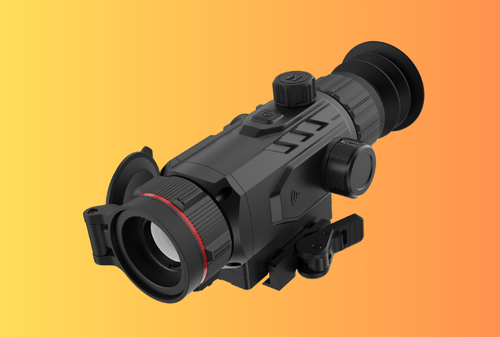
A modern thermal scope is a riflescope that forms an image from long-wave infrared (LWIR) radiation, typically in the 7–14 μm band, instead of visible light. All objects above absolute zero emit infrared energy; the hotter they are (and the higher their emissivity), the stronger that radiation. A thermal scope detects those subtle temperature differences and displays them as a visible image, often with white-hot, black-hot, or colored palettes.
At the heart of almost every hunting thermal scope is an uncooled microbolometer focal plane array. Each pixel is a tiny thermal detector that changes electrical resistance as incoming IR energy warms it. Electronics measure those resistance changes and reconstruct a temperature map that becomes the scope’s image. Microbolometers operate at or near room temperature, so they are compact and robust compared to older cooled detectors.
Inside the housing, the stack usually looks like this:
-
IR objective lens in germanium or chalcogenide glass, designed for LWIR, defining FOV and base magnification.
-
Microbolometer sensor (for example 256×192, 384×288, or 640×512 at 12 µm pitch).
-
Readout and processing electronics that amplify, digitize, and correct the raw signal.
-
Calibration (NUC) algorithms to remove pixel-to-pixel non-uniformity as temperatures drift.
-
Image processing pipeline for gain, noise filtering, sharpening, and color palettes.
-
Display module (usually an OLED microdisplay) plus eyepiece optics.
-
Mechanical chassis and mount to survive recoil and weather.
-
Firmware and UI for reticles, zeroing, recording, Wi-Fi, and power management.
For a B2B buyer, the important insight is that perceived quality comes from the system, not one hero spec. Resolution, NETD, optics, mechanics, and software all contribute to what the hunter actually sees and feels.
Real-World B2B Use Cases
New hunting brands typically target one or more of these thermal scope applications:
-
Night predator and hog hunting on private land.
-
Guided hunts and outfitters needing standardized gear for clients.
-
Professional pest control on farms and industrial sites.
-
Security and law-enforcement cross-over in some markets.
Each use case pushes different design choices:
-
Short-range hog hunters care about fast scanning and simple controls at 50–150 m.
-
Predator hunters on open ground care about recognition at 200–300 m and stable magnification.
-
Professionals care about uptime, warranty, and fleet training, not just image samples.
Your thermal scope OEM brief should start by stating which of these roles you want to win, because that drives everything from FOV to battery type.
Market Relevance and Applications
Key Segments for Thermal Scope Brands
You can think of the thermal scope market as three concentric circles:
-
Entry-level hunting buyers
-
Upgrade from traditional scopes or simple digital night-vision.
-
Price sensitive, often buying their first thermal scope.
-
Expect plug-and-play use and “wow factor” images.
-
-
Committed night hunters
-
Regularly hunt predators or hogs at night.
-
Will pay more for better image quality, reliable zero, and long battery life.
-
Talk to each other; a good product here builds reputation quickly.
-
-
Professional and institutional buyers
-
Outfitters, pest-control contractors, some law-enforcement units.
-
High hours of use, demanding environmental conditions.
-
Focused on uptime, support, and standardized UI across a fleet.
-
A new hunting brand does not need to capture all three. In fact, trying to do so with a single thermal scope is a common failure mode. It is usually better to:
-
Launch one hero model targeted at a clear, constrained use case.
-
Add a second model (cheaper or more premium) once feedback and sales data are available.
Where Thermal Scopes Deliver ROI
From a B2B perspective, a thermal scope line pays off when it:
-
Expands your ASP (average selling price) compared to traditional scopes.
-
Generates higher margin per unit than commodity day optics.
-
Drives pull-through for accessories, mounts, batteries, and cases.
-
Produces repeat sales as satisfied hunters buy additional scopes or upgrade.
For ground truth, talk to dealers about:
-
How many thermal scopes they sell per month.
-
What price bands move fastest.
-
What complaints and returns they see.
Then design your OEM brief to land in the “sweet spot” of your channel, instead of purely chasing the highest headline resolution.
Technical Insights and Key Specifications
In spec sheets, long feature lists can be distracting. In practice, most OEM buyers should focus on four technical pillars:
-
Sensor and optics (resolution, pixel pitch, FOV, magnification).
-
Sensitivity and frame rate (NETD, refresh).
-
Image processing and calibration (NUC, palettes, sharpening).
-
Mechanics and environmental robustness (recoil, IP rating, temperature).
H3: Sensor Resolution, Pixel Pitch, and FOV
Resolution. Hunting scopes commonly use:
-
256×192 – entry level and ultra-compact.
-
384×288 – mid-range, good balance of cost and detail.
-
640×512 – premium, especially for longer-range shots.
More pixels mean more potential detail—but only if optics, mechanics, and encoder preserve it.
Pixel pitch. Microbolometer pixels are typically 12 µm or 17 µm. Smaller pitch lets you:
-
Use a shorter focal length lens for the same FOV (lighter, more compact).
-
Place more pixels across a target at the same distance with the same lens.
FOV and base magnification. FOV is the angular width of the scene; hunters experience it as base magnification.
-
Wide HFOV (18–25°) ≈ low base mag (1.5–2×): ideal for woodland and short-range hog hunting.
-
Narrow HFOV (8–12°) ≈ higher base mag (3–4×): better for open fields and longer ranges.
When you brief your OEM partner, specify:
-
Target engagement distances (e.g., 50–150 m; 100–250 m; 200–400 m).
-
Desired base magnification ranges.
-
Acceptable FOV in degrees at those magnifications.
Then ask the factory to propose sensor + lens combinations that hit those numbers while staying within your weight and cost limits.
Example configuration table
| Tier | Sensor | Pixel pitch | Lens | HFOV (approx.) | Base mag | Typical use |
|---|---|---|---|---|---|---|
| Starter | 256×192 | 12 µm | 19 mm | 9–10° | ~2× | Entry-level hog hunting to 150 m |
| Hunter | 384×288 | 12 µm | 25 mm | 10–12° | ~2.5× | Predator & hog hunting to 250 m |
| Pro | 640×512 | 12 µm | 35–50 mm | 12–8° | ~3–4× | Longer-range predators to 400 m |
Use a table like this in your internal specification document; it helps align sales, product, and engineering.
H3: NETD, Frame Rate, and Perceived Sensitivity
NETD (Noise-Equivalent Temperature Difference) is the standard figure of merit for thermal sensitivity. It represents the smallest temperature difference that produces a signal equal to the system noise; lower values (in mK) mean better ability to distinguish subtle thermal contrast.
Key OEM guidelines:
-
Ask for system NETD, not just detector NETD. System NETD includes optics and electronics.
-
Require the NETD to be quoted with measurement conditions:
-
Frame rate (e.g., 25 or 50 Hz)
-
Lens f-number (typically f/1.0 or f/1.2)
-
Ambient or FPA temperature
-
Better sensitivity helps with small animals, partially obscured game, and hot nights where contrast is lower. But beyond a certain point, gains are marginal if optics, FOV, and encoder are not tuned.
Frame rate. Most hunting thermal scopes run at 25–50 Hz. Higher frame rates:
-
Make panning and tracking smoother.
-
Reduce subject “smearing” on running animals.
However, some export markets restrict thermal devices to ≤9 Hz. Ensure your OEM partner can supply both high-frame and export-compliant configurations if needed.
H3: Image Processing, NUC, and UI Choices
Raw microbolometer data looks ugly without calibration and processing. Here is what you should understand at a high level.
NUC (Non-Uniformity Correction). Even after factory calibration, each pixel responds slightly differently as the FPA warms or cools. NUC algorithms correct those differences so the image looks flat and consistent.
-
Shuttered NUC uses a mechanical shutter to show a reference frame. It is robust but causes a brief image freeze.
-
Shutterless NUC estimates corrections from the live scene. It avoids freezes but relies on scene diversity.
For hunting scopes, a hybrid approach is often best: shutterless corrections continuously, with a short shuttered NUC at power-on and on user request.
In your brief, specify:
-
Maximum acceptable freeze time (e.g., ≤1 s).
-
How often automatic NUCs may occur.
-
Whether a manual “Calibrate” button is required.
Palettes and sharpening. Hunters have strong preferences.
-
White-hot and black-hot cover 80% of real use.
-
One or two high-contrast or “highlight hot” palettes are useful for detection.
-
Excessive sharpening creates halos and eye fatigue.
Keep the palette list short and assign each to a single button or quick menu. Ask your OEM to provide side-by-side clips showing unprocessed, standard, and sharpened images so you can calibrate your expectations.
Integration and OEM/ODM Considerations
Launching a thermal scope line is not just about choosing the right specs; it is about integrating those specs into a product you can sell, service, and support.
Firmware, UI, and SDK
As a brand owner, you may not expose an SDK to customers, but firmware still defines your product.
Clarify with your OEM:
-
Which functions have dedicated hardware buttons (power, zoom, palette, record).
-
How the zeroing workflow works (freeze frame, X/Y move, profile storage).
-
How many rifle profiles can be stored and whether they can be named.
-
Boot logos, menu language, and whether firmware can be white-labelled with your branding.
If you plan to integrate scopes into a broader digital platform later (for example, an app or cloud service), ask about:
-
Basic control protocols over USB, UART, or Wi-Fi.
-
Whether there is an internal API that can be documented later.
Interfaces and External Devices
Most hunting thermal scopes today expose:
-
Video output via internal recording, HDMI/USB, or Wi-Fi streaming.
-
Storage with microSD cards.
-
Control via onboard buttons and, sometimes, a mobile app.
Decide early whether your brand needs:
-
On-board recording only, or also live streaming to an app.
-
Integration with rangefinders or external ballistics (for example, pairing with a laser rangefinder module).
If you plan for rangefinder integration, reference it explicitly in the brief and note that you intend to build around your existing Laser Rangefinder Modules.
Compliance and Safety
A thermal scope is not a laser product, but it is still an electronic device that may need to comply with:
-
CE and FCC for EMC and radio.
-
RoHS/REACH for material restrictions in the EU.
-
National or regional rules for dual-use/export-controlled equipment in higher resolutions or frame rates.
Your OEM partner should provide test reports or certificates. Check that:
-
Model names on test reports match your planned SKUs.
-
Regional variants (for example 9 Hz export versions) are clearly identified.
Cost, Compliance, and Lifecycle ROI
CAPEX vs Field Performance
The ex-factory price of a thermal scope is only one part of your business equation. The full ROI includes:
-
Gross margin after dealer discounts.
-
Expected warranty and return rate.
-
Reputation impact on your broader optics line.
In many cases, a scope that costs slightly more but offers:
-
Better mechanical reliability,
-
Clearer UI, and
-
More realistic specifications
will generate more net profit than the cheapest option. A single widely-shared failure video can cost more than the savings from a cheaper core.
Typical MOQ and Lead Time Patterns
Thermal OEM projects often follow this pattern:
-
Engineering samples (5–20 units) – used for internal evaluation and marketing materials.
-
Pilot batch (50–200 units) – first saleable units; used to confirm field performance and channel response.
-
Volume orders – often in the hundreds per batch.
Lead times vary, but a realistic plan is:
-
3–5 months from brief to stable sample.
-
1–2 months from PO to first pilot batch.
-
2–3 months for standard volume production (depending on sensor supply).
Clarify early how the factory prioritizes your orders relative to larger brands.
Long-Term Maintenance and Hidden Costs
Thermal scopes age in specific ways:
-
Displays can dim or show burn-in.
-
Button contacts and seals wear.
-
Firmware bugs appear in rare use cases.
You can limit lifecycle cost by:
-
Agreeing a spare parts and RMA policy in advance.
-
Keeping mounts and accessories compatible across models.
-
Planning at least one firmware maintenance release per year.
Buyer insights (summary bullets)
-
Do not chase the lowest BOM; prioritize the configuration that survives real hunts.
-
Spend on optics, mechanics, and encoder quality before chasing ultra-low NETD.
-
Make sure acceptance tests are written and signed before tooling.
-
Treat firmware and the mobile app as part of your brand, not an afterthought.
-
Use a two-tier line (starter + pro) to cover most hunters without diluting focus.
Partnering and Next Steps
A successful thermal scope program usually starts from mature modules and grows into branded scopes, not the other way around.
As you plan:
-
Review sensing platforms and optics options in your Thermal camera module portfolio to understand what cores and lenses can be reused.
-
Explore mounting, housing, and firmware integration methods collected in Thermal camera module integration.
-
For combo products that mix aiming and ranging, align specifications with your existing Laser Rangefinder Modules.
-
Structure cooperation, roadmap sharing, and private-label rights through an OEM/ODM Partner Program.
-
When you are ready to move from concept to prototype, contact us to schedule a workshop where we map your hunting scenarios into FOV, NETD, and mechanical requirements for a thermal scope line you can defend in the field and in the boardroom.
Use each of these internal links once in your blog editor so search engines see a clean, meaningful internal linking structure.
FAQs — Thermal Scope OEM for Hunting Brands
Q1: Should my first thermal scope be 640×512?
Not always. If most customers shoot inside 200 m, a well-designed 384×288 thermal scope with the right FOV, good optics, and solid mechanics can give a better value story than a heavier, more expensive 640 model that your channel cannot price competitively.
Q2: How important is NETD compared to resolution?
NETD tells you how small a temperature difference the system can see, while resolution and FOV decide how many pixels cover the animal at range. Aim for a balanced combination: reasonable NETD (for example ≤40–50 mK at your frame rate and f/#), plus optics and magnification that match real hunting distances.
Q3: Do hunters need radiometric (temperature-measuring) scopes?
For pure hunting, radiometric output is rarely necessary. It adds cost and complexity but does not usually change shot decisions. Radiometric features make more sense in inspection cameras than in hunting scopes.
Q4: What is the biggest mistake new brands make in thermal scope OEM projects?
The largest single mistake is trusting PDFs instead of field tests—selecting scopes based only on resolution, NETD, and price without night shooting at real distances on local game. Always test engineering samples on real rifles, in representative weather, before committing to volume orders.
Call to Action
If you are planning a new **thermal scope** line and want it built on proven cores instead of guesswork, we can help you translate hunting distances and price targets into a realistic OEM roadmap. Start by reviewing our core platforms in Thermal camera module, dig into engineering details in Thermal camera module integration, align commercial terms and roadmap via the OEM/ODM Partner Program, and then contact us to plan your first branded thermal scope family with specs, tests, and margins your dealers will trust.