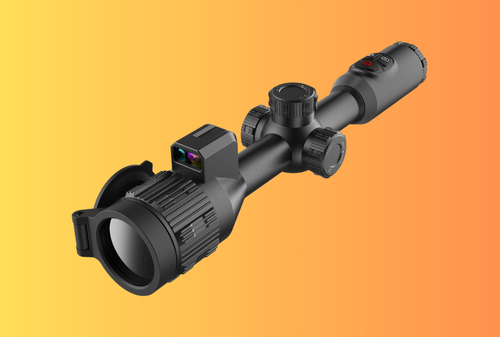
For a serious shooter, a thermal rifle scope is not a toy or a gadget—it is a primary sighting system that must hold zero, stay clear, and stay alive through recoil, rain, cold nights, and thousands of hours of carry. If it fails, the customer does not blame the OEM core; they blame your brand.
Table of Contents
ToggleThis article unpacks what actually makes a thermal rifle scope “durable” from an engineering and business point of view: mechanical design, environmental sealing, sensor stability, power system, and the test standards that prove it. The goal is to help brand owners, distributors, and OEM/ODM teams specify scopes that survive real field abuse, not just the photo studio.
Understanding the Core Concept
What durability means for a thermal rifle scope
Durability for a thermal rifle scope is more than “feels solid in the hand.” In B2B terms, a durable scope must:
- Maintain point-of-aim / point-of-impact through repeated recoil and handling.
- Deliver stable image quality as the sensor and optics heat and cool.
- Resist ingress of dust and water in typical hunting and duty environments.
- Survive temperature swings and condensation without fogging or electronic failure.
- Recover gracefully from power and software faults without bricking in the field.
Institutions such as the U.S. National Institute of Standards and Technology (NIST) treat thermal imagers as systems to be evaluated on multiple performance metrics—field of view, spatial resolution, non-uniformity, effective temperature range, and thermal sensitivity—under controlled conditions that approximate realistic use. A durable scope must keep those metrics within acceptable limits while being slammed by recoil and drenched in bad weather.
How a thermal rifle scope is built
Internally, a thermal scope shares much with other thermal imagers:
- LWIR objective lens – germanium or chalcogenide, optimized for 7–14 μm radiation.
- Microbolometer focal plane array – an uncooled detector whose pixels change resistance as they absorb infrared energy; electronics read those changes to form a temperature map.
- Readout and processing electronics – amplify and digitize the signal, apply non-uniformity correction (NUC), adjust gain and contrast, and manage thermal sensitivity (often specified as NETD).
- Microdisplay + eyepiece – present the processed image through a telescopic ocular design.
- Mechanical chassis and mount – hold everything in alignment and transmit recoil forces without zero shift.
- Firmware and user interface – reticles, zeroing routine, NUC policy, recording, and connectivity.
When any part of this stack is under-engineered, durability suffers: lens carriers shift, solder joints crack, connectors corrode, or firmware locks up under power glitches.
Market Relevance and Applications
Who actually needs a durable thermal rifle scope?
Not every buyer is a high-round-count shooter. But the ones who are will define your reputation:
- Predator and hog specialists firing hundreds of rounds per season from .223 to .308 or 6.5 rifles, often off vehicles.
- Professional pest-control and wildlife managers operating several nights per week, in all weather.
- Ranch security, law enforcement, and tactical users who treat thermal optics like duty equipment, not consumer electronics.
- Training facilities and ranges loaning scopes to many shooters, with frequent drops and impacts.
For these users, a failure is not a minor annoyance; it can cost time, livestock, or a call-out. That is why heavy-duty optics markets often reference military environmental standards such as MIL-STD-810, which defines laboratory shock and vibration tests that simulate real-world abuse.
Business impact: why durability pays back
From a B2B view, durability:
- Reduces warranty cost and returns. Fewer failures per 1 000 units shipped.
- Stabilizes dealer relationships. Dealers spend less time handling complaints and more time demoing.
- Supports premium positioning. A rugged thermal rifle scope can justify higher ASP and longer refresh cycles.
- Improves residual value. Used units that still perform well keep your logo respected in secondary markets.
Durability is, in other words, an ROI lever: you pay more upfront in design and testing, but you save it many times over in reputation and service.
Technical Insights and Key Specifications
Mechanical robustness and recoil management
The first job of a thermal rifle scope under recoil is to stay aligned. Recoil produces brief, high-g acceleration pulses; MIL-STD-810 Method 516 describes shock tests designed to determine whether equipment can physically and functionally withstand such shocks without damage like cracked joints, fractured materials, or connection failures.
For a thermal scope, that translates to:
- Stiff, one-piece main tube or chassis (often aluminum alloy) that carries the load between mount interfaces and optics.
- Recoil lugs and clamp geometry that prevent creeping on the rail.
- Isolated PCB and display mounts that decouple sensitive electronics from peak shock.
- Lens cells with proper pre-load so glass does not shift or chatter between shots.
When you draft specifications:
- Define the caliber class and test protocol—for example, survival of several hundred to a thousand shots of .308-equivalent recoil without more than X MOA zero shift.
- Ask your OEM how they simulate shock: some use weapon-shock simulators built specifically to reproduce live-fire pulses in a lab setting.
In design reviews, look for finite element analysis (FEA) or empirical data on which components are most stressed under shock; in production, insist on at least sample-based recoil certification per batch.
Environmental sealing and temperature resilience
Durability is not just about recoil; it is also about weather and condensation.
Ingress protection is commonly expressed via the IP rating system standardized in IEC 60529. An IP67 device, for example, is considered dust-tight and protected against temporary immersion in up to 1 m of water for a defined time; IP65/IP66 refer to resistance to water jets and spray.
For a thermal rifle scope, realistic targets might be:
- IP66 or IP67 for hunting and duty scopes that will see heavy rain, snow, and occasional drops into puddles or wet grass.
- Operating temperature range around −20 °C to +50 °C, aligned with typical outdoor standards for electronics.
- Protection against condensation—purged and sealed tubes, appropriate desiccants, and tested thermal cycling.
In your spec and acceptance tests:
- Refer explicitly to IEC 60529 for IP ratings, and request test reports or certificates from qualified labs.
- Include a simple field test: scopes should not fog internally when moved from a warm vehicle to cold outside air.
- Ask how O-rings, lens seals, and connector gaskets are validated over time, not just at the first assembly.
Sensor and image durability over time
Mechanical and environmental survivability mean nothing if the image degrades quickly.
NIST evaluations of thermal imagers for fire service use treat them as black boxes and grade them on field of view, non-uniformity, spatial resolution, effective temperature range, and thermal sensitivity (TS, similar to NETD), all measured after temperature cycling and other stresses.
For a thermal rifle scope, image durability depends on:
- Microbolometer packaging – vacuum integrity and mechanical stability of the detector package under repeated heating/cooling.
- Optics alignment – retention of focus and collimation as the unit “breathes” over temperature.
- NUC strategy – whether non-uniformity correction tables remain valid over time and temperature, and how often they must be refreshed.
Practical steps for OEM buyers:
- Request data on thermal sensitivity/NETD before and after temperature cycling across the operating range.
- Ask how frequently shutter-based NUC occurs and what the freeze time is; ensure it is acceptable for your use case.
- Include in the acceptance plan a flat-field test (e.g., imaging a uniform warm surface) to measure residual non-uniformity and banding after environmental stress, similar in spirit to fire-service camera evaluations.
A durable image is one that keeps effective thermal sensitivity and uniformity within tight bounds even after seasons of use.
Power system, controls, and human factors
Many field failures blamed on “electronics” are actually power and interface problems:
- Battery contacts that lose tension after repeated swaps.
- Connectors that wick moisture and corrode.
- Buttons that fail from dirt ingress or mechanical wear.
Serious shooters will swap batteries in the dark, sometimes with gloved hands. Design for:
- Robust battery compartments with positive latching and clear polarity marking.
- Gold-plated or otherwise corrosion-resistant contacts and springs sized to maintain pressure over thousands of cycles.
- Large, tactile buttons with internal sealing and tested actuation life.
From a firmware point of view, durability means:
- The scope can handle brown-outs or quick power cycling without corrupting calibration or bricking.
- There is a safe, documented method to update firmware and recover from failed updates.
In your OEM agreement, explicitly include tests for repeated battery swaps, plug/unplug cycles on any exposed connectors, and controlled power glitches.
A comparison framework: recreational vs duty vs harsh-environment
To structure internal discussions, it helps to quantify durability levels.
| Attribute | Recreational use | Duty use | Harsh-environment use |
|---|---|---|---|
| Recoil rating | .223 / light .308, few hundred rounds | .308 / 6.5 over thousands of rounds | .308 / magnum & 12-gauge, high round count |
| IP rating goal | IP65 (rain, spray) | IP66 / IP67 (heavy rain, brief immersion) | IP67+ (immersion, mud, intensive cleaning) |
| Temp range | −10…+40 °C | −20…+50 °C | ≤−30…+55 °C |
| Shock testing | Basic drop & limited recoil test | MIL-STD-810 Method 516-style lab shock | Extended shock & vibration plus cycling |
| Service expectation | Hobby use, limited hours | Weekly field use, annual maintenance | Daily duty use, multi-year warranty |
You can then decide where each product in your portfolio should sit—your “workhorse” model may aim squarely at the Duty column, while a premium model targets Harsh-environment use.
Integration and OEM/ODM Considerations
Embedding durability into the OEM brief
A common mistake is to send factories a wish list of features but only vague language about durability (“good for .308”, “waterproof”). Instead, your OEM/ODM brief should:
- Reference concrete standards where appropriate:
- Shock and vibration validated “in accordance with MIL-STD-810 Method 516” for a specified test profile.
- Ingress protection tested to IEC 60529 with IP66/IP67 ratings.
- Define acceptance tests you can run or witness: zero shift after recoil, flat-field uniformity, fog resistance.
- Specify environmental profiles (storage and operating temperatures, condensation, cleaning solvents).
Durability should be signed off with a test report, not assumed from a marketing brochure.
Firmware, logging, and diagnosability
For serious shooters and institutional buyers, firmware durability includes:
- Error logging for NUC events, overheating, or sensor anomalies.
- Safe modes that keep the scope usable (even if limited) when non-critical subsystems fail.
- Clear workflows for field firmware updates, ideally using signed images and a rollback mechanism.
From a service standpoint, being able to read a fault log can be the difference between a “no fault found” return and a targeted repair.
Design for maintainability
Even rugged scopes need occasional service:
- Consider whether lens focus and diopter adjustments can be re-indexed or locked after repair.
- Make mounts and accessories cross-compatible across models so dealers can swap demo gear quickly.
- Provide service documentation—at least at a high level—for your own technicians or tightly controlled partners.
These decisions influence your long-term cost of ownership as much as the initial BOM.
Cost, Compliance, and Lifecycle ROI
Where durability adds cost—and why it is worth it
A truly durable thermal rifle scope costs more to design and build:
- Heavier-duty chassis and mounts.
- More rigorous environmental and shock testing.
- Higher-grade seals, connectors, and coatings.
- Extra engineering for firmware resilience and logging.
But these costs are offset by:
- Lower warranty return rates.
- Fewer catastrophic failures in the field, which are the ones shooters remember.
- Strong word of mouth among serious users and professionals.
NIST and NFPA research on thermal imaging cameras for fire service shows that well-designed devices maintain thermal sensitivity, uniformity, and image quality after temperature and usage cycling; poorly designed ones degrade quickly, undermining user trust. The same principle applies to rifle scopes: maintaining performance over time is a brand asset.
Compliance and documentation
Durable scopes are easier to sell when compliance is clear:
- Maintain a dossier with IEC 60529 IP test reports, MIL-STD-810 shock/vibration reports, and electrical safety/EMC results.
- Keep serial-number traceability for batches tested under harsher protocols (e.g., LE or export contracts).
- Document any region-specific variants (frame rate limits, reticle restrictions).
This transparency builds confidence with institutional buyers and distributors.
Buyer insights (quick checklist)
- Specify durability as tests, not adjectives. Use MIL-STD-810 and IEC 60529 references and define your own recoil and zero-shift criteria.
- Balance sensor specs with mechanics. A high-resolution core is wasted in a chassis that loses zero or fogs.
- Design for abuse, not just careful use. Assume drops, fast temperature swings, dirty battery changes, and rain-soaked nights.
- Plan for multi-year support. Firmware updates, spare parts, and compatible accessories extend product life and margin.
- Use durability as a differentiator. Serious shooters and pro users will pay more for a thermal rifle scope that is proven tough.
Partnering and Next Steps
If you want your next thermal rifle scope to feel like real equipment in the hands of serious shooters—not just another consumer gadget—the fastest route is to build on hardened core platforms and a clear test strategy.
Start by reviewing sensing and optics platforms in your existing Thermal camera module portfolio, then dive into mount, housing, and firmware patterns in Thermal camera module integration. For long-range and ballistic applications, consider pairing your scopes with Laser Rangefinder Modules on a common mechanical and electrical interface, and structure multi-year collaboration and exclusivity through an . When you’re ready to turn those building blocks into a scoped line with specific recoil, IP, and image-stability guarantees, contact us to schedule a 30-minute design and test-plan workshop.
FAQs — Durable Thermal Rifle Scopes
Q1: Do I really need MIL-STD-810 testing for a hunting-market scope?
For casual hunting, full MIL-STD-810 qualification may be more than you need. However, borrowing Method 516 shock profiles and basic temperature/ humidity tests from the standard gives you a proven starting point for defining your own simplified test matrix.
Q2: Is IP67 mandatory, or is IP65 enough?
IP65 (jetting water) is often adequate for fair-weather use. If your customers shoot in heavy rain, snow, or tall wet grass—and especially if they use ATVs or boats—IP66 or IP67 is a safer target. IEC 60529 defines these ratings in terms of dust-tightness and resistance to immersion, giving you a common language with labs and OEM partners.
Q3: How many rounds should a durable scope survive?
There is no universal rule, but serious users expect thousands of rounds over the product life. Define a test—for example, 1 000 shots of .308-equivalent recoil with less than a specific MOA shift—and hold your suppliers to it. Using a weapon-shock simulator to repeat that profile in the lab can make the testing repeatable and cost-effective.
Q4: Does higher NETD automatically mean more durable performance?
No. A low NETD value indicates good thermal sensitivity at the time of measurement, but durability is about maintaining that sensitivity and uniformity over temperature cycles, recoil, and time. NIST and NFPA research on fire-service imagers shows that devices must retain acceptable spatial resolution, non-uniformity, and thermal sensitivity after stress; apply the same thinking to scope evaluations.
Sources
-
NIST — Evaluation of Thermal Imaging Cameras
Overview of performance metrics (FOV, non-uniformity, spatial resolution, effective temperature range, thermal sensitivity) and test facilities for thermal imagers.
https://www.nist.gov/publications/evaluation-thermal-imaging-cameras NIST+1 -
NIST & NFPA Fire Protection Research Foundation — Image Quality of Thermal Imagers for Fire Service
Technical notes and research reports describing test methods for thermal sensitivity, non-uniformity, and image quality under realistic thermal conditions.
https://www.nist.gov/publications/evaluation-image-quality-thermal-imagers-used-fire-service nfpa.org+3NIST+3georgiasmokediver.com+3 -
Teledyne FLIR — How Thermal Imaging Works
Vendor technical overview of how thermal imaging cameras convert infrared radiation to temperature-mapped images, including small temperature differences.
https://www.testequipmentdepot.com/teledyne-flir-solutions-for-elevated-skin-temperature-screening Main Website+1 -
IEC 60529 — Ingress Protection (IP) Ratings
International Electrotechnical Commission standard and explanatory guides defining IP65, IP66, IP67, and related ratings for dust and water ingress.
https://www.iec.ch/ip-ratings nemaenclosures.com+4iec.ch+4Applus+ Keystone+4 -
MIL-STD-810 — Method 516 Shock Testing
Overviews from accredited test labs on mechanical shock testing under MIL-STD-810, used to evaluate the ability of equipment to withstand handling, transportation, and weapon-level shocks.
https://mil810.com/test-methods/shock/ Leonardo DRS+3MIL810.COM+3desolutions.com+3