For big-box chains, the affordable thermal scope category is no longer a niche experiment. Night hunting, predator control and rural home defense have pushed thermal optics into mainstream aisles beside red dots and trail cameras. The challenge is that most big-box assortments still look like a random collection of SKUs: one or two “cheap” units, a few mid-range scopes, maybe a premium model, all fighting for space on a short shelf run.
Table of Contents
ToggleIf you want thermal to become a sustainable category, not just a seasonal curiosity, you need a deliberate assortment plan. That means defining what “affordable” really is for your shoppers, mapping clear price steps, deciding exactly which features live in each band, and designing packaging that tells the story at a glance. Done right, a small but well-structured program can turn the search for budget thermal scope options into repeat traffic, strong GMROI and a clear upgrade path into your higher-margin optics.
Big-Box Reality: Why Thermal Needs Its Own Playbook
Thermal behaves differently from most other optics categories in large-format retail. Shoppers rarely impulse-buy; they research online, watch videos and often arrive already familiar with terms like “384 sensor” and “NETD.” At the same time, many are still first-time buyers who are trying to reconcile a limited budget with ambitious expectations shaped by influencer footage and premium brands.
On the floor, associates may know traditional scopes and red dots very well, but feel less confident talking about entry-level thermal optics. If the assortment is a jumble of SKUs with unclear differences, staff default to either the lowest price tag or whatever the vendor rep last trained them on. That leads to inconsistent advice, uneven sell-through and high return rates when customers discover that the cheap hunting thermal scope they grabbed does not match what they saw online.
A structured big-box sporting goods assortment for thermal acknowledges these realities. It gives staff a simple ladder to explain (“good, better, best”), uses packaging and signage to do most of the education work, and reserves true “gear-nerd” details for QR-linked content. Instead of a few random boxes, the shelf starts to look like a curated solution set for different missions and budgets.
Defining “Affordable” by Shopper Mission and Region
In corporate planning meetings, it is tempting to assign a single price band to the word “affordable.” In practice, what counts as an affordable thermal scope varies by region, shopper mission and even store format.
In a rural market where hogs are trashing crops, customers might think in terms of “cost per acre saved.” They are often willing to stretch into a thermal scope under $1000 if the value is clear and financing or layaway is available. In more suburban stores, the same shoppers may be weekend coyote hunters or enthusiasts who want to experiment without committing to a flagship; for them, a lower price band with fewer features could still feel premium compared with visible-light optics.
Planning starts with clustering your stores and shopper missions. Ask:
- Where is predator control a real, economic pressure?
- Where is thermal more of a hobby or “nice-to-have”?
- Which stores have strong firearms and hunting departments, and which rely more on e-commerce for optics?
Once you have those clusters, “affordable” becomes a range rather than a single number. You may decide that in core hunting markets, your entry planogram will include a value-priced thermal rifle scope around one price anchor and a step-up model slightly higher, while in lighter markets you stick to a single hero SKU and rely on ship-to-store for higher tiers.
This segmentation prevents you from forcing the same assortment into every store and allows you to spend inventory dollars where thermal is actually pulling shoppers.
Designing a Tiered Lineup That Makes Sense on the Shelf
For shoppers, nothing is more confusing than a wall of boxes with prices that hop randomly up and down. For thermal, you want a good-better-best thermal scope ladder that is obvious even to someone seeing the category for the first time.
At minimum, a big-box program should define three clear rungs:
1. Entry tier – true “try thermal” experience
This is where you place one or two SKUs that deserve the label budget thermal scope without being disposable. Think 320×240 or 384×288 sensors, short-to-mid lenses, and a simple feature set. Range expectations are modest, but reliability cannot be. Packaging needs to say clearly: “First thermal for hogs, coyotes and property checks within typical farm distances.”
2. Core tier – serious hunting, still accessible
Here you position SKUs that stretch what “affordable” can mean while staying within reach of committed hunters. These might have slightly better sensors, stronger batteries and more refined imaging. An AR-15 thermal scope package often lives here—complete with a robust mount—because many customers at this level are running modern sporting rifles. This band is where you win longer-term customers who may later trade up into premium optics.
3. Step-up tier – visible difference without going full flagship
Finally, you reserve one or two SKUs that flirt with premium performance but keep a lid on price and complexity. A well-designed thermal scope combo kit might sit here, bundling extra batteries or recording accessories. The goal is not to replace your true flagship riflescopes, but to give shoppers a tangible reason to spend more than the core tier while still seeing the purchase as value driven.
Across these rungs, you consciously leave gaps. If the step between entry and core is only a few dollars, you guarantee that everything gravitates to the cheapest box. If the jump to your mid-range feels unjustified in features, you will stall upgrades. Thoughtful spacing of price points and capabilities is what keeps the ladder working instead of collapsing into a pile.
Matching Features to Each Price Band
Once price anchors are set, the next step is to decide exactly which features live at each level. This is where planning for mass-market thermal imaging scope SKUs diverges from enthusiast catalogs: over-featured cheap scopes confuse new users and undermine the upsell story.
In the entry band, focus on basics. You want a simple, reliable optic that someone can mount, zero and use on a weekend without watching an hour of tutorials. Core expectations are:
- clear image at typical engagement distances;
- straightforward controls;
- enough battery life for an evening;
- basic recording or at least an upgrade path.
It is perfectly acceptable for an entry affordable thermal scope to skip advanced ballistics, picture-in-picture or elaborate app integration, as long as it is honest about its limits.
In the core band, features should enable real hunting use-cases: hog hunting thermal optics for running sounders at night, coyote hunting thermal scope performance for calling sets, more robust zeroing options for multiple rifles. Here, network functions and more refined image processing start to make sense, because the buyer is more serious and willing to invest time in setup.
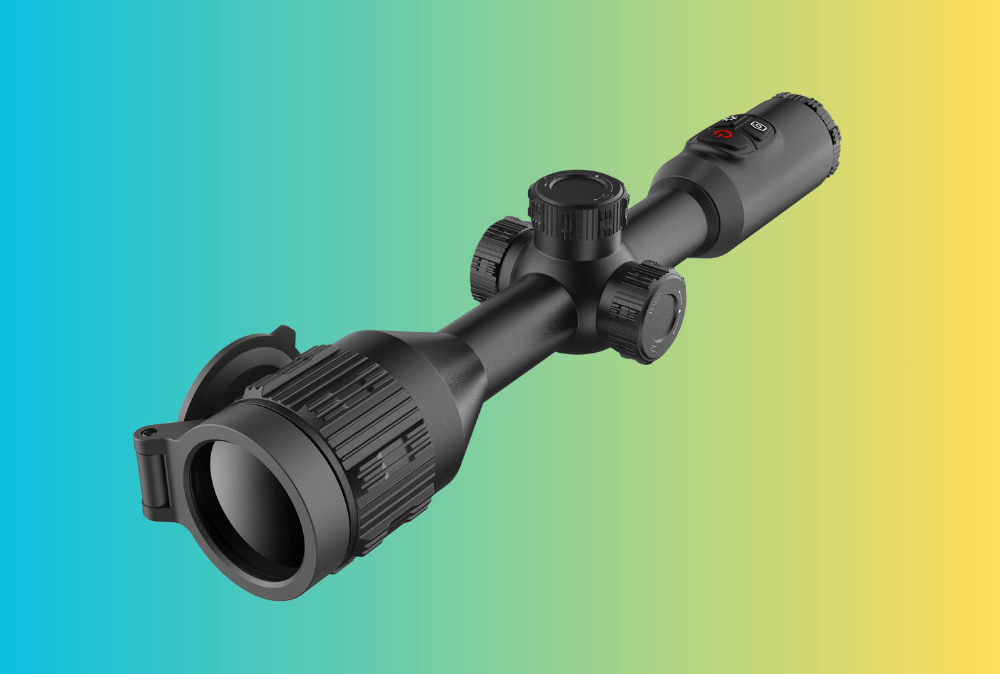
The step-up band is where you might introduce extra profiles, better displays, or high-quality recording. You still hold back some marquee technologies—such as your top sensor resolutions—so that your true premium line has room to breathe. Think of this tier as the bridge between affordable thermal scope programs and your flagship Thermal Rifle Scopes.
Throughout, the feature map should be documented so that vendor line reviews, planogram discussions and staff training all trace back to the same logic. When everyone understands why a given SKU has or lacks a feature, they are less tempted to “special request” exceptions that distort the assortment.
Packaging and Merchandising Built for the Aisle
In a big-box environment, the box is often the sales rep. Many customers will never speak with an associate; they will read whatever is printed on the packaging and make a decision from there. That is why packaging for an affordable thermal scope line cannot just recycle OEM cartons meant for e-commerce.
Front panels should communicate three things in under five seconds: the role (“first night-hunt optic,” “serious hog setup,” “longer-range predator tool”), the key differentiator versus the box next to it, and clarity on what is included. Visuals that show the scope on a rifle, and maybe a small inset of a thermal view, help demystify the product.
Side and back panels can then go deeper, explaining sensor resolution, lens size, detection ranges and supported platforms. This is a good place to call out whether a unit works as a standalone scope, a thermal scope attachment for rifles, or a thermal monocular add-on that can be helmet or handheld mounted. Icons simplify comparisons when shoppers scan multiple boxes.
For stores with higher penetration, you can support packaging with a thermal scope planogram that groups SKUs not just by brand but by mission and price lane. Simple color-coding by tier (entry, core, step-up) helps staff and shoppers orient quickly. Where possible, add an in-store thermal demo unit tethered on the counter or in a locked display, so that associates can let shoppers peek through a working sample without opening stock boxes.
Promotional locations—end-caps, seasonal pads, front-of-store displays—should be reserved for tightly curated offerings. A thermal scope end-cap display that features one hero SKU and a single step-up alternative is far more effective than a crowded wall of indistinguishable boxes.
Well-designed packaging also has a back-end job: surviving shipping, stacking in warehouse-friendly thermal packaging, and being easy to count and re-stock. Standardizing box sizes across your own-label and vendor lines simplifies planograms, shelf labels and replenishment.
Managing Inventory, Seasonality and Regional Mix
An affordable thermal scope program lives on the edge between electronics and hunting seasonality. In some markets, demand spikes dramatically around hog and predator seasons; in others, it’s flatter but tied to general outdoor and firearms cycles.
For assortment planning, you want to distinguish between “always on” SKUs and “seasonal push” SKUs. Entry-tier scopes, especially those in the online-to-store thermal bundle category, may perform steadily year-round and act as traffic drivers during slow months. More advanced kits, like a bundled thermal scope combo kit with accessories, might be brought forward aggressively during specific seasonal windows and then pulled back to e-commerce afterward.
Regional allocation should follow the missions you defined earlier. Stores in states with ample night-hunting opportunities and permissive regulations can carry deeper on-hand quantities and more variants. Others might stock a single hero SKU and rely on drop-ship for the rest of the line.
Because thermal optics are relatively high-ticket items, there is always a balancing act between having enough inventory to support seasonal thermal promotion campaigns and not tying up too much capital in slow movers. Refining your forecast models using prior years’ sell-through data, weather patterns and licensing trends will make each subsequent season more predictable.
Working with Vendors: MAP, Private Label and Long-Term Programs
Big-box chains often work with a mix of branded vendors and private-label programs. In thermal, both have a place, but only if they fit into one coherent plan.
Branded vendors bring credibility and innovation. They may already be known to enthusiasts and can pull shoppers into your aisle through their own marketing. With them, the key is to negotiate assortments that align to your tier definitions and respect thermal scope MAP pricing agreements. If a vendor allows rampant undercutting online, your in-store presentation will struggle; if they hold the line, both parties benefit.
A private label thermal scope program can be your tool for filling gaps: perhaps a simple, rugged entry SKU built to your spec, or a store-exclusive mid-tier configuration. When you design these SKUs, try to keep them compatible with your vendor ecosystem—shared mounts, similar controls—so that staff can speak about them confidently. Be very cautious about racing to the bottom on price; a badly designed private label “cheapest in the aisle” unit can damage not only your brand but perception of the entire category.
For all partners, clear multi-year plans help. If vendors know you intend to build an “affordable” tier, a core tier and a step-up tier, they can propose SKUs at the right spots instead of flooding you with overlapping offers. Joint marketing, co-op support and seasonal thermal promotion calendars become easier to negotiate when everyone sees the bigger picture.
Measuring Whether the Assortment Is Actually Working
Thermal is still young enough in big-box that many retailers do not have solid benchmarks. The temptation is to look only at top-line revenue. A more E-E-A-T-friendly approach is to track a set of operational and customer-centric indicators that tell you whether your affordable thermal scope program is healthy.
Sell-through and GMROI by tier show whether your inventory and price steps make sense. If entry SKUs fly off the shelf but core and step-up hardly move, your ladder may be too steep—or your training and signage may underplay the advantages of moving up. If the inverse is true, you may be over-specifying “affordable” and leaving volume on the table.
Return rates and reasons are critical. High returns on a specific cheap hunting thermal scope usually signal a mismatch between packaging promises and real-world performance. Complaints about mounts, zeroing or reliability indicate that cost savings crossed one of the red lines discussed earlier. Complaints about “doesn’t reach as far as I thought” may be acceptable if you have been honest and the scope is positioned as a short-range tool.
Customer feedback—reviews, survey responses, in-store comments—can be coded for common themes: confusion, satisfaction, perceived value. Using those insights to refine packaging, training and even feature sets is part of building experience and trustworthiness around the category.
Over time, one of the most important metrics becomes upgrade behavior. If buyers who start with an affordable thermal scope come back to your stores or site to purchase mid-range and premium optics, your ladder is working. If they disappear to other brands when they decide to upgrade, something in the experience is pushing them away.
Turning Planning into Action
All of this only matters if it leads to concrete decisions: specific SKUs, price bands, features and packaging choices that merchants and vendors can execute.
A practical next step is to map your current and proposed products onto a simple matrix: tiers on one axis, shopper missions and store clusters on the other. For each cell, ask which product should be the hero, what role the others play, and whether there is a gap that an OEM or private-label SKU might fill. Annotate where a thermal scope attachment for rifles makes more sense than a standalone scope, or where a dedicated thermal monocular add-on could supplement the aisle.
As you refine this map, link it with internal documents like your overall Thermal Rifle Scopes strategy, broader Thermal Imaging Modules roadmap and any OEM/ODM partner plans. Thermal should feel like one integrated family across channels and technologies, not a disconnected island of “expensive gadgets” beside the shotgun shells.
When you treat assortment planning this way, the phrase “affordable thermal scope” becomes more than a search term or a discount tag. It becomes a carefully engineered entry point into your optics ecosystem—one that works for shoppers, store staff, vendors and your long-term brand story.