If your brand already sells binoculars, trail cameras, or riflescopes, your customers are probably asking the same question: “Do you have a thermal monocular?”
Table of Contents
ToggleSearch data and retailer shelves tell the same story. Handheld thermal imaging monoculars have moved from specialist gear into mainstream outdoor equipment—used for wildlife watching, camping, overlanding, homestead security and search-and-rescue support. Recent buyer’s guides from large outdoor retailers highlight thermal monoculars across price bands, emphasising detection range, sensor resolution and battery life as key differentiators.
For outdoor brands, that creates both opportunity and risk. Spec your first thermal monocular OEM line well and you add a profitable, high-tech category that fits naturally beside your existing optics. Get it wrong and you end up with returns, support headaches and a product that quietly disappears from the catalog.
This guide walks through the decisions that matter most when you’re defining a private-label or co-branded thermal monocular family for wildlife, camping and light security use.
Along the way, we’ll point to where a module-based approach, like a dedicated thermal camera module, can simplify integration—and where it makes sense to step up to full systems, such as the ready-made devices in a Thermal Monoculars OEM/ODM program.
1. Why Outdoor Brands Are Adding Thermal Monoculars
From an end user’s perspective, a handheld thermal monocular solves three problems better than traditional optics or flashlights:
- Night-time navigation and awareness. Thermal imaging doesn’t depend on visible light; it detects heat patterns from people, animals and objects. That lets campers navigate around obstacles, find tent lines, or relocate a campfire safely without extra lighting.
- Wildlife spotting and photography support. Hunters, birders and photographers use outdoor thermal cameras to locate animals in brush or darkness, then switch to visible-light optics for ID and photos. Thermal excels at detection, while glass or night vision excels at fine identification—an advantage highlighted in multiple thermal vs. night-vision comparisons.
- Light security and perimeter checks. Rural landowners and overlanders increasingly use compact security thermal monoculars to scan fence lines, barns and vehicles at night. Thermal can reveal human and vehicle heat signatures that would be invisible to the naked eye or standard cameras, especially in brush or low contrast scenes.
For an outdoor brand, these use cases sit naturally next to binoculars, spotting scopes and headlamps. A handheld compact thermal monocular is easy to upsell as the “see heat, not just light” tool that lives in the same bag.
If your product tree already includes rifle optics or hunting gear, you can also position monoculars as the handheld complement to your Thermal Rifle Scopes and Thermal Clip-On Sight offerings, all under a unified Thermal Optics family.
2. Start with Personas, Not Pixels
Before you touch specs, define who you’re building for. Most outdoor brands see three primary customer personas for a thermal monocular line.
Wildlife & Nature Enthusiasts
These users hike, glass and photograph more than they shoot. They want to:
- spot animals without using bright lights;
- avoid disturbing wildlife;
- and scan hillsides or tree lines at dawn, dusk and night.
For them, a thermal imaging monocular is a detection tool. Identification still happens through daylight binoculars or a camera. They care about:
- comfortable long sessions (weight, eyecup design);
- quiet operation;
- good field of view for scanning landscapes.
Campers, Overlanders and General Outdoors Families
A growing group uses a camping thermal monocular the way they use headlamps and power banks:
- navigating camp at night;
- checking for animals near tents or RVs;
- finding lost pets or wayward kids in the dark.
They need robust, simple devices:
- clear image, but not necessarily extreme range;
- intuitive controls that occasional users can remember;
- good battery life and USB-C charging.
Light Security & Farm / Homestead Users
These buyers may already own trail cameras and floodlights. They want to:
- patrol fence lines and buildings at night;
- distinguish between wildlife, livestock and people;
- sometimes support local search-and-rescue or community watch roles.
For them, a security thermal monocular should offer:
- reliable detection at 200–400 m;
- recording for evidence;
- weather resistance and strong warranties.
Once these personas are clear, it becomes much easier to decide sensor resolution, lens size, feature sets and price bands.
3. Core Architecture Choices: Sensor, Lens and FOV
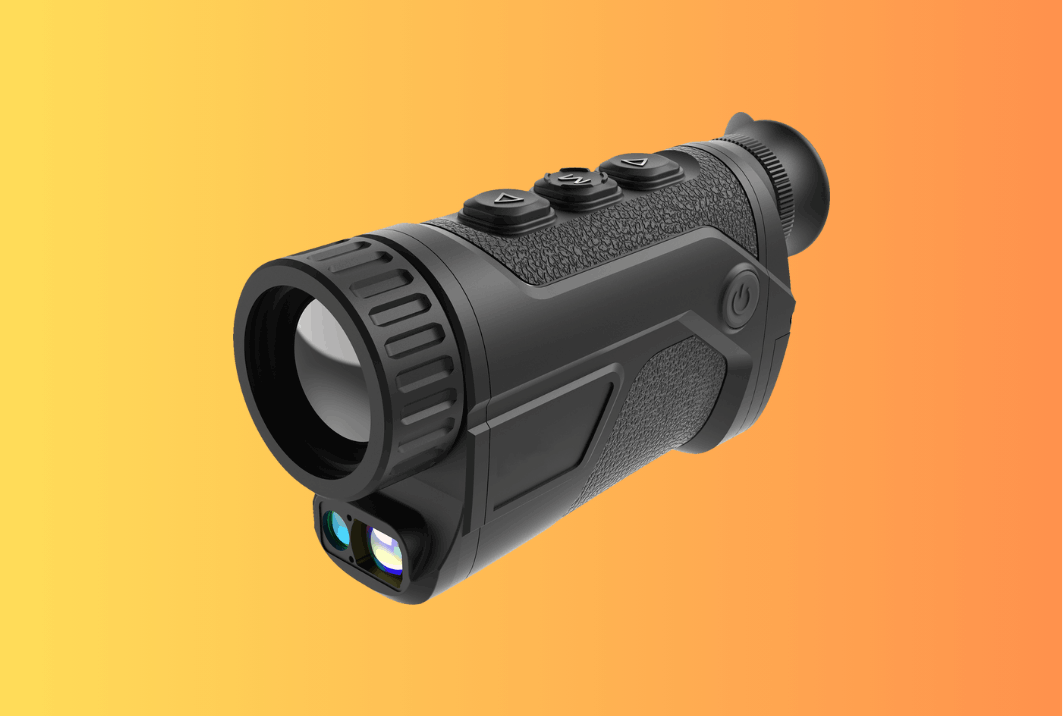
At the heart of any thermal monocular is an uncooled LWIR microbolometer and a germanium lens. For OEM buyers, three specs matter most: resolution, pixel pitch and focal length.
3.1 Resolution & Pixel Pitch
Most modern handheld thermal monoculars use 256×192, 320×256, 384×288 or 640×480/512 sensors. Higher resolutions deliver more detail but cost more.
Recent buyer’s guides and product pages from major brands illustrate typical patterns:
- 384×288 with 12 μm pixels is widely used in mid-range devices, combining good detection range with reasonable cost.
- 640×480 or 640×512 17 μm or 12 μm sensors provide markedly more detail and support longer detection ranges, especially when paired with moderate telephoto lenses.
Industry analysis shows why 12 μm cores are popular: for the same lens, smaller pixels put more sampling points on target, increasing range and perceived sharpness by 30–40% versus older 17 μm designs.
OEM takeaway:
- For entry-level thermal monoculars, 256 or 320 resolution with 12 μm pixels and a small lens can hit aggressive price points while still outperforming night vision on detection.
- For your volume mid-range, a 384×288 12 μm thermal sensor is the current sweet spot.
- For premium wildlife or professional SKUs, add a 640×480 12/17 μm core to justify flagship pricing.
If you intend to design around modules rather than finished products, align your choices with standard formats offered in your Thermal camera module and Thermal camera module Integration catalog so you can reuse cores across binoculars, rifle scopes and monoculars.
3.2 Lens Focal Length & Field of View
Focal length determines both base magnification and field of view (FOV). Outdoor-focused monoculars generally sit between 15 and 35 mm.
As an example, one 35 mm 384×288 handheld model lists a horizontal FOV of about 9.4° and vertical 7.1°, while its 640×512 variant on the same lens reaches roughly 12.5° × 10°.
Translated into user language:
- wide FOV (~12–17° horizontal) = easier scanning, better for campers and hikers;
- medium FOV (~9–12°) = balanced wildlife and security viewing;
- narrow FOV (<8°) = specialised long-range spotting.
For your thermal monocular OEM plan:
- Aim for a wide-to-medium FOV on entry and mid SKUs (shorter lenses, e.g. 15–25 mm on 12 μm cores).
- Reserve longer lenses (35–50 mm) and narrower FOV for premium or hunting-focused models where detection range is a sales driver.
3.3 Sensitivity (NETD), Frame Rate & Image Processing
NETD (“noise-equivalent temperature difference”) describes how small a temperature contrast the sensor and optics can resolve. High-end handheld monoculars now advertise NETD values under 35 mK, and some premium 384/640 devices quote ≤20 mK.
Outdoor users may not know the acronym, but they do notice:
- cleaner images in fog or humidity;
- better separation between animals and warm backgrounds;
- less flicker or noise at longer ranges.
Frame rates around 50 Hz are now standard in hunting-grade monoculars, giving smooth panning and tracking of moving targets.
Your product brief should therefore specify:
- a target NETD (e.g. sub-35 mK on entry, sub-25 mK on mid/premium);
- 50 Hz output for wildlife and security models where panning is common;
- consistent image-processing pipelines (contrast, sharpening, noise reduction) across the family, ideally shared with your Thermal Optics line so users recognise the brand “look.”
4. Ergonomics and UX: What Outdoor Users Notice First
Sensor specs sell on spec sheets; ergonomics sell on the shop floor. Reviews and brand pages for modern handheld thermal monoculars emphasise comfort, simplicity and connectivity alongside raw performance.
Key decisions for an outdoor brand:
Form Factor & Weight
- Compact thermal monoculars under ~400 g are easy to pocket or wear on a lanyard—ideal for hikers and campers.
- Larger models with bigger lenses suit dedicated wildlife observers but should still allow one-handed operation and glove-friendly controls.
Controls & Menus
- Keep core actions (power, palette, zoom, photo/video) on tactile buttons that can be used in the dark.
- Avoid deep menu trees; instead, offer a “favourites” bar or quick-click system for the two or three features each persona uses most.
Display & Eyecup
- High-resolution OLED/LCoS displays (e.g. 1024×768 or 1280×960) are common in modern monoculars and strongly influence perceived quality.
- A soft, wide eyecup that blocks stray light and is comfortable for extended sessions is a small but important differentiator.
Recording, Wi-Fi and Apps
Campers and wildlife watchers increasingly expect to record footage and share clips. Buyers’ guides and product descriptions highlight built-in video, photo capture and Wi-Fi app connectivity as standard in mid-tier devices.
If your brand already offers digital rifle scopes or action cameras, align your thermal monoculars with the same app ecosystem, or consider a common cloud or mobile UI for all devices. This is a natural place to link your handhelds with your broader Thermal Optics and Accessories range.
5. Spec Templates: Designing a Three-Tier Thermal Monocular Family
To keep your catalog coherent, it helps to define “spec templates” before talking to factories. Here’s a realistic three-tier layout tailored for outdoor brands.
Suggested Spec Table
| Tier | Use Focus | Sensor | Lens / FOV (approx.) | Key Features | Target Buyer |
|---|---|---|---|---|---|
| Entry | Camping & general wildlife | 256×192 12 μm, NETD < 35 mK | 15–19 mm, ~13–17° H FOV | USB-C charging, basic video, IP66 | Campers, families, first thermal users |
| Core | Wildlife & light security | 384×288 12 μm, NETD < 35 mK | 19–25 mm, ~10–13° H FOV | 50 Hz, improved display, Wi-Fi app, multiple palettes | Regular outdoorspeople, small farms |
| Premium | Wildlife pros & security | 640×480 12/17 μm, NETD < 25 mK | 25–35 mm, ~7–12° H FOV | Long detection range, advanced recording, optional LRF, GPS | Guides, outfitters, LE/security customers |
Use this as a starting point when talking with a Thermal Monoculars OEM/ODM supplier or when building on your own Thermal camera module Integration platform.
6. Rangefinding, Fusion & Accessory Strategy
Outdoor brands are increasingly tempted to add laser rangefinding or even fusion (thermal + visible) into monoculars. These features can be powerful but add cost and complexity.
When a Rangefinding Thermal Monocular Makes Sense
Built-in LRFs shine when users must judge distance at night for shooting or safety decisions. Integrated combos let the user range targets without lowering the device, and can feed ballistic calculators in related rifle scopes.
For wildlife watching and general camping, though, a rangefinding thermal monocular is usually overkill. Distances are approximate, and users care more about “something’s near camp” than “it’s exactly 186 metres away.”
Consider reserving LRF integration for:
- premium hunting-focused handhelds that pair with your Thermal Rifle Scopes;
- professional security SKUs;
- or demonstration units used in your Thermal + LRF Fusion & Ballistics story.
Accessories and Ecosystem
Think beyond the monocular itself:
- neck lanyards and chest pouches;
- tripod adapters for static wildlife watching;
- external battery packs;
- rail mounts for those who want a crossover between handheld and helmet/weapon use.
Align these with your broader Accessories offering so retailers can cross-sell cleanly.
7. Quality, Compliance and Warranty Expectations
Thermal devices are higher-risk than binoculars: more electronics, more heat, more firmware. B2B buyers will judge your line on how seriously you take quality and compliance.
Safety & Environmental Compliance
For electronics in the EU and many other markets, thermal monoculars fall under safety standards such as IEC 62368-1, which uses a hazard-based approach to classify energy sources (electrical, thermal, optical) and defines safeguards to avoid injury or fire.
You also need to ensure compliance with RoHS substance restrictions—limits on lead, mercury, cadmium, certain flame retardants and plasticisers in electronic equipment—to protect the environment and public health.
Your OEM brief should explicitly require:
- documented conformity with IEC 62368-1 (or local equivalents) for the finished device;
- RoHS and often REACH statements for all electronic assemblies;
- access to test reports for major components like your thermal camera module.
These topics fit naturally into your public Certificates and Quality pages and reassure both distributors and end users.
Warranty Benchmarks
Thermal optics manufacturers now commonly offer 3–5 year warranties on devices with 384 or 640 resolution sensors, especially in North America and Europe.
Position your thermal monocular line accordingly:
- Entry models: minimum 3 years on optics and electronics.
- Mid/premium models: 5-year transferable warranty if your cost structure allows it.
Explain clearly what is covered—sensor, display, electronics, housing—and link to your Warranty and Support sections. Premium buyers in particular treat a strong warranty as a proxy for confidence in the microbolometer and display quality.
8. Working with OEM / ODM Partners: A Checklist
Whether you work from a base design or from the component level, your RFQ and NPI process should address more than just “price per unit.” Use this checklist when talking to factories or module vendors:
- Platform Fit
- Does the vendor already produce thermal monoculars for hunting, camping or security markets similar to your personas?
- Can their cores and firmware also be used in your future Thermal Binoculars or Thermal Pistol Sights to create a consistent family?
- Module & Firmware Roadmap
- What generations of uncooled 12 μm cores do they support today, and what’s next?
- How often do they release image-processing improvements, and can firmware be branded or localised?
- Mechanical & Environmental Design
- Drop tests, IP ratings, operating temperature range.
- Options for custom armour, colourways and brand-specific industrial design.
- Integration Services
- Do they offer design support like the services in a dedicated Module Integration for OEMs or Rangefinder Module Integration program?
- Can they share reference designs if you plan to integrate thermal camera modules into your own housings?
- Production, QA and Traceability
- Factory certifications (ISO 9001, etc.).
- Incoming, in-process and final test procedures for each thermal imaging monocular.
- Serialisation and data logs to support future Downloads, firmware updates and after-sales diagnostics.
- Commercial Terms
- realistic MOQs and lead times by tier;
- spare parts and repair policies;
- support for co-branded marketing content (images, test footage, usage guides for your Blog and FAQs).
Capture answers in a structured document and share across your product, quality and marketing teams before you commit.
9. Turning Specs into a Launch Plan
Once your line is defined, think about how it plugs into the rest of your business:
- Position monoculars as the “entry product” into your Thermal Optics ecosystem, with clear upgrade paths to Thermal Rifle Scopes and Thermal Clip-On Sight solutions.
- Use your Company, About Us and Why Choose Us pages to tell your story as a long-term partner, not just a label on a generic device.
- Publish user-ready guides and comparison charts in your Blog and FAQs so dealers can train themselves without waiting for webinars.
- Make it easy for B2B buyers to reach you via Contact and Get a Quote forms dedicated to Private-Label Optics or Thermal Monoculars — OEM/ODM enquiries.
A well-designed thermal monocular line is more than another SKU set. Done right, it becomes the first thermal product many of your customers ever touch—a gateway into your full imaging portfolio.
If that first experience is clear, reliable and thoughtfully spec’d around wildlife, camping and security needs, it will not only sell itself, but also pull your entire thermal brand story forward.
## Ready to spec your thermal monocular line? If you’re planning your first **thermal monocular** program—or want to clean up an existing one—our engineering team can walk you through sensor, lens and pricing options that fit your brand. You can start with our **Thermal Monoculars — OEM/ODM** page to see typical platforms, or talk directly with us about custom housings, firmware and accessory roadmaps. Share a bit about your project, target market and timelines via the **Get a Quote** form, and we’ll come back with concrete proposals, sample lead times and next steps for validation and field testing.