Ask any dealer what customers actually say and it’s rarely “I need a 384×288 12 μm sensor.” It’s “I’m shooting hogs in peanut fields,” “we call coyotes in brushy pasture,” or “I just want to see deer around the farm at night.”
Table of Contents
ToggleIf you’re building a thermal monocular for hunting portfolio—either under your own brand or as an OEM buyer—your spec sheet has to line up with those real conversations. The same device will not be “best” for hog sounders in Texas wheat fields and for fox hunters in tight European forests. Guides from major manufacturers make the same point: start from what and where you hunt, then choose resolution, FOV and detection range accordingly.
This article gives you a practical playbook: how to translate game and terrain into concrete monocular configurations, and how to explain that logic to dealers. We’ll also show how your hunting monoculars can sit inside a broader Thermal Optics family alongside rifle scopes, clip-ons and binoculars.
Why Specs for a Hunting Monocular Should Start at the Range, Not in CAD
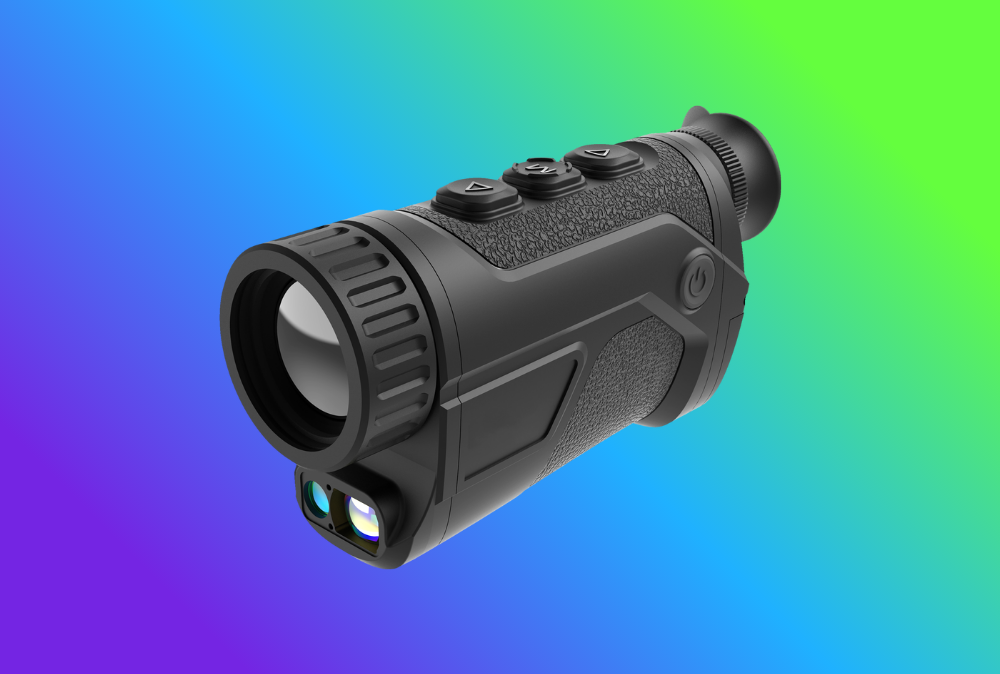
In real hunts, monoculars and scopes do different jobs. Experienced night hunters typically scan with a handheld thermal and shoot with a dedicated rifle scope. The monocular’s job is detection and tracking: keeping up with moving animals, covering large areas, and keeping the hunter’s head up and mobile.
That is why:
- a monocular often benefits from wider FOV than the rifle optic;
- weight, balance and controls matter as much as raw resolution;
- for many users, a good 384×288 sensor in a comfortable housing is more “effective” than a heavy 640 flagship they leave at home.
From a B2B standpoint, you’re not just shipping detectors—you’re shaping how your customers hunt at night. So we’ll keep coming back to three practical questions for every configuration:
- What animal, at what typical range?
- What terrain and background?
- Is this monocular the primary spotter, or part of a larger thermal kit?
Core Building Blocks of a Hunting Thermal Monocular
Before we split by game and terrain, let’s agree on the key levers you can move in any hunting thermal monocular design.
Sensor Class: 256 / 320 vs 384 vs 640
Hunting-oriented buying guides tend to converge on a few rules of thumb:
- A 320×240–384×288 sensor is the sweet spot for most hunting monoculars, offering 500 m+ detection on man-size targets with moderate lenses.
- 640×480/512 sensors deliver noticeably more detail and support longer identification ranges, especially on open ground, but at a steep price premium.
Smaller 12 μm pixels let you reach these ranges with shorter, lighter lenses compared to older 17 μm cores.
Lens & Field of View
Open-country hunters love long detection ranges, but every degree of FOV you give up makes scanning harder. Pulsar’s own advice is to match lens and FOV to terrain: wide in woodland and mixed terrain, narrower only when you genuinely shoot long.
Roughly:
- 15–19 mm on 12 μm cores → wide FOV (13–17°) for closer, faster scanning.
- 19–25 mm → balanced FOV (10–13°) for mixed terrain.
- 25–35 mm → tight FOV (<10°) for long-range spotting.
Sensitivity (NETD)
High-end monoculars now quote NETD values under 35 mK, with premium devices going to 25 mK or better. Lower NETD matters most in low-contrast conditions—humid nights, warm ground, or light fog—which hog and coyote hunters encounter often.
Ergonomics & Power
Hunting monoculars get carried and used constantly while the rifle stays slung. Forum and review feedback repeatedly praises devices that are:
- one-hand friendly;
- easy to orient in the dark;
- light enough to hang from a lanyard all night;
- with batteries that last a full sit or stalk.
Keep those in mind as we build configurations.
Hog Sounders, Crop Fields and Brush: Monocular Specs for Hogs
Feral hogs are strongly nocturnal; telemetry studies and wildlife agency reports show they are most active from dusk through dawn, shifting patterns with temperature and pressure. They travel in sounders across crops, pastures and creek bottoms and may appear anywhere from 50 to 300 m from the hunter.
For a thermal monocular for hog hunting, that implies:
- Priority: see multiple animals at once, scan tree lines and field edges quickly.
- Typical shot ranges: 80–250 m; longer shots happen but are not the majority.
Recommended Hog-Focused Config
- Sensor: 384×288 12 μm.
- Lens: 19–25 mm (10–13° horizontal FOV).
- NETD: ≤35 mK.
- Use: primary spotter paired with a matching thermal rifle scope.
This combination matches what many serious hog hunters and outfitters now describe as their “do-everything” scanner: enough FOV to watch a sounder enter a field, enough range to pick pigs out along distant tree lines.
For premium slots, step to 640×480 with a 25 mm lens and better NETD; keep FOV similar so the hunter’s “picture” doesn’t change, but give them more detail and digital zoom headroom.
Coyotes and Foxes: Faster, Smaller, Often Further
Predator hunters use monoculars differently. Articles and forum threads show typical coyote shots at night clustered around 120–200 yards, with many hunters calling animals as close as possible to avoid marginal hits. Coyotes move quickly, may hang up at distance, and often appear as a single animal or a small group.
For a coyote hunting thermal monocular:
- Priority: fast detection of small, moving heat signatures in open or semi-open country; confident identification at 200 m+.
- Typical terrains: open pasture, cut fields, prairie, rolling hills.
Recommended Predator-Focused Config
- Sensor: 384×288 or 640×480 12 μm.
- Lens: 25 mm for 384, or 25–35 mm for 640.
- FOV: 7–11° depending on lens/sensor combo.
- NETD: ≤35 mK (384) or ≤25 mK (640).
Compared to hog setups, we accept slightly tighter FOV in exchange for more base magnification and identification range. That mirrors what many predator hunters already do with their scopes: choosing lower-power glass or thermals around 2–3× for calling sets, rather than extreme zooms that make close-in coyotes hard to track.
For brands selling both monoculars and scopes, this is also the natural place to talk about integrated solutions such as Thermal + LRF Fusion & Ballistics, where the same ballistic data and ranging logic are shared between handheld and weapon optics.
Deer and General Big Game: Scouting More Than Shooting
In many regions, thermal is not legal for taking deer or other big game, but can be used for scouting and recovery. Regulations vary by state and country, but most hunting publishers emphasise checking local laws carefully before using thermal optics during deer seasons.
Where legal, a deer hunting thermal monocular is often used to:
- glass clearcuts and meadows at dawn/dusk to see where animals stage;
- confirm that a “dark stump” in the distance is alive before committing to a stalk;
- help recover animals in timber after a shot.
Recommended Big-Game Scouting Config
- Sensor: 320×240 or 384×288, 12 μm.
- Lens: 19–25 mm; wide enough for hillsides, tight enough for longer ridges.
- NETD: ≤35 mK.
- Extras: strong battery life, tripod socket, maybe a simple range-estimation aid.
Because this role involves long observation periods, you should also think about how your monocular co-exists with glass or thermal binoculars. Articles comparing monoculars vs binoculars note that monoculars shine for lightweight mobility, while binoculars reduce eye fatigue for long sits.
From a portfolio standpoint, that means offering both: monoculars as agile scouts, binoculars as stand-hunter tools, built on the same detector and image pipeline.
Small Game & Vermin: Rabbits, Raccoons, Jackals, Foxes
For small game and pest control—rabbits in orchards, raccoons around barns, jackals around livestock—the monocular behaves more like a close-range searchlight than a long-range sniper scope. Game-and-fish articles covering thermal optics stress that for many non-big-game species, typical shot distances are under 150 m even at night.
Recommended Small-Game / Farmstead Config
- Sensor: 256×192 or 320×256 12 μm.
- Lens: 15–19 mm with wide FOV.
- NETD: ≤40 mK is often sufficient.
- Design: compact, rugged, aggressively priced.
This is an ideal template for your entry-level thermal monocular for hunting—the one you sell to farmers and homeowners who simply want to see “what’s in the yard” without buying a full hunting kit.
Overlaying Terrain: Forest, Mixed Farmland, Open Country
Game type is only half the story. Terrain and background often determine whether a device feels “right” in the field. Pulsar’s hunting guides boil the decision down to matching FOV and detection range to woodland, mixed or open landscapes.
Here’s a simple way to think about it for a thermal monocular for hunting:
Dense Forest & Tight European Stands
- lots of trees, short sight lines, steep slopes;
- animals appear suddenly at close range;
- your rifle scope is probably low-power.
→ Favour wide-FOV monoculars: 15–19 mm on 384, or very short lenses on 320. Long-range detection is less important than quick awareness.
Mixed Farmland & Pasture
- common for hogs and predators;
- a blend of tree lines, rolling ground and open fields;
- typical shots 80–250 m.
→ The 19–25 mm on 384 configuration shines here; it balances scanning and range. This is where your volume “general hunting” monocular should sit.
Open Plains, Prairie and Big Ag
- long, flat fields;
- coyotes, foxes and hogs may hang up at 300 m+;
- wind and mirage can be big factors.
→ Consider 25–35 mm lenses, especially on 640 cores, for dedicated long-range spotters. But make sure you clearly mark them as open-country specialists so dealers don’t steer typical woodland hunters into “tunnel vision” devices.
A Simple Matrix: Game × Terrain → Monocular Template
You can summarise the above for internal use with a compact matrix like this:
| Game / Terrain | Forest / Tight | Mixed Farmland | Open Country |
|---|---|---|---|
| Hogs | 384 + 15–19 mm | 384 + 19–25 mm (hero SKU) | 640 + 25 mm |
| Coyotes/Foxes | 384 + 19 mm | 384 + 25 mm | 640 + 25–35 mm |
| Deer (scouting) | 320/384 + 19 mm | 384 + 19–25 mm | 640 + 25 mm |
| Small game | 256/320 + 15 mm | 320 + 15–19 mm | 384 + 19–25 mm |
You don’t need a product for every cell, but this matrix forces you to justify each thermal monocular for hunting SKU with a clear story.
Positioning Monoculars Inside a Complete Hunting Kit
Dealers increasingly sell systems, not isolated devices. Blogs and expert Q&As on night hunting emphasise how scanning with a monocular and shooting with a rifle scope or clip-on is far more efficient than trying to do everything through the gun.
Use that in your B2B playbook:
- Pair each hunting monocular configuration with a matching Thermal Rifle Scopes — OEM/ODM or Thermal Clip-On Sight option.
- Offer bundles with shared batteries, chargers and cases, drawing from your Accessories catalog.
- For premium tiers, show how handhelds, scopes and rangefinders can share modules and firmware via your thermal camera module and OEM integration services.
This approach makes it easier for dealers to upsell:
“Start with this 384 monocular and mid-range scope. When you’re ready to upgrade, move to the 640 scanner and LRF scope without relearning the interface.”
Ready to Map Your Hunting Monocular Line to Real Use Cases?
If you want your thermal monocular for hunting range to sound natural in dealer conversations—“this one is for hog sounders in fields, this one is for coyotes in big country”—you need more than a parts list. You need a coherent spec playbook like the one above, tuned to your markets and price tiers.
Our team can help you take the next step: translating those templates into concrete platforms in our Thermal Monoculars — OEM/ODM lineup or into custom designs built around shared modules.
Share a few details about your target game species, main export markets and expected price bands through the Get a Quote form, and we’ll come back with specific sensor–lens combinations, roadmap options and sample plans your sales team can present with confidence.