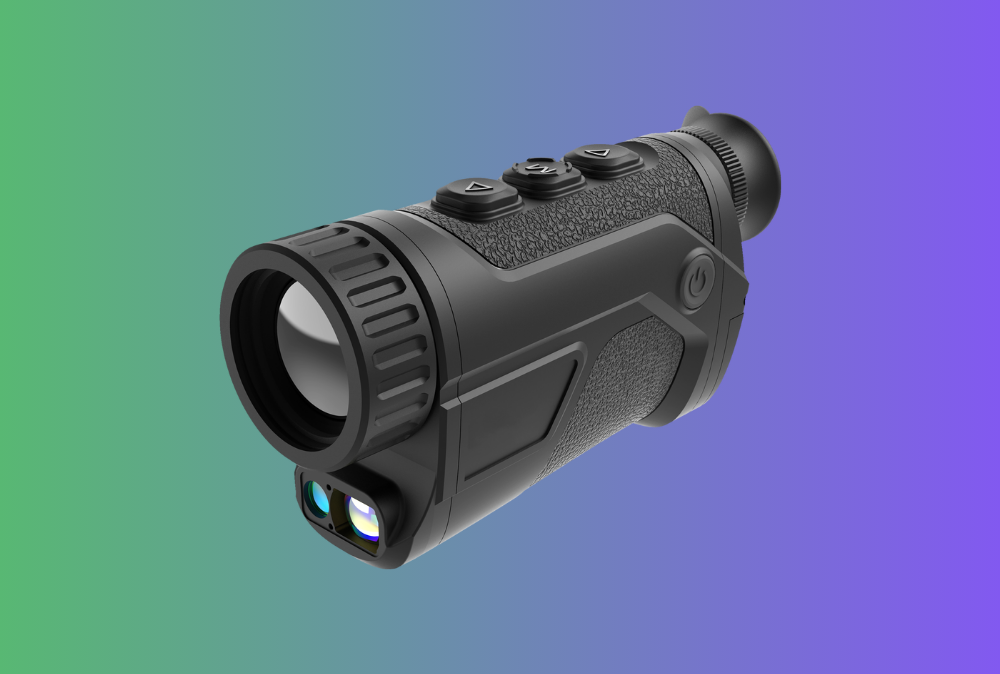
When a government agency or tactical unit publishes a tender for a helmet mounted thermal monocular, they are not shopping for a gadget. They are buying a safety-critical sensor that officers will trust in low light, bad weather and high stress. If your design misses key details—helmet balance, battery life, MIL-STD testing, safety standards—you can win on price and still lose in field trials or follow-on orders.
Table of Contents
ToggleThis guide turns real operator needs and procurement language into a practical design checklist. It focuses on helmet-mounted thermal imaging systems built on modern 384×288 and 640×480 cores, and on the tests and documents that procurement teams now expect before they sign anything. Throughout, we’ll also show how to anchor your designs in a modular Thermal Monoculars and Thermal Optics family, instead of treating every tender as a one-off project.
1. Why Helmet-Mounted Needs Its Own Spec Playbook
A handheld tactical thermal monocular can afford to be a little heavy or front-loaded; the user can change hands or hang it from a lanyard. Once you strap that device to a helmet, every extra gram becomes neck strain, and every millimetre of offset changes how operators clear doorways or climb ladders.
Modern helmet-capable thermal units like the Jerry-YM series or the FLIR Breach deliberately target weights in the 200–230 g range and are designed to work handheld, weapon-mounted and helmet-mounted with compatible dovetails and arms. Night-vision monoculars such as the PVS-14 and NiCAM-16M follow similar logic, combining small form factor, ~40° field of view and long runtimes from a single AA or CR123 cell.
A tender for a helmet mounted thermal monocular almost always implies:
- Hands-free operation during patrol, breaching or rope work.
- Multi-role use (helmet, headband, handheld; sometimes clip-on or weapon-mounted).
- Extended wear during multi-hour missions, not just brief scans.
If your core concept doesn’t explicitly design for these conditions, you risk failing human-factors evaluations even if your sensor looks great on paper.
2. Mission Profiles Behind Helmet-Mounted Systems
Before writing one line of spec, anchor the project in the missions your customer actually runs. Helmet-mounted thermals show up in three broad scenarios.
2.1 Urban Patrol and Tactical Entry
SWAT teams, armed response units and K-9 handlers use helmet mounted thermal monoculars to:
- detect suspects in alleys, yards or rooftops;
- navigate dark interiors without white light;
- keep one eye on the environment while the other uses night vision or a day optic.
In this context, the monocular is often paired with a night-vision helmet mount and may be flipped up or out of the way when not needed. That demands precise eye relief, a compact envelope and reliable flip-up auto-off behaviour similar to advanced night-vision units.
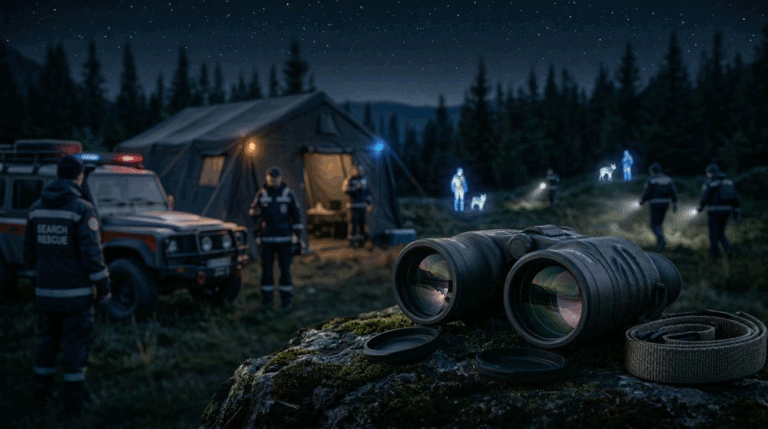
2.2 Search and Rescue (SAR) and Rural Patrol
SAR teams, border patrol and rural police use hands-free thermal monoculars to scan:
- tree lines, ravines and riverbanks;
- avalanche fields and rubble piles;
- large perimeters on foot, ATV or boat.
Thermal imagers help them see missing persons or heat leaks in conditions where visible-light search is almost impossible. For these users, priorities are runtime, weather sealing and a field of view that matches natural head movements.
2.3 Dismounted Soldier and Special Operations
Military tenders may demand a military thermal monocular that plugs into broader soldier systems: fused night vision, weapon sights, rangefinders and radios. Weight budgets are stricter, and standards like MIL-STD-810G environmental testing are mandatory rather than “nice to have.”
Regardless of segment, procurement language will often describe performance in terms like “detect man-size target at 500 m” or “operate continuously for 6 hours at –20 °C.” Your job is to translate those into concrete optical, mechanical and electrical design choices.
3. Optical and Sensor Specs Evaluators Really Care About
Tender documents may list dozens of parameters, but a few determine whether crews like or hate your helmet mounted thermal monocular in practice.
3.1 Resolution, Pixel Pitch and Field of View
Operators coming from handheld thermal monoculars already know 384×288 and 640×480 are the meaningful tiers. Many tactical monoculars now use 12 μm pixel pitch, which allows compact lenses (e.g. 9–19 mm) to deliver useful detection ranges.
For helmet use:
- 384×288 12 μm with a 12–19 mm lens offers a good balance of resolution and a wide, natural field of view for urban and SAR work.
- 640×480/512 12 μm with 12–25 mm optics is better suited for long-range surveillance and high-end tactical tasks.
A wide FOV (around 24–40° horizontally) feels comfortable when the device is over one eye; it reduces “tunnel vision” and helps users maintain situational awareness. Night-vision standards such as those used in PVS-14-type monoculars converge around 40° FOV for that reason.
Key related levers you should name explicitly in tenders:
- 384×288 thermal sensor or 640×480 thermal core with 12 μm pixels.
- 50 Hz thermal frame rate for smooth panning and fast target tracking.
- Wide-FOV thermal monocular optics (e.g. 24° × 19° in FLIR Breach-class devices).
3.2 NETD and Image Processing
Sensitivity matters in fog, smoke and high-humidity environments—exactly where SAR and tactical teams rely on thermal. Modern cores with NETD values around 35 mK or below deliver significantly cleaner images than older, noisier detectors.
For a competitive tender, state a target like:
- ≤ 35 mK NETD for general patrol;
- ≤ 25 mK NETD for elite units and long-range surveillance.
Pair this with proprietary image processing that enhances small, low-contrast details without adding noise—many vendors highlight this kind of digital enhancement in their marketing to law enforcement.
3.3 Detection Ranges and Realistic Claims
Procurement officers have seen plenty of exaggerated ranges. Use conservative, scenario-based distances: “human-size detection 500 m, recognition 200 m” for a 384×288 patrol model, with higher numbers justified only when lens and sensor allow it.
Backing your claims with lab data and field trials—and making those part of your Downloads package—builds trust.
4. Helmet Interface, Balance and Human Factors
A helmet-ready thermal is part of a headborne system, not a standalone gadget. Good ergonomics can matter more than a few extra pixels.
4.1 Weight Budget and Centre of Gravity
Experience from helmet-mounted thermal and night-vision communities shows that keeping the device itself around 200–250 g and the full helmet setup under ~700 g is critical for comfort.
Design goals:
- Ultra-light thermal monocular (ideally <230 g without mount).
- Mounting geometry that keeps the centre of mass close to the face, reducing torque on the neck.
- Compatibility with common shroud and arm systems (e.g. “G24-style dovetail”), explicitly stated in your spec.
4.2 Flip-Up Behaviour and Auto Functions
Operators often flip the helmet mounted thermal monocular up when moving under white light or when switching to other sensors. For safety and battery life:
- Implement flip-up auto-shutoff with adjustable delay, a feature already common in modern NV monoculars.
- Ensure the hinge and arm system are rugged and maintain calibration even after thousands of cycles.
- Provide tactile stops and audible feedback so users know the unit is fully locked.
4.3 Eye Relief, Dioptre Range and Binocular Options
Not every user has perfect vision. A professional-grade search and rescue thermal monocular should offer:
- generous eye relief (15–20 mm);
- a wide dioptre adjustment range;
- optional bridges or dual-mount configurations for binocular or “thermal + NV” fusion setups.
These points rarely dominate marketing copy, but they often show up in tender evaluation sheets and training feedback.
5. Electronics and Power for Shift-Length Use
If your device dies halfway through a search grid, it fails the mission. Patrol-class products like FLIR Breach or NiCAM-16M highlight runtimes measured in many hours—up to 42+ hours on a single AA cell for some NV monoculars.
5.1 Battery Strategy
For tender-grade helmet mounted thermal monoculars, consider:
- Standardized cells (CR123A or 18650) that agencies already stock;
- Field-swappable packs that can be changed with gloves;
- Optional remote battery packs on the back of the helmet, which also help balance front weight.
Define realistic runtime metrics, e.g.:
- “6+ hours continuous operation at 25 °C with on-board battery”;
- “Extended runtime to 12+ hours with remote pack.”
5.2 Power Management and Start-up
Professional users expect:
- start-up times around 1–2 seconds from sleep, similar to leading compact thermals;
- low-power standby modes that keep the sensor warm but blank the display;
- clear, conservative low-battery warnings.
These behaviours should be verified during validation and documented in your tender response, not left as “firmware details.”
6. Environmental and Reliability Standards in Tenders
Most serious tenders will ask about environmental tests. MIL-STD-810G is now the default reference even for many commercial rugged devices, not just defence.
6.1 MIL-STD-810G Test Matrix
At minimum, expect to see requirements or questions about:
- temperature cycling (high/low, operational and storage);
- shock and vibration (vehicle, weapon fire where applicable);
- blowing rain, sand and dust ingress;
- immersion or at least high-pressure spray.
You don’t necessarily need to run every one of the 29 methods on every project, but you must be ready to explain which tests you applied and why they match the intended use.
6.2 Safety: IEC 62368-1
Even for battery-powered helmet mounted thermal monoculars, procurement teams in Europe and North America increasingly look for compliance with IEC 62368-1, the hazard-based safety standard that replaced IEC 60950-1 and 60065 for ICT and AV equipment.
The standard focuses on identifying energy sources (electrical, thermal, mechanical) and designing safeguards, instead of just checking prescriptive construction rules. In your tender pack, you should be ready to state:
- which edition of IEC 62368-1 you comply with;
- which certifying body tested the product;
- how you manage updates as editions evolve.
6.3 RoHS and Environmental Compliance
European agencies will also require RoHS-compliant thermal devices, restricting substances such as lead, mercury, cadmium, hexavalent chromium and certain brominated flame retardants and phthalates.
Make sure your documentation clearly lists RoHS conformity, WEEE obligations and any REACH-related disclosures. Hosting this information on a central Certificates page makes life easier for procurement officers and auditors.
7. Software, Networking and Cyber-Security Expectations
Today’s helmet mounted thermal monocular is rarely an isolated sensor. Many tenders now ask about:
- video recording for evidence;
- live streaming to body-worn cameras or vehicle systems;
- encrypted links to command software.
From a design standpoint:
- Plan for at least basic on-board recording (internal memory or microSD) and a clear policy for overwriting.
- Provide USB-C and Wi-Fi / Bluetooth options with configurable security settings.
- For higher-end projects, expose APIs or SDKs so agencies can integrate with their own platforms, using a structured path like your Module Integration for OEMs.
Remember that every interface is also an attack surface. You may need to support encrypted protocols and secure boot / firmware signing as part of the tender response.
8. Documentation, QA and Factory Visibility
Beyond datasheets, serious tenders ask: “Can this vendor build and support these devices for 5–10 years?”
To answer convincingly, you should be prepared to share:
- an overview of your Manufacturing & Quality processes, including incoming inspection, in-line tests and final burn-in;
- summary failure-rate data for similar helmet mounted thermal monocular or handheld thermal monocular programs;
- sample quality reports and traceability flows.
Publishing high-level information on your Quality and Company pages builds your E-E-A-T story before the tender even lands in your inbox. It signals that you’re not just an assembler but a long-term partner.
Accessories and packaging matter here too. A professional-grade kit—helmet mount, lanyard, soft or hard case, cables and documentation from your Accessories range—reduces field improvisation and makes logistics officers more comfortable recommending your solution.
9. Turning Spec Lists into a Bid-Ready Platform
Treat every tender as a variant of a few well-engineered platforms, not a fully custom project. A modular approach built on a shared thermal camera module and a common firmware base lets you:
- configure helmet mounted thermal monoculars, handheld thermals and even clip-ons or pistol sights from the same core technology;
- reuse integration work across projects, including Thermal + LRF Fusion & Ballistics for customers who also need weapon optics;
- maintain consistent UX and training across your Thermal Monoculars — OEM/ODM portfolio.
When a new tender appears, you’re then choosing the closest platform:
- Patrol/SAR-oriented helmet mounted thermal monocular (384 core, wide FOV, long runtime).
- Tactical/elite model (640 core, tighter FOV, LRF and advanced connectivity).
From there, you tune accessories, packaging and software options to match the specific bid.
Ready to Bid Your Next Helmet Mounted Thermal Monocular Project with Confidence?
If your team is eyeing upcoming tenders for helmet mounted thermal monocular systems, the best time to align specs, tests and documentation is before the RFP hits your inbox. That’s when you can still choose the right sensor families, mechanical layouts and test plans without schedule pressure.
Our engineering and OEM teams can help you translate mission profiles and tender requirements into platform-level designs, backed by documented quality systems and certification support.
Start by exploring our Thermal Monoculars — OEM/ODM and wider Thermal Optics portfolio, then share your project details—target agencies, expected lot sizes, standards and timelines—via the Get a Quote form.
We’ll respond with concrete sensor–lens options, MIL-STD and IEC 62368-1 test plans, and a roadmap that lets your next helmet mounted thermal monocular bid compete on performance, reliability and lifecycle cost—not just on price.