If you sell or develop long range thermal monoculars, you already know the problem: spec sheets are full of impressive range claims, big magnification numbers, and marketing-friendly buzzwords. But when your dealers put those devices into the hands of real hunters, patrol teams, or security customers, reality can look very different from the brochure.
Table of Contents
ToggleFor a B2B buyer, this gap between “catalog promise” and “field performance” is not just a technical issue. It means extra RMAs, damaged brand reputation, frustrated dealers, and slower reorders. The goal of this guide is simple: help you understand which spec sheet numbers actually matter for a long range thermal monocular, and which ones can be safely ignored or pushed back on when you negotiate with OEMs and module suppliers.
This article is written for product managers, business owners, and engineers who want to build a sustainable, honest long range thermal monocular line that sells well, performs as advertised, and does not destroy your margin with returns.
1. Why Long Range Thermal Monocular Specs Are So Confusing
Most “long range” stories start with a single headline number: detection range. You see claims like “2,600 m human detection” or “3 km vehicle detection” and it is tempting to build your entire story around that. The problem is that this number is often calculated under ideal laboratory assumptions: big, warm target, cold background, no humidity, no fog, and no real-world clutter.
In the field, a hunter trying to spot a coyote across a cut field in mild fog, or a border patrol officer looking for a human-sized target in mixed terrain, will not experience the same clean conditions. That is why a long range thermal monocular that “detects to 2,600 m” on paper can feel like an 800–1,000 m device to real users.
On top of that, spec sheets often mix three critically different concepts:
- Detection range – You can see that something is there.
- Recognition range – You can tell what type of target it is (human vs animal vs car).
- Identification range – You can identify details (e.g., wild boar vs deer, or armed vs unarmed person).
For B2B buyers, the difference matters more than the number itself. A long range thermal monocular that only looks good on “detection” but fails on recognition and identification will create unrealistic expectations in your sales channels. Dealers will sell it as a “2 km unit,” but users will complain that they can only truly “ID” at 500–700 m.
Another source of confusion is how different manufacturers combine sensor resolution, pixel pitch, and lens focal length into a single “long range” label. One brand calls a 384×288, 35 mm device “long range,” while another uses that term only for 640×512 with a 50 mm or 75 mm lens. Without understanding how these numbers interact, it is almost impossible to compare offers fairly.
This is why you need a structured way to read spec sheets for long range thermal monoculars, and to translate laboratory numbers into realistic field performance for your customers.
2. Understanding Long Range Thermal Performance
Before debating individual specs, it helps to revisit what a long range thermal monocular actually is and how it works in B2B scenarios.
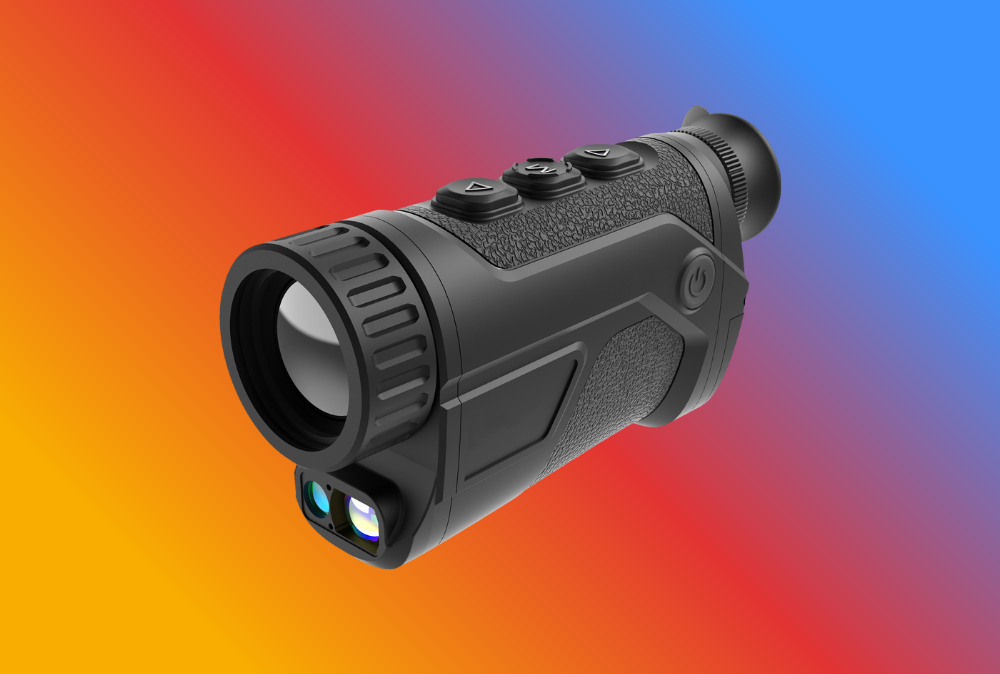
A thermal monocular is a handheld imaging device that detects infrared radiation (heat) instead of visible light. Inside, a thermal imaging module converts tiny temperature differences into an electronic signal, which is then processed into a grayscale or colorized image. For long range use, the monocular combines:
- A sensitive thermal sensor (often 384×288 or 640×512 resolution).
- A lens with relatively long focal length (typically 35 mm, 50 mm, or more).
- Image processing algorithms that enhance contrast, reduce noise, and manage hot/cold backgrounds.
Unlike day optics, thermal devices do not need ambient light or IR illuminators. That is what makes a long range thermal monocular so attractive for night hunting, border security, and patrol: users can detect hot targets in complete darkness, through light brush, or in mixed lighting where traditional night vision struggles.
For a B2B audience, long range thermal monoculars usually fall into a few key use cases:
- Hunting and wildlife observation – Spotting, tracking, and identifying animals over large fields, forest edges, or open hillsides.
- Law enforcement and security – Detecting humans at stand-off distances, searching for suspects, and monitoring perimeters without visible lights.
- Border and critical infrastructure protection – Continuous observation of long fences, coastlines, or remote assets where early detection is critical.
- Search and rescue (SAR) – Locating missing persons in large areas, especially in cold backgrounds where human body heat stands out strongly.
In all of these scenarios, the “long range” label only matters if users can reliably detect, recognize, and identify targets at distances that align with the promises you make. The spec sheet is only useful if you know which numbers correlate with that real-world ability.
3. Market Relevance: Where Long Range Really Matters
Not every thermal monocular needs to be long range. For many forestry or pest control applications, a compact, wide-field handheld thermal monocular is more than enough. But in several segments, long range is directly tied to ROI and perceived value.
3.1 Hunting and Outdoor Dealers
For hunting-focused brands, a long range thermal monocular is typically positioned as a premium scouting tool that sits above entry-level spotters. Dealers use it to upsell serious hunters who already own a rifle scope or day optics and want an edge in spotting animals before anyone else.
Here, the perceived range capability and image clarity at 1,000 m or more directly affects how much customers are willing to pay. If your long range thermal monocular fails to outperform cheaper devices in that distance band, dealers quickly lose confidence, and the product becomes hard to move at a premium price.
3.2 Tactical, Law Enforcement, and Security
For law enforcement agencies, private security companies, and certain government customers, the long range thermal monocular is often a safety and mission-critical tool. Patrol teams may need to surveil large areas from a stand-off position or scan ridgelines and valleys for hidden persons.
In this segment, decision-makers want:
- Clear, repeatable performance metrics for human detection, recognition, and identification.
- Assurance that the device will hold up under rough handling and weather.
- Confidence that the long range thermal monocular will integrate with existing radios, mapping tools, or recording systems.
ROI is measured in fewer missed detections, safer patrol patterns, and fewer man-hours spent on low-yield searches.
3.3 Border, Infrastructure, and Industrial Monitoring
Border forces and critical infrastructure operators use long range thermal monoculars as flexible mobile tools next to fixed cameras and radar. A handheld long range thermal monocular can verify alarms, support mobile patrols, or act as a backup if fixed systems fail.
For these buyers, long range performance is tied to coverage per device. A reliable long range thermal monocular can effectively “extend” the reach of each officer, reducing the number of devices needed for a given sector and lowering total system cost.
4. Technical Specs That Actually Predict Long Range Performance
Now we can get practical. When you read a spec sheet or talk to a module supplier, which numbers should you focus on for a long range thermal monocular?
4.1 Sensor Resolution, Pixel Pitch, and Lens Focal Length
These three parameters form the core of long range capability:
- Sensor resolution – Common options include 256×192, 384×288, 640×512, and sometimes 1024×768. For truly long range thermal monoculars, 384×288 is usually the minimum, and 640×512 is often preferred.
- Pixel pitch – The distance between pixels, in micrometers (µm). Modern sensors use 12 µm or 17 µm. For the same lens, smaller pixel pitch gives more “pixels on target” at a given distance.
- Lens focal length – Measured in mm (e.g., 25 mm, 35 mm, 50 mm, 75 mm). Longer focal lengths narrow the field of view and increase magnification, which improves long range detection and recognition.
As a rule of thumb, a 640×512, 12 µm sensor with a 50 mm lens has significantly more true long range capability than a 384×288, 17 µm sensor with a 35 mm lens, even if both spec sheets claim similar detection ranges.
For B2B buyers, the key is to compare these three numbers together, not in isolation. A “long range” label on a 25 mm lens device should trigger tough questions if your target market expects reliable recognition at 1,000 m and beyond.
4.2 NETD and Image Quality
NETD (Noise Equivalent Temperature Difference) is a measure of how small a temperature difference the sensor can detect. It is usually listed in mK (millikelvin), e.g., “NETD < 35 mK.” Lower values mean better sensitivity and finer detail, especially at long range and in low-contrast situations like warm nights or high humidity.
However, NETD on its own does not tell the whole story. Image quality at long range also depends on:
- Lens quality and coatings.
- Internal calibration (NUC) frequency and strategy.
- On-board image processing: noise reduction, sharpening, contrast, dynamic range.
When you compare offers, ask for real sample videos at long distances in different weather conditions. Use them to “stress test” the NETD value. A realistic long range thermal monocular evaluation should always combine spec sheet numbers with visual evidence.
4.3 Detection, Recognition, and Identification Ranges
Most manufacturers calculate detection, recognition, and identification distances based on standardized models (for example, a human target of a given size, specific contrast, and certain observation criteria). These values can help compare devices, but they are often over-interpreted.
For B2B purposes, consider using a factor-of-three rule when translating these numbers into your own marketing claims:
- Internal technical documentation uses the full lab-tested detection/recognition/identification distances.
- External marketing materials and dealer training focus on conservative practical ranges, often significantly shorter than lab values.
For example, if a long range thermal monocular is rated for 2,400 m human detection, 1,200 m recognition, and 800 m identification, you might position it in your catalog as a “reliable 1,200 m spotting and 700–800 m ID device.” This gives dealers a safer story to tell and reduces the chance of disappointed end users.
4.4 Example Comparison Table
The table below shows three simplified long range thermal monocular configurations and how they differ conceptually. These numbers are illustrative, not product-specific, but they help structure your thinking.
| Model Type | Sensor Resolution | Pixel Pitch | Lens Focal Length | Typical Use Case Focus | Practical Human ID Range* |
|---|---|---|---|---|---|
| Compact field spotter | 384×288 | 17 µm | 35 mm | General hunting, mid-range scan | 500–600 m |
| Balanced long range monocular | 640×512 | 12 µm | 40 mm | Mixed hunting + patrol | 700–900 m |
| Premium long range specialist | 640×512 | 12 µm | 50–75 mm | Dedicated long range spotting | 1,000–1,300 m |
*Practical ID range here assumes real-world field conditions, not ideal lab tests.
When you evaluate OEM proposals, use a similar table to position each configuration in your lineup. It helps you avoid the trap of buying three different devices that all claim “2 km detection” but behave very differently in practice.
5. System-Level Factors Beyond the Spec Sheet
A long range thermal monocular is more than a sensor and a lens. Several system-level choices can make or break long range usability, even when the core imaging specs are strong.
5.1 Ergonomics and User Interface
Long range observation typically involves extended viewing sessions, sometimes in cold, wet, or windy conditions. If the device is:
- Too heavy or badly balanced,
- Difficult to hold steady at high magnification, or
- Buried behind a confusing user interface,
then even a strong imaging core will not deliver usable long range performance.
For B2B buyers, pay attention to:
- Eyecup and eye relief – Can users maintain a stable, comfortable viewing position for several minutes?
- Button layout and tactile feedback – Can operators adjust zoom, palettes, or brightness without looking at the device?
- Digital zoom strategy – Over-aggressive digital zoom may create “blurry” impressions at long distances and reduce perceived performance.
A well-designed long range thermal monocular should be easy to operate with gloves, in darkness, and under stress.
5.2 Power, Battery, and Heat Management
Long range missions often involve long hours in the field. A premium long range thermal monocular that dies after two hours of use will not survive in professional markets.
Key questions to ask:
- What is the real continuous runtime at typical brightness and refresh rate settings?
- Are batteries hot-swappable without rebooting the device?
- How does the thermal core manage internal heating during continuous long range observation?
Good power design directly affects long range performance because sensors and lenses can drift thermally over time. Stable long range imaging requires both sufficient power and good internal thermal management.
5.3 Ruggedness and Environmental Protection
For hunters, law enforcement, and border forces, long range devices are often used in bad weather and rough terrain. A hard drop, unexpected rain, or vehicle vibration can all affect calibration and optics alignment.
Look for:
- Ingress protection (IP) rating suitable for outdoor use.
- Shock and vibration resistance, especially if the same core is used in a thermal scope that will experience recoil.
- A clear warranty and service policy that covers long term professional use.
Even if you are focusing on a handheld thermal monocular rather than a weapon-mounted thermal scope, long range users tend to treat the device like a tactical tool, not a fragile consumer gadget.
6. OEM/ODM Integration Considerations
If you are building your own branded long range thermal monocular line, you are likely working with an upstream supplier of thermal imaging modules and, in many cases, a laser rangefinder module as well. Integration decisions here will determine how competitive and reliable your final product is.
6.1 Choosing the Right Core and Firmware Options
A good starting point is to work closely with your Thermal Imaging Modules partner and clarify:
- Sensor options (resolution, pixel pitch, frame rate).
- Supported lenses and their mechanical interfaces.
- Available image processing modes (adaptive contrast, ultra-clear modes, automatic gain control).
Insist on firmware that allows you to fine-tune image processing for long range conditions. For example, being able to switch between “high contrast” for humid nights and “soft detail” for dry, cold environments can turn a decent long range thermal monocular into a truly flexible professional tool.
6.2 Integrating a Laser Rangefinder
Many long range thermal monoculars now incorporate a laser rangefinder module to provide exact distance readings to targets. When you consider this integration, check:
- Laser class and safety compliance (Class 1 or Class 1M for eye safety).
- Maximum range on typical field targets, not just highly reflective markers.
- Beam divergence and aiming alignment between thermal image and laser spot.
- Communication interface (UART, RS-232, CAN, or other) and protocol simplicity.
A well-integrated laser rangefinder makes it much easier for users to judge whether a target is within their effective range and can even support ballistics if your thermal monocular is part of a broader ecosystem that includes thermal scopes or day optics.
6.3 Interfaces, SDK, and System Integration
Professional buyers increasingly expect thermal monoculars to connect into their broader systems. That is where a good software development kit (SDK) and flexible interfaces matter.
Clarify with your supplier:
- Whether the long range thermal monocular can output video over analog, USB, or network interfaces.
- If there is an SDK for integration into existing VMS systems, Android apps, or mapping tools.
- How firmware updates are delivered and whether you can rebrand or customize the UI without losing warranty.
For advanced solutions, it can be helpful to align your long range monocular roadmap with your Thermal Monocular Devices and other smart optics in your portfolio, so your engineering team can reuse code, UI concepts, and integration pathways.
6.4 Compliance and Certification
Compliance is not just a checkbox. For B2B sales, it can be the deciding factor between winning a tender and being disqualified.
For each long range thermal monocular model, ensure clarity on:
- EMC and safety standards (e.g., CE, FCC).
- RoHS and environmental compliance.
- Laser safety documentation if a rangefinder is integrated.
- Export control status, especially if selling into sensitive markets.
Having a clear technical file and documentation ready allows your OEM/ODM Partner Program to present a professional, low-risk image to global distributors and government buyers.
7. Cost, Compliance, and Lifecycle ROI
A long range thermal monocular is a high-ticket item. Small performance differences can have a large impact on cost, but also on lifetime value and service costs.
7.1 Balancing Sensor and Lens Upgrades
Upgrading from a 384×288, 35 mm device to a 640×512, 50 mm design can easily increase your unit cost significantly. The question is whether the real-world long range performance gain is visible to your customers and worth the price increase.
A practical strategy is to design a tiered product line:
- A “balanced mid-range” device for most hunters and basic patrol needs.
- A “true long range” flagship for demanding professional users and prestige markets.
Each step up in sensor resolution or lens length should deliver a clearly visible improvement in practical identification range, not just another impressive detection number.
7.2 Compliance and Service Cost
Devices that are poorly documented or lack clear compliance can become expensive to maintain. Customs delays, rejected tenders, or extra testing all add hidden costs that eat into your margin.
From a lifecycle perspective, a well-documented long range thermal monocular with clear CE/FCC/RoHS compliance and robust laser safety documentation can save months of friction and significantly reduce the workload on your technical support team.
7.3 Managing RMA Risk Through Honest Specs
One of the biggest hidden costs in long range thermal monocular programs is RMA and warranty returns driven by over-promised specs. When marketing claims are not aligned with real long range performance, the following tends to happen:
- Dealers over-sell the device as “3 km capable.”
- Users take it into challenging conditions and feel let down.
- Devices are returned as “defective” even though they technically meet lab specs.
You can dramatically reduce this risk by:
- Using conservative, field-tested performance claims in your catalogs and training.
- Providing demo units and sample footage to key dealers.
- Educating partners about detection vs recognition vs identification.
In the long run, a slightly more modest long range claim with excellent reliability is more profitable than an aggressive range claim with high return rates.
7.4 Buyer Insights in a Nutshell
When your engineering and commercial teams sit down to plan a new long range thermal monocular, keep these buyer-focused points in mind:
- Serious users care more about consistent real-world ID range than about maximum lab detection distance.
- Clear compliance and documentation make it easier to win tenders and reduce legal risk.
- Honest performance claims reduce RMAs and build trust with dealers and end users.
- A tiered lineup with clearly differentiated long range capabilities helps you cover more price points without confusing the market.
- Long-term support, firmware updates, and service plans are part of the ROI story, not an afterthought.
8. How to Read a Long Range Thermal Monocular Spec Sheet in 10 Minutes
To make this practical, here is a step-by-step way for a product manager or buyer to evaluate a long range thermal monocular proposal quickly and consistently.
First, go straight to the sensor and lens section. Note the resolution (e.g., 384×288 vs 640×512), pixel pitch (12 µm or 17 µm), and focal length (35 mm, 40 mm, 50 mm, 75 mm). This combination tells you more about long-range potential than any headline range claim.
Second, check NETD and frame rate. Look for NETD values below 40 mK for serious long range use, and make sure the frame rate fits your target market’s export rules and use case. High frame rates are helpful for tracking moving targets at long distances, but they must be paired with good noise performance.
Third, review the detection/recognition/identification ranges for human targets. Instead of taking them at face value, mentally translate them into conservative practical ranges. For example, divide the ID range by a safety factor that reflects your own field experience and climate.
Fourth, scan the mechanical and environmental specs. Check IP rating, operating temperature range, and drop or shock resistance. A long range thermal monocular that meets your performance needs but fails in heavy rain or cold mountain conditions will not satisfy professional users.
Fifth, consider integration and ecosystem. See whether the device provides video output, supports recording, or can talk to other systems you offer, such as Thermal Scope Solutions or mobile apps. This ecosystem view often influences repeat business more than raw specs.
Lastly, review warranty, service, and documentation. Make sure there is clear coverage for professional use, defined turnaround times, and accessible documentation for compliance checks. If your supplier is vague here, expect friction later.
By following this checklist, your team can compare offers more systematically and avoid chasing impressive but unrealistic long range claims.
9. Partnering for a Sustainable Long Range Lineup
A strong long range thermal monocular program is rarely built on a single “hero product.” Instead, successful brands develop a coherent lineup and a clear, honest performance story that runs through their entire portfolio.
You might start with a reliable mid-range device built around your preferred Thermal Imaging Modules, then add a flagship long range monocular with a larger lens and integrated Laser Rangefinder Modules. Over time, you can connect these devices to your thermal scopes, clip-ons, and other optics so dealers can offer complete packages.
As you scale, it becomes important to work with partners who understand both the engineering and commercial sides of long range thermal imaging. A good OEM/ODM Partner Program is not just about hardware; it includes co-design support, joint field testing, and shared training content for your distributors.
When you are ready to refine your next generation of long range thermal monoculars, you can contact our engineering team to review your current specifications, discuss realistic range targets, and map out a tiered product strategy that aligns with your markets and price ladders. The goal is not just to win the spec-sheet game, but to build a long-term, profitable business around thermal devices that perform exactly as promised.
FAQs: Long Range Thermal Monoculars for B2B Buyers
Q1: Is a 640×512 sensor always necessary for a long range thermal monocular?
Not always. A well-optimized 384×288, 12 µm sensor with a good 35–40 mm lens can deliver strong performance for many hunting and basic patrol scenarios. However, for premium long range applications where users expect reliable identification beyond 800–900 m, a 640×512 sensor with a longer lens often provides a visible advantage and stronger perceived value.
Q2: Why do some devices with similar detection ranges feel very different in the field?
Because detection range is calculated under ideal conditions and focuses only on spotting the presence of a target. Real field performance depends heavily on recognition and identification capability, weather, cluttered backgrounds, NETD, lens quality, and image processing. Two devices with similar lab detection ranges can deliver very different experiences in real terrain and climate.
Q3: How can we reduce return rates for long range thermal monoculars?
Anchor your marketing claims to conservative, field-tested performance rather than headline detection numbers. Provide sample footage, train dealers on what “long range” really means for your devices, and make sure your specifications clearly distinguish detection, recognition, and identification. This sets more realistic expectations and significantly reduces RMA driven by disappointment rather than true defects.
Q4: What is the best way to differentiate models in a long range lineup?
Use a combination of sensor resolution, pixel pitch, lens focal length, and feature set (e.g., integrated laser rangefinder, recording, advanced connectivity). Each model should have a clearly defined practical ID range and role: one as a versatile all-rounder, one as a true long range specialist, and possibly a smaller unit for compact carry. Align these roles with distinct price points so dealers can guide customers smoothly up your range.
By focusing on the numbers that truly matter—and translating them into honest, field-relevant promises—you can build a long range thermal monocular portfolio that dealers trust, users rely on, and your finance team is happy to support for years.