If you already sell thermal monoculars and rifle scopes, adding a handheld thermal scope can feel like overlap or even internal competition. Done right, though, a handheld thermal scope becomes the “bridge product” that turns spotters into shooters and gives dealers a clean upsell ladder. This guide shows how to define the role, spec and pricing of handheld thermal scopes between monoculars and thermal rifle scopes so every product has a clear job in your line-up.
Table of Contents
ToggleIn this guide you will learn
- What role a handheld thermal scope should play between monoculars and rifle scopes
- How to spec optics, ergonomics and firmware so the product feels “dual-role”
- How to avoid cannibalizing your thermal monocular and rifle scope sales
- How to build a good-better-best ladder for dealers and OEM/ODM partners
- How to brief your China factory so handheld thermal scopes share modules and parts
Step 1: Define the unique job of a handheld thermal scope
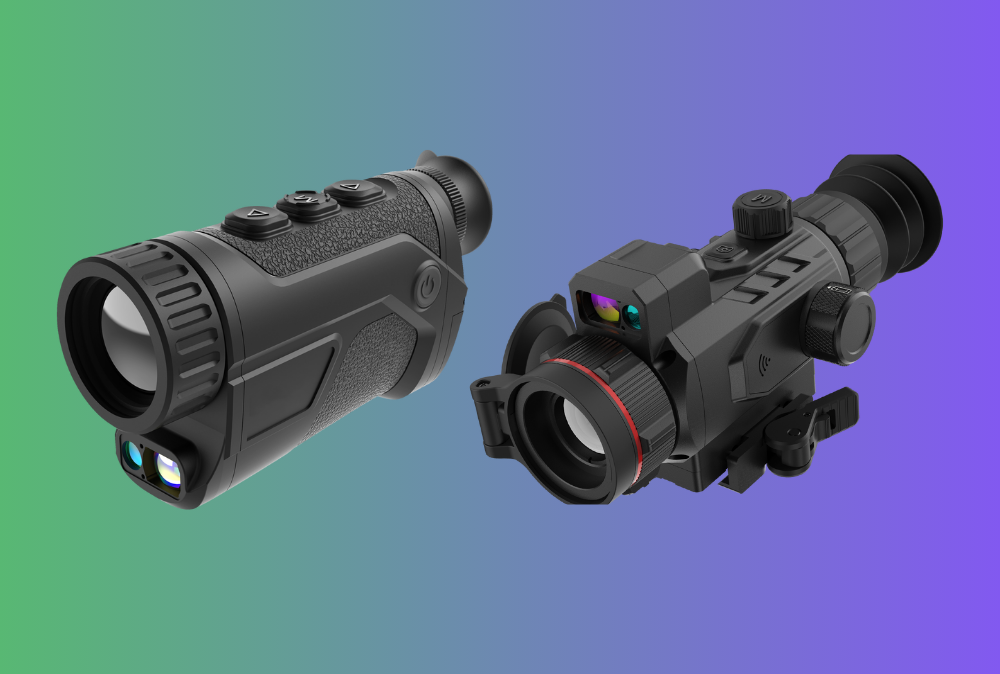
A thermal monocular is a pure spotting tool; a thermal rifle scope is a dedicated shooting optic. A handheld thermal scope sits between them:
- It functions as a spotter in the hand most of the time.
- It can be mounted to a rail or quick-detach system when the user wants to shoot.
- It shares the same “image feel” and ballistics assumptions as the rifle scope family.
From a product strategy angle, you want the handheld thermal scope to:
- Convert “curious spotter” customers into full-solution users (spotter + gun optic).
- Give professional users (guides, game wardens, security teams) a flexible tool that can jump between observation and engagement.
- Let dealers bundle handheld + weapon packages without overcomplicating inventory.
Think of it as a transitional platform: users who start with a handheld thermal scope should naturally progress to a dedicated rifle scope when their shooting use becomes serious, while still keeping the handheld unit as a backup or secondary optic.
Step 2: Map the three roles in one view
Start by mapping your three key categories side-by-side. This gives your product definition and marketing teams a shared language.
| Product type | Primary role | Typical user behaviour | Where handheld thermal scope sits |
|---|---|---|---|
| Thermal monocular | Spotting only | Scans fields, tracks animals, no direct aiming through the device | Handheld scope must feel almost as light and quick as a monocular |
| Handheld thermal scope | Spotting + occasional shooting | Scans in hand; sometimes mounted to a rifle or carbine | Bridge between pure spotter and full rifle scope |
| Thermal rifle scope | Dedicated shooting optic | Lives on the rifle, zeroed, used primarily when the shot is imminent | Handheld scope feeds users into this category as their “next step” |
Once this is clear, you can decide what must be shared and what must be different between the three families.
Step 3: Optics and mechanics – design for dual-role use
The optics and housing define how “scope-like” your handheld thermal scope feels.
Optics choices
- Magnification & FOV
- Too much base magnification makes it clumsy as a scanner.
- Too little magnification makes it unsatisfying as an aiming optic.
- Many brands land in the 1.5–3× base magnification range with a moderate field of view so users can scan and still aim precisely.
- Objective diameter & weight
- You want enough aperture for good image quality but not the weight of a full-size rifle scope.
- Think of “mid-size rifle scope” glass, not “micro monocular” or “giant long-range optic”.
- Mounting interface
- Use a robust rail or clamp system that can repeat zero if the scope is mounted consistently in the same position.
- Quick-detach mounts let users swap between handheld and rifle quickly.
Mechanical design ideas
- Two grip modes
- Comfortable hand-held grip with controls on top / side.
- Clear “scope” geometry when mounted so the eye box and cheek weld make sense.
- Shared accessory ecosystem
- Batteries, cables and some mounts should be shared with your thermal monoculars and rifle scopes.
- This increases attach-rate for accessories and simplifies OEM supply chains.
For OEM/ODM projects, building all three categories on the same thermal camera module platform cuts engineering cost and ensures a consistent image signature across your brand.
Step 4: Firmware & UX – feel like a scope in hand
A handheld thermal scope that tries to be a monocular and rifle scope at the same time can end up confusing. The firmware and UI must reinforce its bridge role.
UX principles for handheld thermal scope
- Two main operating profiles
- Handheld mode: priority on wide view, quick zoom steps, fast image optimization.
- Mounted mode: priority on reticle clarity, stable zero, shot recording/logging.
- Mode switching
- Don’t bury it. A single long-press or menu tile labelled “Handheld / Mounted” is better than a hidden advanced menu.
- The mode can toggle secondary features (reticle visibility, button mapping, standby behaviour).
- Reticle behaviour
- In handheld mode, hide reticles or show only a subtle center mark so it feels like a spotter.
- In mounted mode, show full reticle options aligned with your thermal rifle scope portfolio.
- Recoil profile
- When you know the intended calibres and recoil levels, build in appropriate filter and trigger behaviour.
- Make clear in documentation which mode and mount patterns are truly recoil-rated.
If you already have rifle optics, reuse reticles, ballistic profiles and menu logic where possible so users feel at home when they upgrade.
Step 5: Pricing & positioning – build a clean ladder
You want dealers to instantly understand where your handheld thermal scope sits in the line-up.
Typical ladder structure
- Thermal monocular – lowest price, pure spotter
- Handheld thermal scope – mid-price, dual-role
- Thermal rifle scope – highest price, dedicated shooting optic
Some simple rules:
- Handheld thermal scopes should be noticeably more expensive than monoculars with similar sensors (to reflect mounting hardware, firmware and recoil engineering) but clearly cheaper than rifle scopes with the same core.
- On spec sheets, highlight the dual-role value instead of raw pixels:
- “Scan in hand, mount to rifle in seconds”
- “Shared reticles with our rifle scope family”
This way, handheld thermal scopes become a high-margin middle rung that naturally steers heavy shooters into full scopes while keeping more budget-conscious users in your ecosystem.
Step 6: Use kits and bundles to connect the dots
Dealers don’t just want products; they want packages they can sell quickly:
- Spotter Kit (Entry)
- Thermal monocular + basic case + charger
- Hybrid Kit (Mid)
- Handheld thermal scope + quick-detach mount + rail adapter
- Full Hunter Kit (Top)
- Handheld thermal scope + dedicated rifle scope + shared accessories
Design your handheld thermal scope packaging and accessories so it fits seamlessly into these kits. For OEM/ODM, you can define shared foam inlays, multi-product boxes and co-branded materials to keep logistics simple.
Step 7: OEM/ODM considerations with your factory
If you’re working with a China OEM partner, positioning decisions must travel all the way down to engineering and production.
Key points to include in your brief
- Shared module: handheld thermal scope uses the same core as your rifle scope or monocular for image consistency.
- Recoil rating: clearly specify which rifles and calibres the mounted configuration must survive.
- Accessory compatibility: batteries and mounts shared with existing families.
- Firmware variants: SKUs for “handheld only” vs “handheld + mounted” if you want price-differentiated models.
You can also leverage pages like thermal rifle scope OEM/ODM and thermal monocular OEM/ODM as internal checklists: if your handheld thermal scope doesn’t align with those capabilities, refine the spec.
Frequently Asked Questions {#faq}
Q1: Won’t a handheld thermal scope cannibalize rifle scope sales?
It might if you price and position it too close to your rifle scopes. Keep it clearly between monoculars and rifle scopes in both features and price, and frame it as a bridge product. Heavy shooters will still want a dedicated rifle optic.
Q2: Should every handheld thermal scope be recoil-rated?
If the product’s promise includes mounting to rifles, it must be tested at realistic recoil levels. However, you can also create a “handheld only” variant with lower cost and weight for markets that don’t need weapon use.
Q3: Is a handheld thermal scope better than a monocular for guides and outfitters?
Often yes. Guides can scan in handheld mode and still have the option to mount the device if they need a quick shooting solution. For pure scouting with no shooting, a lighter monocular can still be the right choice.
Q4: Can I use the same housing design for monoculars and handheld scopes?
You can share design language and some mechanical parts, but the handheld thermal scope needs more robust mounting options and eye relief suitable for rifle use. A straight reuse of a monocular shell usually won’t be enough.
Q5: How do I explain handheld thermal scopes to dealers?
Give them a simple message: “This is the product between our monoculars and rifle scopes. It scans like a monocular but can be mounted when needed, and it leads users naturally into our full rifle scope line.”
Summary and next steps
A well-positioned handheld thermal scope is not a redundant extra—it’s the bridge between spotting and shooting in your portfolio. By defining its unique job, tuning optics and firmware for dual-role use, building a clean price ladder and sharing modules and accessories with monoculars and rifle scopes, you give dealers a compelling middle choice that strengthens, rather than weakens, your line.
Next steps:
- Map your current monocular and rifle scope specs and prices.
- Decide what the middle “handheld thermal scope” tier should offer—and what it should deliberately not do.
- Work with your OEM/ODM partner to design a shared-module product that fits those requirements.
- Build simple kits and sales stories so dealers know exactly when to recommend each step in the ladder.
If you’re exploring a new handheld thermal scope line, Gemin Optics can help you align module choices, optics and firmware so it slots cleanly between your existing thermal monoculars and thermal rifle scopes. For OEM/ODM discussions, you can contact us to review concepts and roadmaps.Extended thinking