When a project is “practically complete” but not yet handed over, everyone is under pressure: the owner wants keys, the GC wants retention released, and subcontractors want to close their punch lists. It’s also the stage where hidden defects in the building envelope and services can either be caught cheaply—or come back as multi-year warranty headaches.
Table of Contents
ToggleIndependent research on construction claims has shown that the majority of defects and warranty call-backs are related to the building envelope and mechanical systems—issues like water infiltration, air leakage, thermal bridging and wet insulation. These are precisely the areas where a thermal camera for construction can see problems before they show up as stains, mold or comfort complaints.
This article is written for developers, general contractors, façade and roofing contractors, owner’s reps, and OEM/ODM buyers who want to build or source construction thermal cameras and workflows that really work on site—not just look good in a catalog.
We’ll walk through:
- How building-science thermography actually works in construction
- What makes a “thermal camera for construction” different from a generic thermal imager
- The key specs that matter for leak detection and envelope QA
- Typical use cases before hand-over
- How to evaluate a thermal camera construction OEM/ODM partner in China
- Where Gemin Optics fits in as a China manufacturer and engineering partner
1. Why Construction Defects Hide in Plain Sight at Hand-Over
1.1 Building envelope failures dominate risk
Building-envelope systems—roofs, façades, windows, balconies, parapets—have become more complex: layered membranes, multiple cladding systems, and tight energy codes. An engineering paper on infrared building-envelope testing notes that, in one study, over 84% of construction-related claims, defects and warranty call-backs were linked to the building envelope and mechanical systems.
The biggest culprits include:
- Water infiltration through poorly detailed joints or flashing
- Moisture accumulation in walls or roofs
- Air leakage through discontinuous air barriers
- Thermal bridges around structural elements and penetrations
None of these are easy to see with the naked eye on a new building, especially before visible damage appears.
1.2 Traditional inspection is slow and fragmented
Before thermal imaging, QA teams relied on:
- Visual checks from lifts and scaffolds
- Tap tests on render or tiles
- Core cuts and test openings
- Spot moisture-meter readings
- Limited water spray tests
These methods are:
- Slow – you only sample a small percent of the envelope
- Intrusive – many require cutting finishes that must be repaired
- Reactive – often triggered by a complaint or stain
In contrast, thermography can scan whole façades, roofs or interior walls from a distance and flag anomalies for targeted destructive testing.
1.3 Why thermography fits modern QA
Building-science organizations have been using infrared thermography since the 1960s for insulation checks, air-leakage detection, moisture intrusion, façade delamination and roof moisture inspections.
Today:
- National and international standards such as ASTM C1060, ASTM C1153 and ASTM E1186 define procedures for using IR cameras to detect missing insulation, wet roofing, and air leakage in building envelopes.
- ISO 6781-1:2023 specifies requirements for infrared thermographic services to detect heat, air and moisture irregularities in buildings.
- Energy-efficiency programs from the U.S. Department of Energy (DOE) and others explicitly include infrared scans as part of building audits and envelope diagnostics.
In other words: infrared thermography is no longer an exotic tool; it’s a standardized, recognized way to manage risk in construction QA.
2. What Is a Thermal Camera for Construction?
2.1 Infrared thermography in plain language
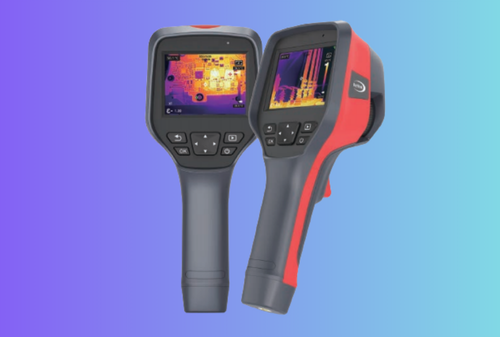
A thermal camera detects long-wave infrared radiation emitted by surfaces and converts it into a temperature map (a thermogram). Instead of visible light, you see temperature differences—often as small as 0.05–0.08 °C—mapped into color.
For construction QA, those temperature patterns can reveal:
- Missing or poorly installed insulation
- Air leakage paths when combined with blower-door pressurization
- Moisture in walls and roofs (wet materials cool or heat differently)
- Voids in concrete or masonry
- Underfloor heating loops and embedded pipes
2.2 How a construction thermal camera differs from a generic thermal imager
Any thermal imager can “see heat,” but a thermal camera for construction is optimized for building-envelope and interior diagnostics:
- Temperature range
- Building work usually needs −20 °C to 150 °C, occasionally up to 250 °C.
- High-temperature ranges (e.g., 650 °C+) are more relevant to industrial process monitoring and electrical switchgear.
- Sensitivity and resolution tuned to subtle gradients
- To see moisture, air leakage and insulation defects, you need a low NETD (noise-equivalent temperature difference) and adequate pixel resolution to resolve framing bays, fasteners, and hairline patterns.
- Field-of-view (FOV) balanced for façades and interiors
- Wide enough for whole wall sections from a reasonable distance, but not so wide that you lose spatial detail.
- Building-science features in firmware
- Multiple palettes, wall and roof profiles, emissivity presets for common materials, and reporting tools that work with construction workflows.
- Compliance with relevant standards
- For professional services, your construction thermal camera should be suitable for work under ASTM and ISO procedures; it doesn’t need formal certification to those standards, but its performance and calibration must be compatible.
3. Key Specs and Design Choices for Construction Thermal Cameras
For buyers specifying a thermal camera for construction—or OEM/ODM brands working with a Chinese factory—these spec decisions affect what your inspectors can actually see.
3.1 Detector resolution and NETD: seeing the small stuff
Resolution
For envelope and interior diagnostics, common detector resolutions are:
- 160 × 120 – entry-level; usable for close-range checks but limited on tall façades
- 256 × 192 / 320 × 240 – good general-purpose level for interior walls and small façades
- 384 × 288 – strong balance for most QA teams; enough detail for framing patterns at moderate distance
- 640 × 480 / 640 × 512 – premium; ideal for high-rise façades, long standoffs, and detailed analysis
On a typical mid-rise façade, a 640×480 industrial thermal camera lets you see patterns in individual insulation boards or masonry units from the ground or adjacent building. That’s critical for spotting localized moisture or thermal bridging.
NETD (thermal sensitivity)
- Aim for NETD ≤ 60 mK as a minimum for construction QA
- For demanding leak detection and subtle moisture anomalies, NETD ≤ 40 mK is preferable
High sensitivity is particularly important when:
- Indoor–outdoor temperature differences are modest (5–10 °C)
- You’re looking for early-stage moisture or small insulation voids
- Environmental noise (wind, solar loading) makes patterns faint
3.2 Field of view, optics and working distance
The right optics depend on how your teams work:
- Wide-angle lenses (40–50°)
- Best for interior work, small rooms, and balcony details
- Good when you can stand relatively close to the surface
- Standard lenses (24–32°)
- Good compromise for most envelope scans from the ground or lift
- Enough framing detail while still covering a decent area
- Telephoto options (12–15°)
- For high façades, roofs from adjacent buildings, or long stand-off distances
- Useful where access is restricted or scaffolding is minimal
For OEM buyers, offering a construction thermal camera platform with interchangeable lenses (or at least two focal-length SKUs) makes it easier to match cameras to specific trades: façade inspectors, roofers, and interior QA teams.
3.3 Temperature range, accuracy and building standards
For construction work:
- Typical temperature range: −20 to 150 °C
- Accuracy: ±2 °C or ±2% of reading (whichever is greater) is common and adequate
Standards like ASTM C1060 (insulation inspection) and ASTM E1186 (air-leakage site detection) set recommended indoor–outdoor temperature differences (often 10 °C or more) and environmental conditions, rather than mandating a specific camera accuracy.
However, consistent calibration is important when:
- You want to compare scans across seasons or years
- You’re documenting defects for legal or insurance purposes
- You’re using thermal camera construction data to support performance guarantees
3.4 Ruggedness, safety and ergonomics
Construction sites are harsh. When you spec an industrial thermal imaging camera for building work, look for:
- Ingress Protection: IP54 or above for dust and splash resistance
- Drop rating: Typically 1–2 m to concrete
- Operating temperature: At least −10 to 50 °C
- Display readability: High-brightness screen for outdoor use
- Glove-friendly controls: Large buttons or joystick for cold-weather work
For OEM/ODM programs, a China thermal camera for construction manufacturer should support:
- Housing materials that resist UV, impact, and chemical exposure
- Anti-slip grip designs for ladder and lift work
- Optional intrinsically safe or ATEX variants for petrochemical and hazardous environments (often needed around fuel storage, tank farms, or some industrial plants)
3.5 Connectivity, reporting and cloud workflows
For construction QA, the value is in the report, not just the image.
Practical features for a construction thermal camera include:
- Wi-Fi/Bluetooth to sync images to tablets or cloud apps
- On-camera annotation (voice notes, markers) by location or drawing
- Automatic file naming by project, floor, and area
- Integration with QA platforms or custom apps via SDK
Many envelope commissioning guidelines recommend pairing thermography with blower-door tests, duct leakage tests and moisture measurements, then compiling everything into a unified report. Cameras that streamline that workflow reduce both admin time and disputes later.
Example spec tiers for construction thermal cameras
| Tier | Target user | Typical resolution | NETD | Key use cases |
|---|---|---|---|---|
| Entry | Foremen, site supervisors | 160×120 – 256×192 | ≤60–80 mK | Quick checks of cold bridges, missing insulation, simple leak tracing |
| Core QA | QA/QC teams, envelope consultants | 320×240 – 384×288 | ≤50 mK | Routine façade, roof and interior commissioning, punch lists |
| Expert | Specialists, consulting engineers | 640×480 / 640×512 | ≤40 mK | High-rise façades, detailed forensic work, documentation for claims |
4. Application Scenarios: Where Thermal Cameras Catch Defects Before Hand-Over
4.1 Façade and envelope insulation defects
Thermography has long been used to locate missing or damaged insulation in framed walls and façade systems. With a thermal camera for construction and sufficient indoor–outdoor temperature difference, you can:
- See where insulation is missing or settled in exterior walls
- Spot thermal bridges at slab edges, balconies, and structural penetrations
- Identify cold corners where condensation and mold may form
Typical workflow:
- Heat or cool the building to create a ≥10 °C indoor–outdoor temperature difference for several hours.
- Walk interior and exterior elevations with the camera, recording thermal patterns.
- Mark suspicious areas for follow-up moisture readings or destructive verification.
By doing this before finishes are fully closed—or before hand-over—you can correct problems when access is still reasonable.
4.2 Roof moisture and wet insulation
Standards such as ASTM C1153 describe methods for locating wet roof insulation using infrared imaging. SGH+1 Wet insulation has higher heat capacity than dry materials, so after a sunny day, wet areas stay warmer longer at night.
A construction thermal camera can:
- Highlight “warm islands” in flat roofs that indicate trapped moisture
- Separate amorphous patterns from board-shaped anomalies (e.g., wet insulation boards vs. boards installed wet)
- Help prioritize where to cut test cores and repair membranes
For owners and contractors, catching roof moisture before hand-over can avoid extremely expensive re-roofing or legal disputes years later.
4.3 Bathrooms, balconies and water-proofing details
Bathrooms, balconies, and podium slabs are high-risk areas for leaks because of:
- Many penetrations (drains, pipes, anchors)
- Complex waterproofing layers
- Frequent movement at joints
A construction thermal camera helps by:
- Locating moisture spreading under tiles or screed after controlled water tests
- Identifying cold patterns that trace water paths from balconies into interior walls
- Documenting that membranes and slope-to-drain perform as intended
Thermal imagery is particularly powerful when combined with moisture meters and written test protocols.
4.4 Underfloor heating and embedded services
Thermography is a practical way to:
- Confirm the layout and spacing of underfloor heating loops
- Verify that every circuit is connected and operating correctly
- Locate embedded pipes to avoid drilling damage
Snell Infrared and others have documented numerous examples where thermal imaging revealed missing or misrouted hydronic heating loops and helped avoid costly slab rework.
An industrial thermal imaging camera tuned for building work can see embedded coils even through several centimeters of screed or concrete when the system is operating.
4.5 Air leakage and comfort issues
Excessive air leakage can account for a significant share of heating and cooling losses in leaky buildings, reducing comfort and increasing energy bills.
Combining blower-door testing with a thermal camera for construction allows QA teams to:
- Pressurize or depressurize the building
- Walk interior surfaces and scan for cold (or hot) streaks that show infiltration
- Document leakage at window interfaces, sill details, top-floor ceilings, service penetrations, and stairwells
ASTM E1186 and related standards outline how IR scans can be used during pressurization to detect air-leak sites in building envelopes. SGH This kind of testing is increasingly included in commissioning plans for high-performance buildings.
4.6 Structural and façade safety
In some markets, thermography is also used to check:
- Delamination of façade tiles or stone
- Grouted cores in masonry or precast elements
- Voids around anchors or structural embeds
Because delaminated tiles or debonded layers heat and cool differently, they show distinct thermal patterns compared to sound areas. efficiencyvermont.com While thermography alone cannot replace structural testing, it can quickly highlight where to investigate more closely.
5. How to Choose a China Thermal Camera for Construction Factory / Supplier
If you’re a brand, distributor, or integrator considering a thermal camera for construction China manufacturer, you’re not just buying a sensor—you’re buying a building-science toolchain. Here’s how to evaluate OEM/ODM partners.
5.1 Engineering capability and building-science literacy
Look for a supplier who:
- Understands ASTM and ISO frameworks relevant to building thermography (C1060, C1153, E1186, ISO 6781-1)
- Can explain why certain NETD, FOV and resolution levels are better for façades vs. interiors
- Has experience tailoring firmware and UI for building inspectors rather than just generic imaging
Ask for:
- Example thermograms of insulation defects, air leakage, roof moisture and underfloor heating
- Case studies or demo workflows showing how their construction thermal camera is used on actual projects
A true thermal camera construction OEM supplier in China should speak both “camera language” and “building language”.
5.2 Quality control, calibration and traceability
Thermal performance depends heavily on calibration and QC. You should expect:
- Factory calibration procedures traceable to recognized temperature standards
- Batch-level records for each industrial thermal camera or module
- Periodic re-calibration options, especially for fleets used in commissioning or legal documentation
If you build your own instrument around thermal camera modules—for example using thermal imaging modules from a specialized OEM—you also need to control the integration environment (heat sources, airflow, mechanical stresses) so calibration remains stable over time.
5.3 Mechanical design, environmental and safety testing
Construction use is demanding. When evaluating a China construction thermal camera factory, check whether they:
- Design housings for IP54+ ingress protection and 1–2 m drop resistance
- Perform thermal-cycle and vibration testing representative of site use
- Offer options for insulated housings or sunshades for outdoor work
- Can provide variants with certifications for hazardous environments if your projects include petrochemical or industrial plants
If you’re integrating modules into your own housing, services like thermal camera module integration can help you co-engineer optics, mechanics and firmware so the final system meets your environmental and regulatory targets.
5.4 Firmware, SDK and reporting stack
Your thermography program is only as strong as its data workflow.
Look for an OEM/ODM partner that offers:
- Flexible firmware with customizable measurement presets for building materials
- SDKs or APIs so you can plug imagery into your own QA portal or mobile apps
- On-device tagging (location, room, grid reference) and integration with QR or BIM IDs
- Batch export to standard formats (JPEG with embedded temperature, radiometric files, and CSV summaries)
For brands targeting construction QA, it’s often valuable to design a handheld thermal imager platform—based on an industrial core—that can later be cloned into multiple SKUs for different trades or markets.
5.5 Delivery, MOQ and after-sales support
For B2B buyers, commercial terms matter as much as specs:
- Reasonable MOQs for pilot runs (e.g., 20–50 units)
- Clear lead-time commitments and buffer capacity for scale-up
- Spare parts and repair policies for screens, batteries and optics
- Training materials for site teams (quick-start guides, checklists)
A strong thermal camera for construction OEM supplier in China will help you design not just the product but also a practical route to market and support model.
6. Gemin Optics as Your Construction Thermal Camera OEM/ODM Partner
Gemin Optics is a China-based manufacturer focused on thermal imaging modules, laser rangefinder modules, and finished devices for both industrial and outdoor markets. For construction and building-science applications, we can support three typical integration paths:
6.1 Build from modules
If you’re developing your own branded construction thermal camera, you can start from:
- Uncooled thermal imaging modules with resolutions from entry to high-end
- Multiple lens options suitable for interior or façade work
- Interfaces ready for rugged handhelds, tablets or embedded building QA tools
Working with configurable thermal camera modules, you control enclosure design, ergonomics, and your own software stack, while we ensure the thermal core is stable and factory-calibrated.
6.2 Customize handheld industrial thermal imagers
If you want faster time-to-market, Gemin Optics also offers handheld thermal imager platforms that can be tuned for industrial and construction use:
- Construction-ready optics and NETD for insulation, moisture and air-leak checks
- Rugged housings suited to site conditions
- OEM/ODM options: private label branding, UI customization, and workflow presets
These platforms can complement your existing industrial product range and connect to your own cloud or reporting systems. See our handheld thermal imager page for a sense of the base capabilities you can extend.
6.3 Combine handheld and online thermal monitoring
For complex facilities (data centers, industrial plants, large commercial buildings), owners increasingly pair:
- Handheld construction thermal cameras for commissioning and periodic inspections
- Fixed or online thermal imaging systems for 24/7 monitoring of critical assets
As an industrial thermal imaging partner, Gemin Optics can supply both modules and devices that cover handheld inspection and fixed monitoring, so you can architect end-to-end solutions that match your clients’ risk maps.
7. Work with a China Thermal Camera for Construction Manufacturer You Can Trust
A good thermal camera for construction program can:
- Shorten inspection routes and punch lists
- Catch leaks and insulation defects before they become expensive claims
- Provide visual proof that your building envelope and services perform as designed
But it only works if the hardware, firmware and workflow are aligned with building-science practice and recognized standards like ASTM C1060, ASTM C1153, ASTM E1186 and ISO 6781-1. SGH+1
As a China-based thermal imaging manufacturer and OEM/ODM supplier, Gemin Optics combines:
- Robust thermal imaging modules and handheld platforms
- Engineering support for optics, mechanics, firmware and integration
- Flexible OEM/ODM options for brands, distributors and system integrators in construction and industrial markets
If you’re planning a new construction thermal camera line—or want to add thermal QA capabilities into your existing industrial portfolio—we’d be happy to explore options.
- Contact our team to discuss your thermal camera for construction project and OEM/ODM needs.
- Share your target specifications, volumes and timelines so we can recommend the right module or device platform.
- You can also submit your OEM/ODM requirements and integration questions via the Gemin Optics contact page.