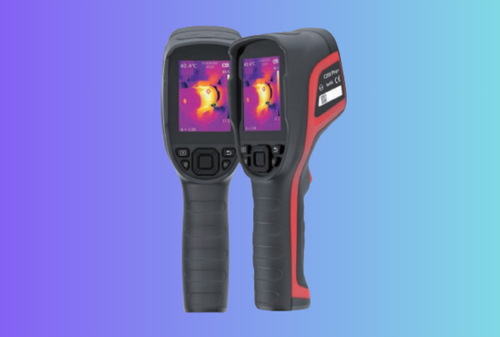
If you talk to maintenance or reliability engineers about infrared surveys, you’ll hear the phrase “FLIR electrical inspection” sooner or later. In many plants, FLIR-style electrical inspection workflows have become the de facto template for using an industrial thermal camera or industrial infrared camera on switchgear, MCCs, transformers and bus ducts.
Table of Contents
ToggleThis playbook shows how to design and run those workflows yourself—whether you are:
-
- A maintenance manager standardizing electrical thermography routes
-
- A service contractor building an IR inspection offering
-
- Or a B2B buyer planning an industrial handheld thermal camera program with a China OEM/ODM factory
We’ll cover:
-
- What “FLIR electrical inspection style” really means in practice
-
- How NFPA 70B, NETA MTS and ASTM E1934 frame modern infrared electrical surveys
-
- The camera specs that matter for industrial electrical work
-
- A step-by-step handheld inspection workflow you can train teams on
-
- How to turn that workflow into a differentiated industrial thermal camera product line
Note: FLIR is a registered trademark of Teledyne FLIR. In this article we use “FLIR electrical inspection style” simply to describe a widely adopted, standards-aligned approach to electrical infrared inspection. You can follow the same principles using any qualified industrial thermal camera, including devices built by a China manufacturer or OEM/ODM supplier.
1. Why Copy FLIR-Style Electrical Inspection Workflows?
1.1 Infrared has moved from “nice to have” to mandatory
The 2023 edition of NFPA 70B turned electrical maintenance guidance into a mandatory standard. It requires that all electrical equipment be inspected at least every 12 months, and that some categories—those in poorer condition—receive more frequent thermographic inspections as part of a formal electrical maintenance program.
Similarly, ANSI/NETA MTS-2019 (Standard for Maintenance Testing Specifications for Electrical Power Equipment & Systems) includes a dedicated section on thermographic surveys, with suggested actions based on temperature rise.
In other words:
-
- Infrared inspections are now a core element of electrical preventive maintenance.
-
- Electrical IR programs are expected to follow recognized standards, not ad-hoc “walk-around with a camera” routines.
FLIR and other early players helped formalize these workflows. Today, your industrial thermal camera program needs to align with NFPA 70B, NETA MTS and ASTM E1934—not just with marketing brochures.
1.2 Infrared finds problems before they become failures
Infrared electrical surveys are widely recognized as one of the most cost-effective predictive maintenance tools:
-
- They detect abnormal heating from loose connections, overloading, imbalances, deteriorated contacts and failing terminations while equipment is in service, with no outage.
-
- Case studies and industry reports show that regular infrared inspections significantly reduce unplanned downtime and fire risk by catching issues early.
An effective FLIR-style inspection route typically finds multiple defects per survey, from minor anomalies to urgent hazards.
1.3 Standards define responsibilities, not just camera specs
ASTM E1934—“Standard Guide for Examining Electrical and Mechanical Equipment with Infrared Thermography”—spells out:
-
- Joint responsibilities of the end user and the thermographer
-
- Requirements for planning, conducting and documenting IR examinations
-
- The purpose of an IR exam: to identify and document thermal exceptions that may indicate problems
A serious flir electrical inspection program is therefore more than a tool purchase. It is:
-
- A repeatable workflow
-
- Anchored in NFPA 70B, NETA MTS, ASTM E1934 and related guidance
-
- Executed with a capable, repeatable industrial infrared camera platform
2. What Do We Mean by “FLIR Electrical Inspection Style”?
2.1 Common features of FLIR-style workflows
If you look at typical FLIR and Fluke application notes, training materials and user guides, you see a consistent pattern for electrical IR surveys:
-
- Operate under load – Inspections are done with equipment energized and under normal or near-maximum load to reveal thermal anomalies.
-
- Follow NFPA/NETA guidance – Routes reflect recommended inspection frequencies and targets (switchgear, MCCs, UPS, bus duct, breakers, etc.).
-
- Systematic documentation – Each anomaly is captured with a thermogram and a visible-light photo, asset ID, load, ambient conditions and a recommended action.
-
- Severity ranking – Findings are classified based on ΔT (temperature rise above similar components or ambient) using thresholds derived from NETA MTS or similar tables.
This approach is vendor-neutral. You can implement the same method with an industrial handheld thermal camera China manufacturer solution—as long as the hardware and software support the workflow.
2.2 Typical assets in a FLIR-style electrical route
A FLIR electrical inspection route usually includes:
-
- Main switchgear and load centers
-
- Motor control centers (MCCs) and starters
-
- Distribution panels and panelboards
-
- Bus ducts and cable terminations
-
- Transformers, fuses, disconnects and relays
-
- UPS systems, battery banks and PDUs
Your industrial thermal camera must therefore handle both near-field and mid-range targets, with enough resolution and sensitivity to see small hot spots on conductors and lugs.
3. Camera Fundamentals for FLIR-Style Electrical Inspection
3.1 Resolution and NETD: seeing the hot spot, not just the panel
For electrical inspections, detector resolution and thermal sensitivity (NETD) are critical:
-
- Resolution:
-
- 160×120 – acceptable for close-range small panels, but limited.
-
- 256×192 / 320×240 – solid baseline for most LV/MV distribution.
-
- 384×288 – better detail for crowded MCCs and bus ducts.
-
- 640×480 / 640×512 – ideal for substations, tall switchrooms and long standoffs.
-
- Resolution:
-
- NETD (Noise-Equivalent Temperature Difference):
-
- For electrical surveys, ≤60 mK is a pragmatic minimum.
-
- ≤40–50 mK gives cleaner images and more confidence when differentiating small ΔT.
-
- NETD (Noise-Equivalent Temperature Difference):
Standards and best-practice guides emphasize that interpreting thermal anomalies requires both good image quality and proper training.
3.2 Temperature range and accuracy
Most industrial infrared camera platforms for electrical work use:
-
- Ranges such as −20 to 150 °C and 0 to 650 °C, sometimes extended higher
-
- Accuracy around ±2 °C or ±2% of reading
You need enough range to:
-
- Capture small ΔT on lightly loaded equipment
-
- Avoid saturating on severe hot spots or high-temperature components
As ASTM E1934 notes, infrared exams identify and document exceptions; they do not guarantee proper operation by themselves. Other tests (e.g., torque checks, insulation resistance, power quality) still matter.
3.3 Optics, focus and working distance
For FLIR-style inspection routes, your industrial thermal camera should offer:
-
- A standard lens (≈24–32° HFOV) for most panels and gear
-
- Optional telephoto for outdoor yards and bus structures
-
- Reliable manual or motorized focus—critical for small connection targets
Auto-focus is convenient but should not replace training. Many thermal imaging handbooks stress that poor focus is one of the most common sources of bad or misleading data.
3.4 Safety, PPE and electrical boundaries
NFPA 70B and related guidance assume that IR inspections are done as part of a formal electrical maintenance program with proper arc-flash assessment and PPE.
Your hardware must support safe operation:
-
- Reasonable working distance so the thermographer can stay outside restricted approach boundaries
-
- High-brightness display visible from awkward stances
-
- Physical design that is easy to grip with gloved hands
In some applications, using infrared windows with your industrial thermal camera reduces the need to remove dead-fronts, further improving safety.
4. Step-by-Step FLIR Electrical Inspection Playbook
The following playbook assumes a standards-aligned program using an industrial handheld thermal camera. You can adapt it to your own equipment and country-specific codes.
4.1 Step 1 – Program design and asset list
Start at the program level:
-
- Define scope and objectives
-
- Which assets (switchgear, MCC, transformers, UPS, etc.)?
-
- Which standards will you align with (NFPA 70B, ANSI/NETA MTS, ASTM E1934, Infraspection)?
-
- Define scope and objectives
-
- Create an asset register
-
- Unique ID, location, voltage level, criticality, access notes.
-
- Link it to your CMMS or reliability system.
-
- Create an asset register
-
- Set inspection frequency
-
- Use NFPA 70B and NETA guidance as your base (e.g., at least annually; more often for critical or Condition 3 equipment).
-
- Set inspection frequency
-
- Define severity thresholds
-
- Base recommended actions on ΔT thresholds from NETA MTS or other recognized tables.
-
- Define severity thresholds
4.2 Step 2 – Route planning and pre-job briefing
Before you switch on your industrial infrared camera:
-
- Plan routes by switchroom, building and voltage level.
-
- Confirm operational constraints (load levels, system configuration).
-
- Obtain permits, lockout/tagout exceptions, and clearance to open panels where necessary.
-
- Conduct a safety briefing: arc-flash boundaries, PPE, escape paths, communication.
This is where a FLIR-style checklist approach shines: inspectors follow the same pattern every time, reducing misses.
4.3 Step 3 – Camera setup and verification
On the day of the flir electrical inspection style route:
-
- Check the camera
-
- Battery, storage, calibration date, lens cleanliness.
-
- Check the camera
-
- Set parameters
-
- Emissivity preset for common materials (painted metal, bus insulation, cable jackets).
-
- Reflected apparent temperature estimate.
-
- Temperature ranges and color palettes standardized for your program.
-
- Set parameters
-
- Capture a reference image
-
- A known “good” component at normal load, to sanity-check readings and focus.
-
- Capture a reference image
Many training providers stress that consistent setup is as important as raw camera performance for repeatable results.
4.4 Step 4 – On-route scanning technique
A typical FLIR-style electrical route with an industrial handheld thermal camera looks like this:
-
- Open panel (or view through IR window) following safety procedures.
-
- Stand at a safe distance and scan from the overall assembly to individual components.
-
- Focus carefully on suspected hot spots.
-
- Compare similar components under similar load (phases, parallel feeders, identical breakers).
For each anomaly, capture:
-
- Radiometric thermal image
-
- Matching visible-light photo
-
- Asset ID, load current, ambient temperature
-
- Brief description and suspected cause (e.g., loose lug, overload, imbalance)
4.5 Step 5 – Immediate triage vs. deferred analysis
For safety-critical anomalies, you may decide on immediate action (e.g., fast-track maintenance, load reduction). For others, you log them for engineering review.
Here, your industrial thermal camera China factory platform should support:
-
- On-camera tagging (e.g., “critical”, “monitor”, “reinspect”)
-
- Voice notes, so the thermographer can explain what they see without stopping to type
-
- QR or barcode scanning to link images to assets
The goal is to separate “handle now” from “plan later,” without losing traceability.
4.6 Step 6 – Reporting and severity ranking
After the route, you convert raw captures into a standards-aligned report:
-
- Summaries by location, voltage level and severity
-
- For each exception: ΔT vs. reference, probable cause, recommended action
-
- References to applicable guidance (NFPA 70B, NETA MTS, ASTM E1934, Infraspection)
Many service providers use severity categories such as:
-
- Critical – Immediate attention required, risk of failure or fire
-
- Serious – Correct at next outage or within defined time
-
- Moderate – Monitor closely, schedule corrective work
-
- Low – Note and recheck at next inspection
Your industrial handheld thermal camera and software should make it easy to get from field captures to this kind of clear, consistent report.
5. Designing Cameras That Fit FLIR Electrical Inspection Workflows
For OEM/ODM buyers, the question is: what should an industrial thermal camera look like if you want it to be the go-to tool for FLIR-style electrical inspections?
5.1 Hardware design priorities
-
- Rugged handheld form factor
-
- Pistol grip, one-hand operation, glove-friendly buttons
-
- IP54+ ingress protection and drop resistance
-
- Rugged handheld form factor
-
- Optimized optics
-
- Standard FOV lens as default; telephoto option for substations
-
- Reliable manual focus, with optional auto-focus
-
- Optimized optics
-
- Thermal performance
-
- Resolution tiers (e.g., 256×192, 384×288, 640×480) to cover different service levels
-
- NETD targets aligned with electrical work (≤60 mK baseline, better on higher models)
-
- Thermal performance
-
- Battery and user interface
-
- Shift-length battery life, with hot-swap capability
-
- High-brightness display with intuitive UI; minimal clicks to capture, tag and review
-
- Battery and user interface
5.2 Firmware and application features
To support flir electrical inspection style routes, firmware should include:
-
- Presets for “Electrical – Low Voltage”, “Electrical – Medium Voltage”, etc.
-
- Emissivity libraries and measurement spot presets for conductors, lugs, bus bars
-
- Asset tagging, voice annotation and standardized naming schemes
-
- On-camera severity tagging based on ΔT and user-defined thresholds
Behind the scenes, the SDK should let you feed radiometric data into your own reporting and asset-management tools. That is how a China industrial infrared camera OEM supplier can help you build a complete solution, not just sell hardware.
5.3 Integration with wider industrial ecosystems
Many plants want infrared inspections integrated with:
-
- Online asset health dashboards
-
- Condition-based maintenance programs
-
- Other sensing (vibration, partial discharge, ultrasound, etc.)
If your industrial thermal camera platform can share data with thermal imaging modules embedded in fixed systems, or with online thermal monitoring on critical assets, you can offer both periodic handheld surveys and 24/7 monitoring under one brand.
6. Choosing a China Industrial Thermal Camera Manufacturer for Electrical Work
If you plan to build your own brand of industrial handheld thermal camera for FLIR-style electrical inspection workflows, selecting the right China factory / OEM/ODM partner is crucial.
6.1 Module strategy vs. finished devices
You have two main paths:
-
- Module-based design
-
- Start from proven thermal imaging modules as the core.
-
- Develop your own handheld housing, UI and reporting software around them.
-
- Module-based design
-
- Platform OEM/ODM
-
- Take an existing industrial thermal camera design from a China manufacturer.
-
- Customize branding, firmware presets and integration hooks for your service or channel.
-
- Platform OEM/ODM
The first offers maximum differentiation; the second offers faster time-to-market.
6.2 Standards literacy and calibration
A capable OEM/ODM industrial infrared camera China manufacturer should be comfortable discussing:
-
- NFPA 70B, ANSI/NETA MTS, ASTM E1934 and Infraspection guidance at a conceptual level
-
- How their calibration processes ensure stable NETD and temperature performance
-
- How they test devices under realistic electrical maintenance conditions (ambient ranges, vibration, enclosure ratings)
Ask for sample reports, thermal images and calibration certificates from real electrical inspection applications.
6.3 OEM/ODM cooperation details
When you evaluate a flir electrical inspection China manufacturer or OEM partner, dig into:
-
- MOQ and lead times for pilot and scale-up
-
- Options for custom color palettes, menu layouts, and on-camera language packs
-
- SDK documentation and support for your software team
-
- Long-term availability of key components (sensors, cores, lenses)
The goal is to ensure you can support your electrical customers for years, not just through a single product cycle.
7. Gemin Optics as Your Industrial Thermal Camera OEM/ODM Partner
Gemin Optics is a China-based manufacturer specializing in thermal imaging modules, industrial handheld thermal imagers, and laser rangefinder modules for B2B markets.
For FLIR-style electrical inspection workflows, Gemin Optics can support you in three ways:
7.1 Build from thermal imaging modules
Start with configurable thermal camera modules that offer:
-
- Multiple resolution options and NETD levels
-
- Interfaces suitable for handhelds, panels or embedded controllers
-
- Lens choices for indoor switchrooms and outdoor substations
You design the housing and workflow; Gemin Optics ensures the thermal engine meets your performance targets.
7.2 Customize industrial handheld thermal cameras
If you prefer a platform approach, you can work from Gemin’s industrial handheld thermal imagers and adapt them to FLIR-style inspection programs:
-
- Pre-loaded electrical inspection presets and emissivity tables
-
- On-device tagging, voice notes and project management support
-
- Branding, UI and reporting customizations for your service or channel
This route is ideal if you want to position yourself as an industrial thermal camera OEM supplier to electrical contractors and plant maintenance providers.
7.3 Integration and long-term roadmap
Because Gemin Optics also builds thermal imaging modules for fixed systems, you can:
-
- Offer handheld devices for periodic FLIR electrical inspection-style routes
-
- Combine them with fixed thermal monitoring on critical assets
-
- Maintain a unified SDK and data model across handheld and fixed installations
That makes it easier to grow from a single industrial infrared camera product into a full electrical thermography ecosystem.
8. Work with a China Industrial Thermal Camera Manufacturer You Can Trust
The core principles behind a flir electrical inspection workflow are standards-driven and vendor-neutral:
-
- NFPA 70B now mandates structured electrical maintenance programs, with regular infrared inspections of electrical equipment.
-
- ANSI/NETA MTS and ASTM E1934 define how thermographic surveys are planned, executed and documented.
-
- Infraspection and other bodies offer detailed application standards and training for IR inspection of electrical systems.
If you combine those frameworks with a well-designed industrial handheld thermal camera, you can:
-
- Catch hot spots before they fail
-
- Reduce unplanned outages and fire incidents
-
- Offer high-value predictive maintenance and audit services to your customers
As a China-based industrial thermal camera manufacturer and OEM/ODM supplier, Gemin Optics can help you design or source the right imaging cores, handheld platforms and integration tools to support FLIR-style electrical inspection workflows worldwide.
If you’d like to explore options:
-
- Contact Gemin Optics to discuss your flir electrical inspection-style program and industrial thermal camera OEM/ODM requirements.
-
- Share your standards, voltage ranges, channel strategy and volume expectations so we can propose modules or handheld platforms that fit.