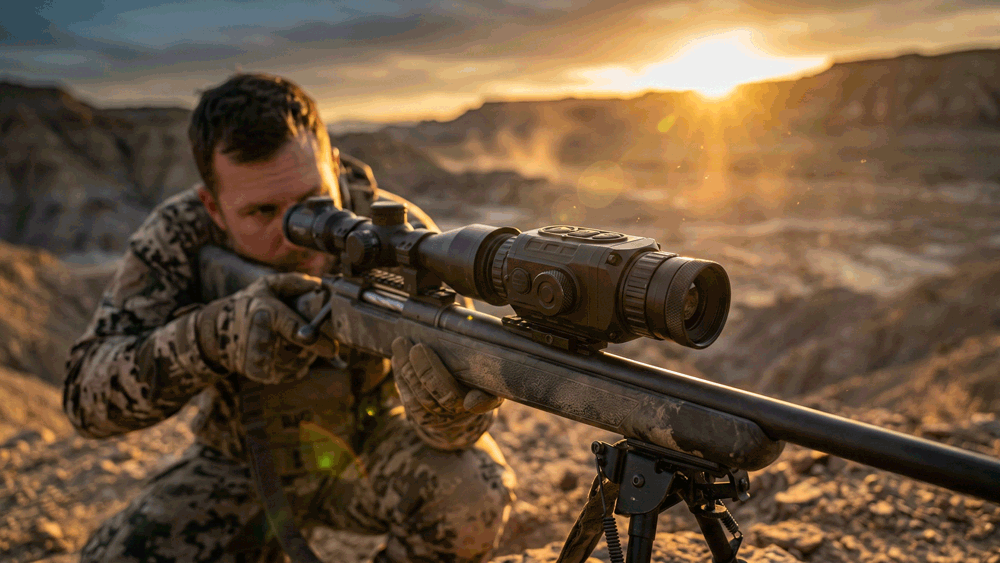
If POI control is the business model of a thermal clip-on, then mounting rings are the profit and loss statement.
Table of Contents
ToggleMost B2B clip-on programs don’t lose channel trust because the thermal core is weak. They lose trust because mounting is inconsistent in the real world. Dealers mount one unit and it feels solid, then mount another and it feels slightly different. A customer remounts after travel and sees a shift they can’t explain. A distributor gets mixed feedback: “works great” and “moves every time.” The brand then inherits the worst kind of return problem—one that feels subjective, hard to reproduce, and emotionally tied to confidence.
Mounting ring fit consistency is the simplest way to reduce that risk. It is also one of the most under-specified parts of clip-on OEM projects. Brands ask for a ring size and a clamp range, then assume the problem is solved. In reality, ring design is a tolerance-stack system. The ring, the clip-on housing interface, the day optic objective geometry, and the user’s torque behavior all interact. If you don’t specify that system, you will get “a ring that fits” rather than “a ring that mounts repeatably.”
This article explains how to specify, validate, and production-control mounting rings so the clip-on can be installed consistently across units, across customers, and across time. It is designed to work with the Series A pillar, Thermal Clip-On Sight and the POI-centric OEM framing from Thermal Clip-On OEM Spec and POI Control. If you want the manufacturing discipline behind repeatable interfaces, align your supplier expectations with Manufacturing & Quality.
Why “it fits” is not a B2B requirement
In B2B, you are not shipping a single clip-on to a single user. You are shipping a repeatable experience to a dealer network, and that means “it fits” is not enough. Fit must be consistent under normal variation.
Normal variation includes day scope objective housings that are not perfectly round, coatings and paint thickness differences, slight objective bell taper, temperature-related diameter change, and user-installed torque differences. Normal variation also includes ring variation, because even good factories will produce tolerances and surface finish differences unless you define and monitor them.
When ring fit is not disciplined, the clip-on stack becomes sensitive to micro-movements: a small slip, a slight tilt, or a tiny alignment change. Users do not see those movements, but they see the result. They see POI shift and conclude the product is unreliable. That is why ring design and ring quality control are not accessory details. They are brand protection.
The two mounting truths dealers learn quickly
Dealers learn two truths about clip-on mounting long before brands do.
The first truth is that customers do not install products like engineers. They install them like humans: in a hurry, at night, wearing gloves, sometimes with imperfect tools. If your ring only works under ideal installation, the channel will experience inconsistency and call it “POI issues.”
The second truth is that mounting repeatability is a system, not a part. A great ring on an inconsistent interface still produces inconsistent results. A consistent interface with a mediocre ring still produces inconsistent results. The system must be specified and validated as a system.
So your OEM spec must include ring requirements, interface requirements, and installation requirements together. Anything less becomes guesswork at scale.
Ring fit consistency starts with defining the interface geometry
Many clip-on ring discussions start with the nominal diameter: “We need 56 mm rings,” or “We need a clamp range.” That is a weak starting point because nominal diameter does not define real-world contact behavior.
Your spec should begin by defining what ring interface is actually clamping to. In a typical thermal clip-on, the ring clamps to a cylindrical housing section designed for the adapter ring. If that section has taper, surface texture changes, or inconsistent concentricity, the ring’s performance will vary.
A production-grade ring system usually needs three interface definitions:
First, the clamp surface geometry on the clip-on. That includes the diameter tolerance, roundness expectation, surface finish expectation, and any chamfer/lead-in features that prevent incorrect seating.
Second, the ring’s internal geometry and friction approach. Is the ring relying on bare metal friction, a liner, a knurl, or an elastomer? Each approach has different repeatability behavior under temperature and torque variation.
Third, the alignment reference feature. Some systems include a keyed interface, a stop edge, or an index line that forces consistent seating depth and rotational position. Without a reference feature, users can mount “close enough” but not repeatably.
If you don’t define these three items, you will get rings that physically clamp, but your repeatability will depend on the user’s luck.
Clamp force, friction, and slip are the real POI levers
In POI discussions, brands often chase optical alignment and ignore slip. Slip is the quiet cause of “it moved after a few shots” complaints.
Slip happens when clamp force is insufficient or inconsistent, or when friction behavior changes under humidity, temperature, or surface contamination. A ring that relies on bare anodized-to-anodized friction may work in clean conditions but become sensitive after handling and cleaning. A ring that relies on an elastomer liner may grip well but exhibit creep if the material relaxes under heat.
Your OEM spec should treat slip resistance as a requirement outcome, not an assumed property. It should define that the ring must maintain position under defined handling and recoil exposure without micro-movement beyond an allowable envelope.
The key is that this must be testable. In production, you can’t run live-fire on every unit, but you can validate mount integrity through mechanical stress tests and use those as acceptance proxies. That is why ring fit must be designed alongside validation and QC, not after.
Torque control is part of ring design, not only a user instruction
In real channels, torque is the most common uncontrolled variable. Two users apply dramatically different clamp force using the same ring, especially if the ring uses a simple thumb screw or a non-limited lever.
If torque is uncontrolled, ring performance will be uncontrolled. So your program must decide how torque is controlled.
Some brands choose torque-controlled fasteners and include a torque spec and tool. Some choose lever systems with defined cam geometry so the lever “snaps” at a repeatable clamp force. Some choose hybrid systems where gross clamp is controlled by a lever and fine clamp is set by a pre-adjusted screw.
There is no single right answer. The right answer depends on your market: hunting customers value fast mounting; professional users may accept a torque tool if it improves repeatability. But you must choose intentionally and make it part of the spec. If you do not, the ring becomes a “user skill dependent” part and POI repeatability becomes a support problem.
Ring concentricity and cant control matter more than most datasheets admit
Even when a ring clamps strongly, it can still introduce alignment sensitivity if it induces tilt or cant.
If the ring’s internal surfaces are not concentric, or if the clamp geometry pulls unevenly, the clip-on can seat slightly off-axis. That may still look visually centered through the day scope at low magnification, but it can create sensitivity that becomes visible under higher magnification or at different target distances.
This is why a serious ring specification should include geometric requirements: concentricity, parallelism, and repeatability of seating position. You don’t need to publish those numbers to customers. You need them so your supplier can build and QC the ring system.
A good supplier should be comfortable discussing how they measure those features in production. If they are not, expect inconsistency.
Day scope objective variation is the hidden compatibility trap
Clip-on rings are often marketed as “fits X mm objective.” That language is dangerous because day scope objective housings vary in real geometry.
Two scopes labeled “56 mm” can have different external housing diameters at the bell. They can have different taper profiles. They can have different external textures. Some have protective rings or flares. Some have rubberized coatings. Some have paint thickness that makes the effective diameter larger.
If your ring system requires tight fit, you will get returns due to non-fit. If your ring system allows too much range, you will get inconsistency due to poor centering and variable clamp force.
The B2B solution is to define compatibility boundaries as a controlled matrix rather than as a single number. You validate representative day scope families and document what rings and what installation rules apply. That matrix becomes part of your dealer enablement and part of your after-sales clarity.
In other words, compatibility is not a marketing claim. It is a validated deliverable.
The production problem: rings fail through variation, not through design
Many brands assume ring issues are “design issues.” In mass production, ring issues are often “variation issues.”
Even a good ring design can produce inconsistent outcomes if:
the inner diameter tolerance stack varies too widely; surface finish varies; liners vary in thickness or hardness; anodize thickness varies; fastener friction varies; lever cam geometry varies; or assembly torque of ring subcomponents is inconsistent.
This is why the OEM spec must include production controls. Without production controls, you cannot guarantee repeatability, and POI complaints will emerge in the channel as soon as you scale volume.
If you want to keep this disciplined but not overcomplicated, your spec should require that the ring supplier provides a basic control plan: incoming material controls, key dimension checks, surface finish checks, and functional clamp checks using a standard gauge. This is the kind of maturity B2B buyers look for when they evaluate partners through systems like Manufacturing & Quality.
One practical ring specification checklist that is both buildable and testable
Below is the only table in this article. It’s designed as a minimal ring specification checklist you can paste into an RFQ appendix. It focuses on what actually drives repeatability and dealer satisfaction, and it includes how each item can be verified without turning your program into a lab project.
| Spec item for thermal clip-on rings | Why it drives POI repeatability | How to verify in samples and pilot |
|---|---|---|
| Clamp method definition (lever/screw/hybrid) | controls clamp force variability | repeated mount/dismount with defined user tool |
| Torque window or clamp-force equivalence | prevents over/under clamping | torque tool test or lever snap-force check |
| Seating reference feature (stop/index) | prevents inconsistent seating depth/rotation | visual alignment + repeatability checks |
| Internal geometry control (concentricity/parallelism) | reduces tilt-induced sensitivity | gauge test + alignment jig results |
| Friction strategy (bare/liner/knurl) | affects slip and creep under heat | long-run and handling exposure check |
| Slip resistance requirement | prevents micro-movement under recoil handling | mechanical stress / recoil proxy test |
| Surface finish and coating spec | stabilizes friction behavior | coating thickness and finish inspection |
| Fit range and compatibility boundary | prevents “fits but inconsistent” outcomes | approved day scope set validation |
| Replacement and spare ring policy | reduces downtime for dealers | spares availability + part numbering |
This table is intentionally focused. It gives suppliers clear targets and gives your QA team a practical verification path.
Validation that matters: remount cycles and real handling
If you are validating rings only in a single mount event, you are not validating rings. You are validating a moment.
Clip-on rings must survive repeated mounting because the real market behavior includes removal for travel, removal for day-only use, and reinstallation under imperfect conditions. So your validation should include repeated mount/dismount cycles performed by typical users, not only by engineers.
It should also include handling stress: light bumps, sling carry, temperature changes, and time-under-clamp. These conditions expose creep and slip issues that do not appear in a clean bench session.
The objective is not to torture the product for marketing. The objective is to expose the failure modes that cause dealer complaints.
When you find issues, they often point to a small number of causes: insufficient clamp force repeatability, poor seating reference design, inconsistent surface friction, or poor ring geometric control. Fixing those early is cheaper than absorbing returns later.
Dealer installation guidance is a spec deliverable, not an optional PDF
Even the best ring will fail commercially if installation is not teachable.
Your OEM program should require an installation guide that dealers can use in under one minute. That guide should define seating, clamp method, torque guidance (or lever closure method), and the “do not do” mistakes that cause the most inconsistency.
This guide should also define what the dealer should check quickly: seating against a stop, alignment marks, and any simple “shake test” or retention confirmation that signals correct clamp.
This installation guide becomes part of channel trust. Dealers who can teach installation quickly will demo confidently. Dealers who feel uncertain will either avoid the SKU or blame the product when a user installs incorrectly.
Field service: plan for rings as consumables in high-use channels
In real channels, rings and adapters often behave like semi-consumables. Not because they wear out quickly, but because they are handled often, borrowed, swapped, and occasionally damaged.
A mature B2B program plans for that reality. It defines spare ring availability, part numbers, and replacement rules. It defines whether rings are user-replaceable without affecting warranty. It defines whether dealers can hold a small ring spare kit to support customers quickly.
This is small operational work that prevents large channel pain. If a dealer can’t replace a ring quickly, they may return the whole unit. If a dealer can replace a ring in minutes, the customer’s confidence is preserved and your return rate declines.
FAQ
Why do thermal clip-on POI complaints often trace back to rings?
Because rings govern mounting repeatability and slip resistance. Small differences in seating, torque, or friction can create micro-movement that becomes visible as POI shift, especially after remounting or recoil cycles.
Is a larger clamp range better for compatibility?
Not always. A large range may fit more scopes, but it often reduces centering consistency and makes clamp force more variable. A better approach is controlled fit ranges with a validated compatibility set.
Do I need torque-controlled fasteners for clip-on rings?
Not always, but you need torque control somehow. Torque tools, lever cam geometry, or hybrid designs can all work. The key is repeatable clamp force in the hands of typical users.
How can I verify ring quality without live-fire testing every unit?
You validate the system through stage testing, then rely on production proxies: geometric gauge checks, functional clamp checks, slip proxy tests, and traceability of critical dimensions and surface finish.
What is the most common installation mistake dealers see?
Inconsistent seating and inconsistent clamp force. Users mount slightly forward or backward, don’t seat against a stop, or apply very different torque each time. Installation guidance and reference features reduce this dramatically.
Should dealers stock spare rings?
Often yes, especially in active channels. Rings are a fast-fix item that can prevent full unit returns. A spare ring policy and clear part numbering is a low-cost channel trust lever.
Call to action
If you share your target day-scope pairing assumptions (objective sizes, typical scope families, magnification ranges) and your preferred mounting approach (lever vs torque-controlled), we can convert this into a supplier-ready ring specification appendix: fit range boundaries, repeatability validation plan, installation deliverables, and production control requirements that keep POI behavior stable at scale.
Use Contact to share your clip-on program requirements. For clip-on product framing, see Thermal Clip-On Sight.
Related posts
- Thermal Clip-On OEM Spec and POI Control
- Thermal Clip-On Mounting Rings and Fit Consistency
- Thermal Clip-On Day Scope Compatibility and Parallax
- Thermal Clip-On POI Shift Test and Acceptance
- Thermal Clip-On UI for Fast Mode Switching
- Thermal Clip-On Dealer Stock and Demo Program